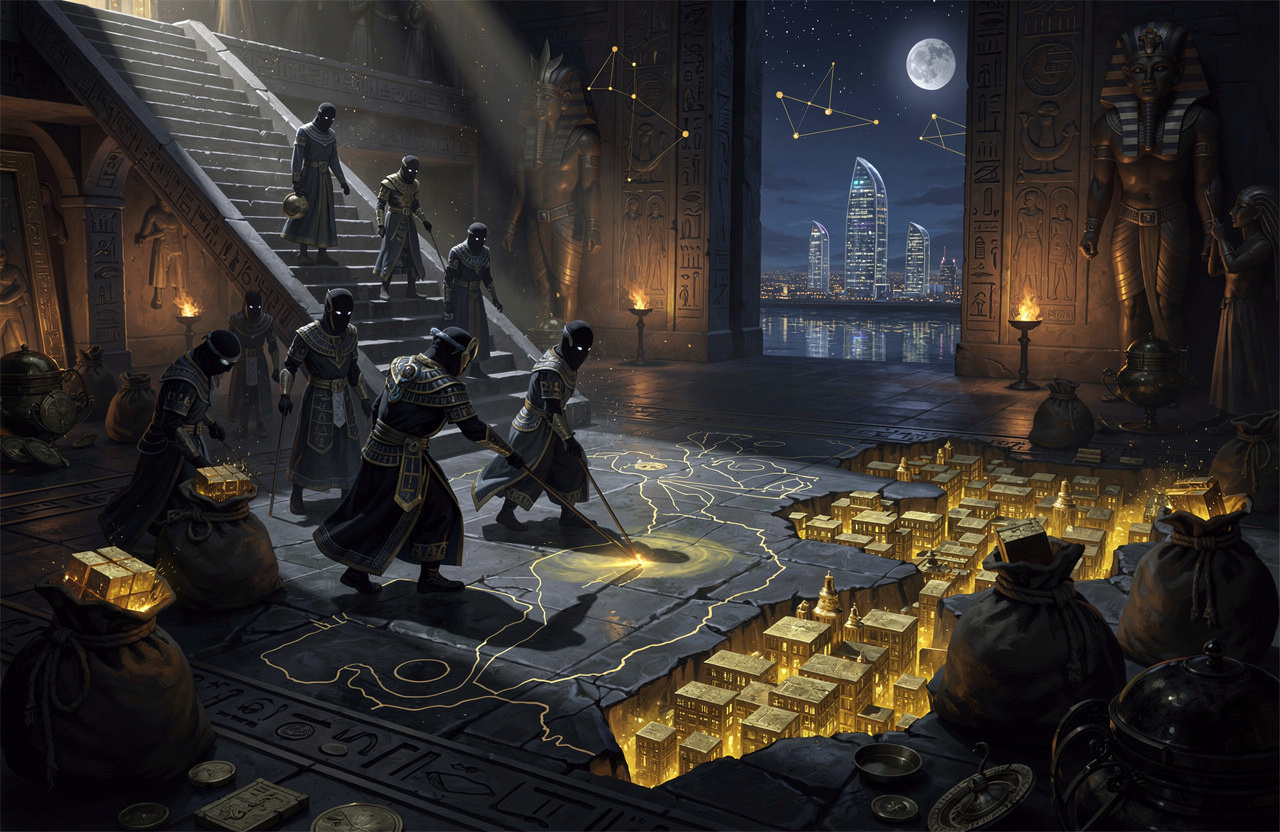
When the Soviet Union collapsed, it wasn't tanks that came. It was advisors. Young, confident, with degrees from the world's best universities, carrying ready-made recipes for "how to turn socialism into a market." They'd later be called the "Harvard Boys" — after the university from which this team of economists and consultants traced its line. And this is perhaps the cleanest textbook case of soft power: a country wasn't conquered — it was "helped to reform."
I look at the 1990s through an engineer's eyes, and it's painfully familiar. It's like letting outside contractors into your production system, giving them root access, trusting their slides — and a couple of years later discovering that the system works not for you, and that the critical keys are held by strangers. That's exactly what happened to Russia.
Who the "Harvard Boys" were
In the early 1990s, the Russian reformers led by young economists did not act alone. Working beside them was a group of Western consultants, whose core ran through the Harvard Institute for International Development. Part of their work was funded, among other channels, through the American "development aid" line — USAID.
Formally they taught: how to liberalize prices, how to privatize factories, how to launch a securities market, how to write new laws. Aid? On paper, yes. The selfless transfer of knowledge to a lagging country.
In reality it was the transfer of the right to write the rules of the game to people who intended to play that game themselves — and not on Russia's side. When an outside consultant writes your privatization law, he writes it the way it suits those who'll later buy up the assets. That's not a conspiracy theory — it's a conflict of interest built into the very design.
Aid that left things worse
The most uncomfortable part is the result. The book lists it in dry figures, and the dryness only makes it scarier:
- vouchers — "a slip of paper worth 10,000 rubles for everyone," which by the time it could be used was worth a loaf of bread;
- the loans-for-shares auctions of 1995, where the country's main assets went for a song to a narrow circle;
- hyperinflation up to 2,500% — the savings of an entire nation burned away in a matter of months;
- a drop in life expectancy of 5–7 years — not a metaphor, but people dead from stress, poverty, and vodka;
- IMF loans with conditions that tied the country to outside rules.
Remember this pattern, because it repeats around the world: consultants arrive "with the best intentions," "textbook reforms" are carried out — and out the other end comes an impoverished population and a handful of people who got the assets. The book calls it plainly "a familiar pattern": the same consultants, the same loans, the same result — in Russia as in dozens of other countries.
Why "by the textbook" is part of the trick
"But they acted according to economic science!" the defenders will say. And here is the subtlest point.
An engineer knows: you can break a system while formally following every instruction. Apply the right recipe in the wrong order, with no safety cushion, on a living organism with no anesthesia — and you get a catastrophe, and formally everyone will have been right. "Shock therapy" — free prices all at once, privatize everything fast, throw the markets wide open — was presented as the only scientific path. The alternative ("slowly, with protection for people") was branded as backwardness.
Who benefits from precisely that speed? Whoever is ready to buy. While the population is in shock and doesn't understand what's happening, the assets change hands. "Scientific rigor" worked here as the wrapper of "aid" — it disarmed criticism. Who are you to argue with a Harvard professor?
Fact and myth
Fact: Western consultants, including the Harvard team, genuinely took part in designing Russia's 1990s reforms, and those reforms led to the impoverishment of the population and the concentration of assets in the hands of a narrow group. This is documented, including by later investigations into conflicts of interest within the consultant team itself.
Myth: that the entire disaster of the 1990s was staged solely by foreigners, with locals blameless. Untrue. The local reformers and future oligarchs were full co-authors. Soft power never acts alone — it always works through local partners who stand to gain. An external vector plus internal interest — that's the working formula.
Where the ordinary person stands
Everywhere — in the role of the one the experiment was run on. The grandmother whose savings burned away. The engineer whose factory was "privatized" around him. The man who didn't live out his 5–7 years. The ordinary person was not a participant in the reforms but their raw material. He wasn't asked. The advisors, the reformers, and the future factory owners decided for him — those with access to the levers. He had no lever.
The answer: the MAAT token and DAO
The lesson of the 1990s is simple and bitter: when the rules of the game are written by strangers in someone else's interest, and you have neither a voice nor access to the levers, you'll be robbed strictly "by the textbook" and to applause. You can't defend yourself alone. You can defend yourself only with your own network, with transparent rules written by the members themselves.
That is MAAT. The MAAT token is membership in a cooperative where the rules and the treasury belong to the people themselves, and decisions are made on the principle of one human, one vote, not "whoever has access to the auction takes the factory." Governance runs through a DAO — a decentralized organization with a transparent treasury where every movement of funds is visible to all. No outside "consultant" writes your rules in secret: everything is open, every decision is recorded and verifiable, anyone can see who got what.
In the 1990s the ordinary person had neither a voice nor transparency — which is why he was stripped bare. MAAT returns both. The entry is simple: read the book, take the token, get your vote. And never again be a test subject in someone else's "textbook" experiment.