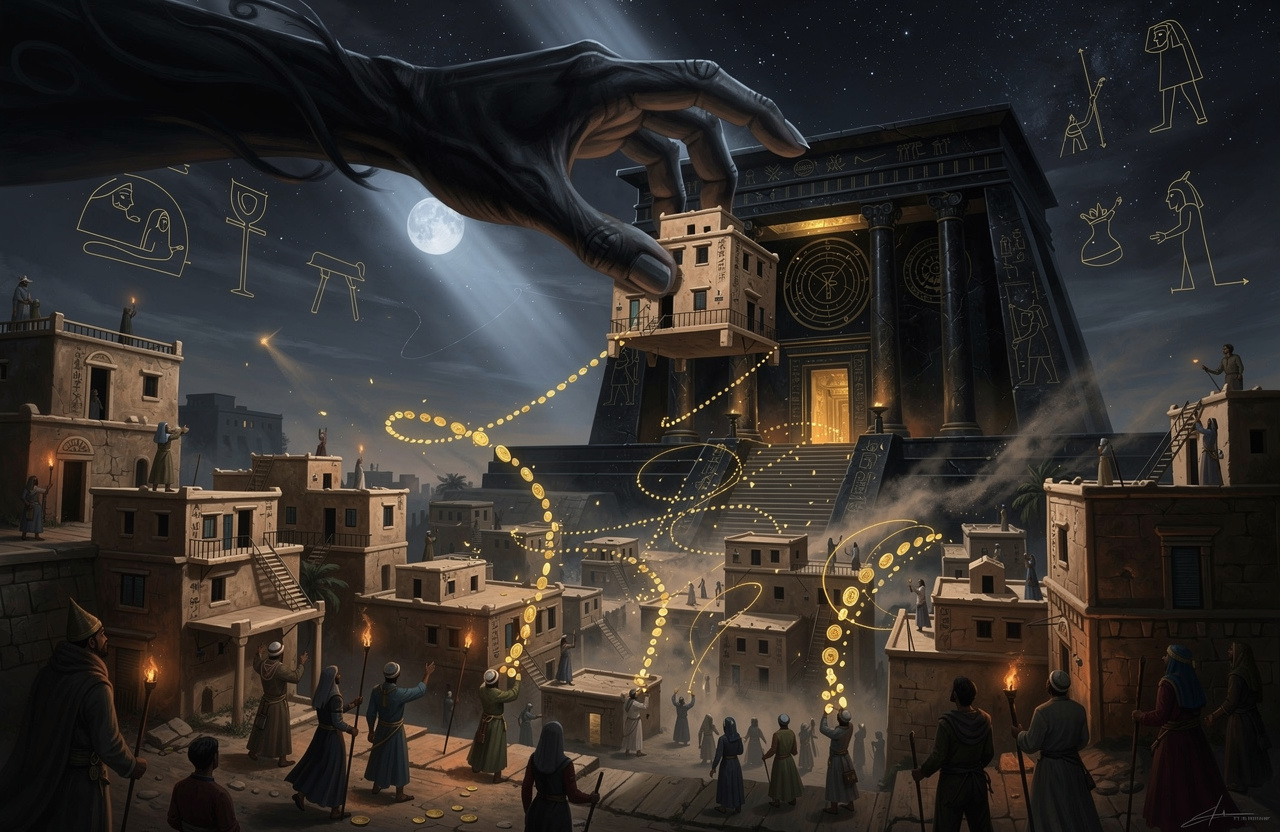
There is a simple test for who actually won in an economy. Not "how much money do you have," but "what do you own." And by that test, the last fifteen years have seen a quiet redistribution, carried out without a single shot: the house that a family used to buy is increasingly bought by a fund instead. The same kind of fund that holds your pension and votes your shares. Only now it stands between you and the roof over your head.
How housing became an "asset class"
Before the 2008 crisis, a house was a thing you lived in. After the crisis it became what Wall Street calls an asset class — something held alongside bonds and gold. The turning point happened literally on the ruins.
When the mortgage bubble burst, millions of Americans were thrown out of their homes; banks foreclosed for missed payments. Suddenly the market was flooded with hundreds of thousands of empty, cheap houses all at once. An ordinary family could not buy them — it had just lost both its home and its job. But whoever had spare billions and cheap credit from the Federal Reserve bought them by the block.
That is how companies like Invitation Homes (grown from Blackstone money) appeared — the largest owner of single-family rental homes in the United States. Not apartments in a tower, but exactly those "houses with a lawn" where middle-class families lived for generations. Tens of thousands of homes in one set of hands.
Why it's easier for the fund than for you
The logic here is brutally simple, and there is no magic in it — only a difference in access to money.
- The fund's money is nearly free. It borrows at 2–4%, you take a mortgage at 7%. On the same house the fund is by definition the stronger buyer.
- The fund buys wholesale. A thousand homes at once means a discount, an in-house repair crew, its own management software. You buy one house and lose every economy of scale.
- The fund is in no hurry to live anywhere. It doesn't need to "move in by September because of school." It can wait, outbid you, scoop up homes in a downturn.
The result is predictable: in a bidding war for the same house, a family with a mortgage loses to a fund with cash almost every time. And each home that goes into a fund's portfolio is a home that will never again come back to a human buyer. It switches permanently into rental mode.
Rent instead of ownership
Here the real mechanism shows itself. When you buy a house, after thirty years you stop paying — it's yours. The payment ends. When you rent, the payment never ends. That is the whole difference between an owner and a permanent payer of rent.
The fund understands this better than you do. To it, your house is not a place to live but a pipe through which a monthly rent payment flows. The more such pipes, the steadier the stream. And a rent stream is the most predictable income on earth: people always need somewhere to live.
The book puts it plainly: "Housing costs more than you can earn. Without credit, no housing. Without housing, no family. The system is designed so there is no choice. This is not a bug in the system. It's a feature." When a fund stands between a person and their home, it stands between that person and their future too. No place of your own means it's harder to start a family, harder to save, harder to plan anything at all.
This is Isfet in its purest form
The ancient Egyptians would have called such a setup Isfet — not fairy-tale "evil," but the inversion of fair exchange. In a normal exchange you pay for a house and you get a house. In the inverted one you pay forever and get nothing except the right not to be on the street for one more month.
And the fund creates nothing. It did not build these houses — they stood there before it arrived. It simply positioned itself at the point through which a basic human need passes and installed a meter. That is the behavior of a parasite in the technical sense: latch onto a working organ and draw off the resource while giving nothing back.
Where is the ordinary person in this
In the role of donor. You pay rent — the stream flows upward, into the fund's portfolio, from there to investors, and onward through the network of concentrated capital. Your payment for a roof turns into someone's quarterly profit. And the dream of "one day I'll buy my own" recedes each year by exactly as much as the funds buy up the market faster than you can save.
And notice: all of this is perfectly legal and even sold as a benefit — "flexibility," "no repairs to deal with," "the rental economy of the future."
The answer: the MAAT token and DAO
The fund's power in the housing market is not genius — it is concentrated money and coordination. A thousand homes in one hand beats a thousand scattered families one by one. So the answer is symmetric: scattered people need to gather back together — but transparently, and without an intermediary who keeps the control for himself.
That is the meaning of MAAT. The MAAT token is membership in a cooperative where millions of people pool their strength to buy and hold infrastructure together, instead of losing it to funds one at a time. Only here the principle is one human, one vote, not "whoever has more money decides." Governance runs through a DAO — a decentralized organization with a transparent treasury where every movement of funds is visible to all, and no node can quietly turn the shared home into its private rent pipe.
The funds are betting you'll stay a renter forever, and alone. MAAT bets the opposite. The entry is simple: read the book, take the token, get your vote — and stop being a permanent payer of someone else's rent.