A DAO promises something old philosophers only dreamed about: rule by code, not by rulers. No king, no board, no man behind the curtain. The smart contract executes what the majority votes, and the majority is everyone who holds the token.
Beautiful. And exactly where the weakness lives.
Because "rule by the majority of tokens" has a quiet second meaning: whoever controls the majority of tokens controls the DAO. Not the majority of people — the majority of votes. And votes, in most DAOs, are for sale.
In 2022 an attacker did the honest version of this to Beanstalk, a DeFi protocol. He took out a flash loan — hundreds of millions of dollars borrowed for the space of a single transaction — used it to buy enough governance tokens to pass a malicious proposal, drained roughly $180 million from the protocol, and repaid the loan. Total time: seconds. Total cost: gas fees. The vote was legitimate. The code did exactly what it was told. That's the horror and the lesson in one.
Let me show you where code-democracy breaks — and how the good ones armor against it.
The core weakness: one dollar, one vote
Most DAOs use token-weighted voting. Your power equals your token balance. Hold 5% of the supply, you cast 5% of the votes. It sounds fair — everyone with a stake gets a proportional say.
But read it again. It isn't "one person, one vote." It's "one token, one vote." Which, since tokens are bought with money, collapses into "one dollar, one vote."
That single design choice is the seam through which almost every capture attack enters. If votes track dollars, then a DAO's governance is only as decentralized as its token distribution — and most token distributions are not decentralized at all. A handful of early investors, funds, and the founding team often hold a controlling slice. The "community" votes, but the whales decide.
Whoever can assemble more than half the active voting power owns the machine. And there are three ways to assemble it.
The three doors of capture
Door one: the whale. Someone simply accumulates enough tokens to swing votes. A large fund, an exchange voting with customer deposits, or a founding team that never really let go. No attack required — just a big enough wallet. In many DAOs, voter turnout is so low that controlling even 10–20% of supply is enough to pass proposals, because most holders never vote at all. The quorum was set low, and apathy did the rest.
Door two: the flash-loan raid. The Beanstalk pattern. You don't need to own the tokens — you need to hold them for one block. Borrow a fortune, buy the governance token, vote, execute, sell, repay. If a DAO lets you vote with tokens you acquired the same instant, its democracy can be rented by the second. This is the purest governance exploit: the rules were followed perfectly, and that's exactly why it worked.
Door three: the governance exploit proper. Here the attacker doesn't overwhelm the vote — he games the mechanics. A malicious proposal disguised as a routine parameter change. A quorum threshold so low a coordinated minority slips a proposal through while everyone sleeps. A delegation system where a few delegates quietly hold thousands of proxied votes. A proposal that looks like it does one thing and, in the fine print of the calldata, does another. The exploit isn't in the tokens — it's in the process.
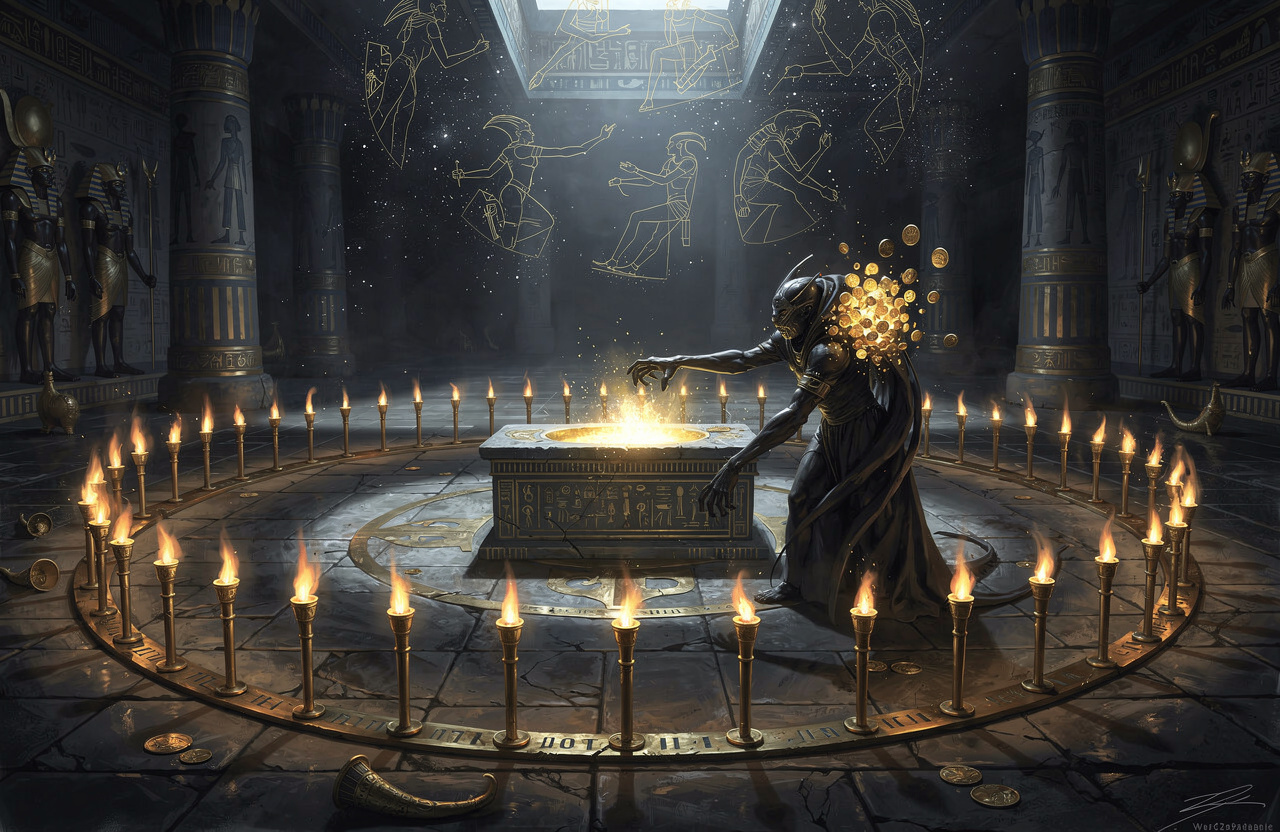
Our record. Code is Heka — the creating word, the utterance that becomes real the instant it is spoken. A DAO makes governance into Heka: the vote is spoken, and the contract manifests it, with no human to say "wait, this is wrong." That is the power and the danger together. An honest word builds Ma'at — order, balance, truth. A poisoned word, spoken with a stolen majority, builds Isfet just as faithfully. The Scales do not judge intent. They weigh what is placed on them. So the whole art of a good DAO is guarding what gets placed on the Scales — and slowing the hand that reaches to place it.
How the good ones armor up
Here's the door — because DAOs are not defenseless, and the best ones have already patched most of these holes.
Timelock. The single most important defense. When a proposal passes, it does not execute immediately. It sits in a queue — 24 hours, 48, a week — before the code runs. This kills the flash-loan raid outright: you cannot borrow money for one block and also wait a week to execute. And it gives the community time to see a malicious proposal coming and respond. A timelock turns "instant, irreversible" into "delayed, visible, contestable."
Veto and guardian roles. A trusted multisig or council that can cancel a clearly malicious proposal during the timelock window. Yes, it reintroduces a bit of human authority — but a narrow veto that can only stop harm, never cause it, is a reasonable circuit breaker. The best designs make the guardian able to hit the brakes but never the accelerator.
Quorum and thresholds set honestly. Require that a real share of the total supply participates for a vote to count, and set proposal thresholds high enough that a random address can't spam malicious proposals. Turnout apathy is an attack surface; a well-chosen quorum shrinks it.
Vote-escrow and time-locked tokens. Make voting power depend not just on how many tokens you hold but on how long you've locked them. Someone who commits tokens for four years has skin in the game. A flash-loan raider, who holds for one block, gets zero voting weight. This directly severs the "one dollar, one vote" seam — you now also have to prove time and commitment, not just money.
Delegation transparency and caps. Make it visible who holds delegated power, and cap how much any single delegate can wield, so influence can't silently pool.
The deeper fix
Every armor above is a patch on the same underlying bug: token-weighted voting equates money with legitimacy. You can raise the timelock, tune the quorum, add a guardian — and you should — but you're still playing defense on a field tilted toward whoever has the most capital.
The real fix is to change what a vote represents. Weight it by identity, by contribution, by time committed — by anything harder to buy in bulk than a token. Move from "one dollar, one vote" toward "one verified human, one vote," and the whale's core advantage evaporates. That is the design frontier the strongest projects are pushing into.
Never doom without a door. So the takeaway is not "DAOs are broken." It's this: before you trust a DAO with your capital or your voice, read its defenses. Does it have a timelock? A veto guardian? An honest quorum? Time-locked voting? Does one dollar equal one vote — or has it found a way past that?
Ask those questions, and you can tell a fortress from a facade in five minutes. The code is the law — so learn to read the law before you live under it.