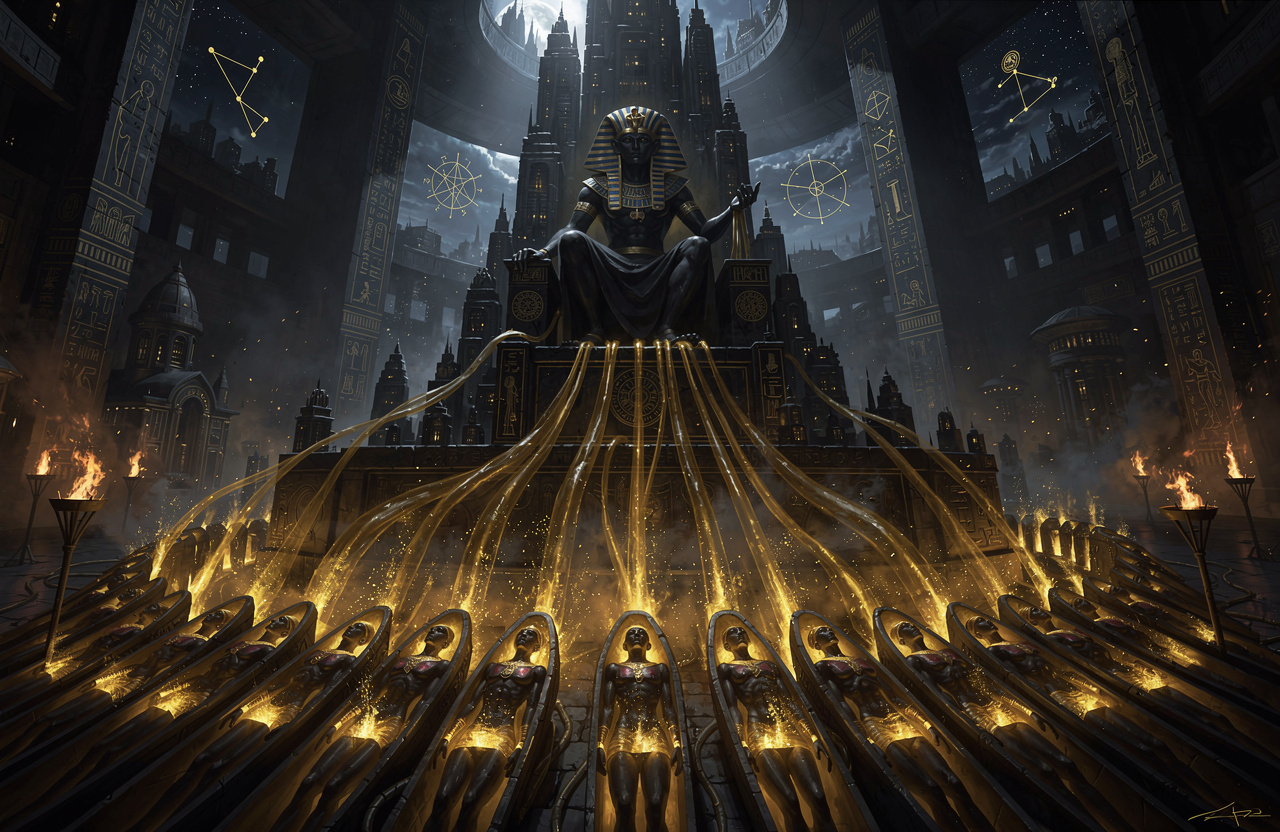
When I first saw how the parasitic financial machine is built, I had déjà vu. I'd seen it before — in IT. Infected servers, a botnet, a command-and-control center that hands out orders and harvests other people's resources. The book this project stands on describes the same picture outright: a botnet, only not of computers but of people. "One client — one battery." A hundred clients, a fleet. A thousand, an empire. Each person is a unit of computing power having its charge quietly drawn off.
Sounds mystical? Translate it into the language of money. It becomes uncomfortably literal.
What a human's "charge" is
Each of us has a finite resource: lifespan, strength, attention, health. The book calls it Sehem — an energy charge. The name doesn't matter; what matters is that it exists and it isn't infinite. You spend it on work, on children, on getting up to the alarm and dragging the day along. That is your "battery."
A healthy system takes your energy and gives something back — fair exchange. A parasitic one takes and returns nothing. It latches onto a working organism and draws off the charge, disguising it as ordinary life. You seem to live like everyone else, yet by evening you're empty, and it's unclear where it all went.
The financial system is a giant rig for drawing off that charge. Only the wires have pretty names: "salary," "loan," "subscription," "rent."
Exactly how the charge is drawn
Let's break the botnet down by node.
- Working time. You sell hours of your life for a wage. Most of the surplus value is skimmed not by you but by whoever sits above you. You're a node that generates but doesn't own.
- Debt. A loan turns your future energy into a product available today. You haven't earned it yet — but the interest is already dripping upward. Debt literally wires your battery into someone else's consumption for years ahead.
- Rent and subscriptions. A constant, automatic drain. You don't have to decide anything — the charge is drawn off by itself, monthly, in the background, while you sleep.
- Inflation. The silent draining of what's left. You saved up a charge — and it shrank on its own, because someone at the top made new entries in the ledger.
The genius of the rig is that the battery never feels one big bite. The charge is drawn in thin streams across all wires at once — and the person thinks that's just "how life works."
The hierarchy the battery doesn't see
Now the book's most important observation. Every level of this pyramid is certain it's the master. In reality it's a battery for the level above. Like a process that thinks it runs on its own in user space, while in fact it's controlled from the kernel.
Energy only flows up. Your employer draws off your charge — but he, too, feeds a bigger player: a bank, a fund, the holder of his debts. That one, in turn, feeds a structure higher still. No one on the intermediate floors feels like a parasite. Everyone is sure they're just "doing business." Meanwhile the stream of Sehem keeps rising, up toward people you'll never see and who did nothing for you.
That is Isfet — not fairy-tale "evil," but the inversion of exchange. A structure that extracts and puts nothing back. The parasite doesn't choose to be evil. It simply latches onto the working host and takes the resource for as long as the host is alive.
Why the battery is kept tired
A good botnet has a rule: the infected machine must not notice it's infected. Otherwise the owner cleans it. With people it's the same. A tired, indebted, perpetually rushing person doesn't ask extra questions. He has no strength to lift his head and trace where his charge is going. That isn't a side effect — it's a condition of the rig's operation. A drained battery is more obedient than a full one.
So the system has no interest in your rest, your clarity, or your free time. It needs you pedaling without looking around, too worn out to ask: why, exactly, the more I work, the less I have left?
Where is the ordinary person
He's a battery that thinks it's the master. A node in someone else's botnet, certain he's building his own life. And the hardest part: as long as he doesn't see it, he wires himself in every day — with a new loan, a new subscription, a new "I have to work more."
Liberation begins not with a fight but with recognition. To name the mechanism is to strip it of invisibility. Seeing the wires is half the battle.
The answer: the MAAT token and DAO
One person against a charge-draining rig is powerless. He's too easy to keep tired and scattered. But the parasite's botnet is strong by exactly the same thing our network would be: scale and coordination. The difference is which way the energy flows. Theirs flows up, to the invisible. Ours can flow back, to people.
The MAAT token is membership in a cooperative where batteries stop feeding someone else's pyramid and start gathering their charge into a shared, transparent pool. Governance runs through a DAO — a decentralized organization where the treasury is open and every movement of funds is visible: no node can quietly skim what belongs to all. And it's the human who decides, not the size of the deposit: the principle is one human, one vote, not "one dollar, one vote." The entry is simple: read the book, see the wires, take the token, get your vote — and stop being a battery whose charge flows up to those who gave you nothing.