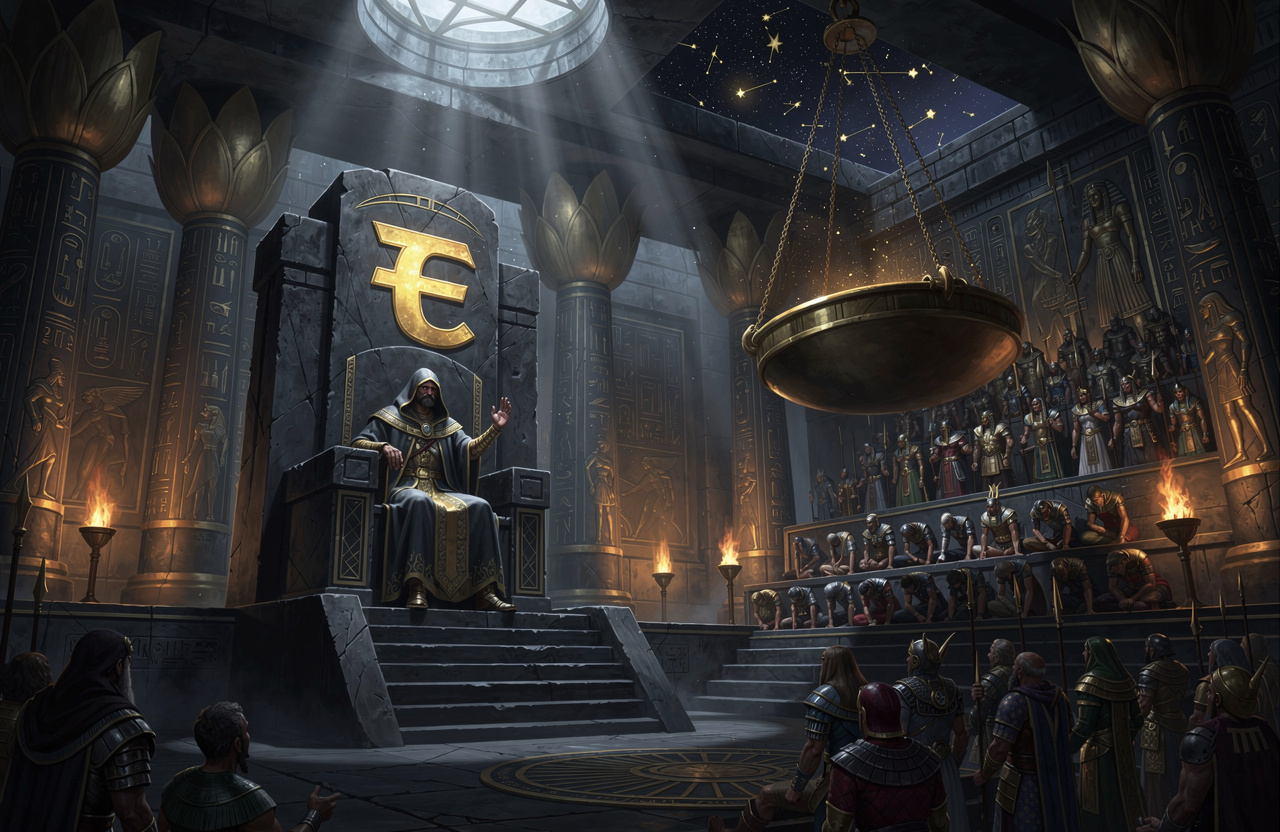
Picture a board where the important decisions require 85% of the votes. It sounds like protection against a tyrant: no single country can force anything through alone. Now picture one member holding just over 15% of the votes. What does that mean? It means 85% can never be reached without their "yes." They cannot command — but they can block everything. This is not a theory. It is the charter of the International Monetary Fund, and that member is the United States.
How the votes are counted
The IMF does not run on "one country, one vote." It runs on "one quota, one weight." A quota is how much money a country has paid into the fund's common pot. The more you pay in, the more votes you get. The logic looks market-fair: whoever pays the piper calls the tune.
The United States paid in the most. Its voting share hovers around 16–17% — the exact figure shifts with quota reviews, but for years it has stayed just above one critical line. Remember that line: 15%.
Because the IMF charter requires, for its most important decisions, not a simple majority but a supermajority of 85%. Changing quotas. Allocating SDRs (that "world currency" deserves its own piece). Amending the charter itself. Selling the fund's gold. Everything that changes the rules of the game requires 85%.
Now the simple arithmetic. If you hold 16%, your opponents are left with 84%. They need 85. They are short by exactly you. You are never once in your life forced to say "yes" — but any decision you dislike, you smother by saying nothing. An engineer would call this a single-node `veto` right inside a distributed system where everyone is formally equal, yet one node holds the kill switch.
Why 85, not 70 or 90
The number 85% did not fall from the sky. It was chosen precisely so that one specific member's share turns into a blocking stake. This is the "magic of percentages": the figure looks like protection of the collective against dictatorship, while in fact it sews the dictatorship into the design.
Set the threshold at 80% and the US alone could no longer block — it would need allies. Set it at 90% and anyone reasonably large could block, and the system would freeze. 85% is a sniper-precise height of the bar: high enough that one player has a monopoly on "no," low enough that the rest cannot gather to route around that monopoly.
The most elegant part is that, formally, it is all fair. There is no "US veto" written in the charter. What is written is 85%. The veto emerges on its own, as a consequence of math and wallet size. Not forbidden — simply arranged so it could not be otherwise.
What it means in practice
The IMF is the institution countries go to for a loan when they have run out of money. Argentina, Greece, Indonesia, dozens of African states. And the fund hands out money not for free, but on "conditions": privatize, cut spending, open your markets, float your currency. That machinery has its own articles. Here only one thing matters: the rules by which this global lender of last resort operates cannot be changed without one country's consent.
A bloc of developing economies wants to redistribute quotas so their voice weighs more? You need 85%. They want a new reserve-asset issue that bypasses the dollar? 85%. They want to change the charter itself? 85%. And at every one of these crossroads stands one barrier, with one hand on the lever.
The result is a fund that calls itself "international" and "collective," yet on the key questions runs like a private club with one honorary member who holds the key to the door.
Where the ordinary person is in this
Further than it seems — and closer than you'd like. When your country gets an IMF loan on conditions of "cut pensions, raise tariffs," you never see those percentages. You see the bus fare rise, the frozen wage, the closed hospital. And up top, in Washington, all of it is the consequence of rules your country cannot rewrite, because it cannot reach 85%.
You are the endpoint where the fallout of someone else's arithmetic collects. Votes in this system are handed out by wallet size. Your wallet is small. So your vote is none at all. Nobody asked you — they simply sent you the bill.
The answer: the MAAT token and DAO
The whole "magic of 85%" rests on one principle: a vote equals money. Whoever has more in the pot has the power, up to the right to single-handedly block the entire world. That is "one dollar, one vote" perfected.
MAAT is built on the opposite axiom. The MAAT token is membership in a cooperative where the rule is one human, one vote, not "one dollar, one vote." Here you cannot buy a blocking stake by piling up more money, because the weight of a vote is not tied to a wallet. Governance runs through a DAO — a decentralized organization with a transparent treasury, where every movement of funds is visible to all, and no node can quietly seize the lever.
The IMF showed how one figure in a charter turns a "collective" institution into the instrument of a single player. MAAT is an attempt to assemble an institution where that trick is mathematically impossible. The entry is simple: read the book, take the token, get the vote — the very one the old system never granted you by the size of your wallet.