There is one photograph worth keeping in mind every time you hear about "help" from international financial institutions. January 1998, Jakarta. Indonesia's president Suharto, who had ruled the country for over thirty years, sits signing an agreement with the IMF. And directly above him, arms folded across his chest, stands the fund's managing director. The pose of a man who isn't asking but accepting a surrender. Within months Suharto will be out of power. The loan he signed cost the country a president — and far more than just a president.
How the fire started
In 1997 a financial crisis swept across Southeast Asia. First the Thai baht collapsed, then the wave reached Indonesia. The local currency, the rupiah, fell several-fold.
The root was familiar: Indonesian companies and banks had piled up dollar debt because it was "cheaper" and "more modern." They earned in rupiah but owed in dollars. While the rupiah held, everything worked. Once it fell, the debt, converted into local money, instantly swelled several times over. The same bug that ruined Argentina and Turkey: a loan in someone else's currency is a bomb with a remote detonator, and the lever isn't in your hands.
Enter the "rescuer"
Capital fled, reserves melted — and the IMF took the stage with a package of around 40 billion dollars. And, as always, not just money. The loan came with a long list of conditions.
Among them were demands to, in particular:
- close dozens of banks;
- roll back state subsidies — including on fuel and basic food;
- open the markets and the financial sector to foreign capital;
- carry out "structural reforms" on the standard template.
Each item was sold as "putting things in order." But look at what happened on the ground. The abrupt removal of subsidies spiked fuel and food prices in a country where tens of millions lived on the edge. Closing the banks finished off confidence and brought down what remained of the financial system. The medicine prescribed by the "rescuer" struck those already hanging over the abyss.
The price the people paid
Then came what dry reports call "social costs." Millions of people fell below the poverty line within months. Food prices jumped. Unemployment rose. The middle class's savings evaporated along with the rupiah.
In May 1998 it all spilled into the streets. Riots, pogroms, deaths; ethnic minorities suffered especially, as anger was, as always in such cases, redirected onto them. Against this chaos Suharto — after thirty-two years in power — stepped down. The regime was authoritarian and corrupt, no argument there. But notice the mechanics: the country was first driven to a social explosion by loan conditions, and then the change of power happened as a collapse, not a managed transition.
Who came out ahead
Now the central question of any such story: who ended up better off? Certainly not the Indonesian peasant, nor the urban clerk who lost his savings.
When the local currency is crushed and the financial sector is "opened" to foreigners at the creditor's demand, the predictable happens: assets cheapened several-fold — banks, companies, stakes — are bought up by whoever holds hard currency. That is, by the foreign capital for whose entry the "reforms" were launched in the first place. Local wealth, priced in collapsed rupiah, passes into the hands of those who pay in dollars. It's the same logic as in Greece and Argentina: a fire sale in the middle of the fire, where the buyer knows the seller is desperate.
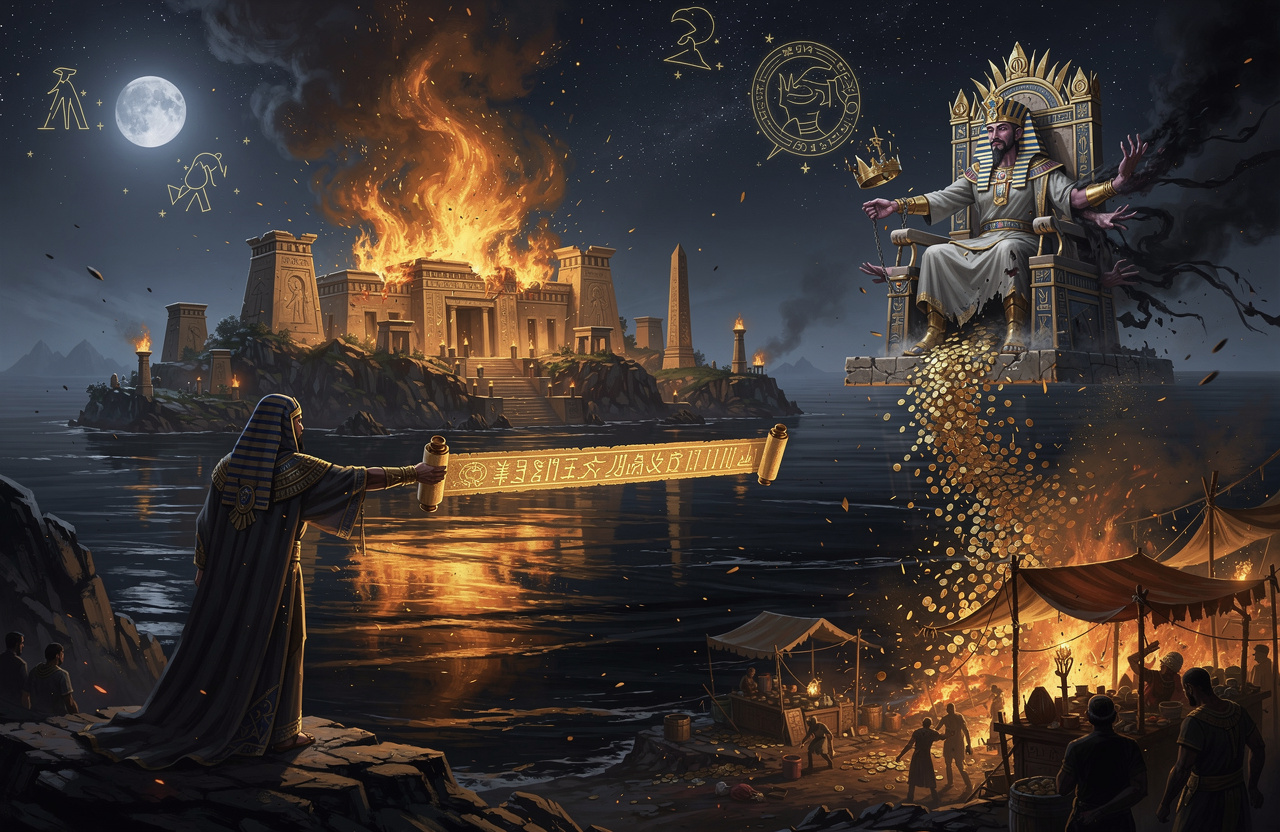
The ancient Egyptians would have called this position Isfet — the inversion of fair exchange. Not "a villain with a plan to destroy Indonesia," but a structure that arrives on weakness, draws the resource, and puts nothing back. The parasite doesn't care whether it faces a democracy or a dictatorship, a friend or an enemy. All that matters is what can be sucked out.
Where is the ordinary person in this
Everywhere it hurt. The Indonesian family whose food doubled in price in half a year. The worker who lost his job when the factories stopped. The depositor of a closed bank. None of them sat at the table where the fund's representative folded his arms. Everything was decided for them: the conditions, the timeline, and who would ultimately buy the cheapened country.
It's the same trouble as a pensioner whose vote at the shareholder meeting is wielded by a fund: you are the system's fuel, but not its owner. An intermediary decides, and not in your favor.
The answer: the MAAT token and DAO
Indonesia 1998 showed the limit: a loan on someone else's terms can cost a country not only its assets but its government, and blood in the streets. And all because on one side of the table is a coordinated creditor with a ready template, and on the other tens of millions of scattered people with neither a shared vote nor a shared treasury.
This is what MAAT changes. The MAAT token is membership in a cooperative and a single vote on the principle of one human, one vote — not "one dollar, one vote" like those who buy up collapsed assets. Governance runs through a DAO, a decentralized organization with a transparent treasury that doesn't depend on the local currency's exchange rate or on who freezes the local banks. An Indonesian, a Greek, an Argentine, and a Russian suffer from one system — and can belong to one cooperative with shared funds across all continents. The entry is simple: read the book, take the token, get your vote — and stop being the country that gets bought up while its people queue for bread that just doubled in price.