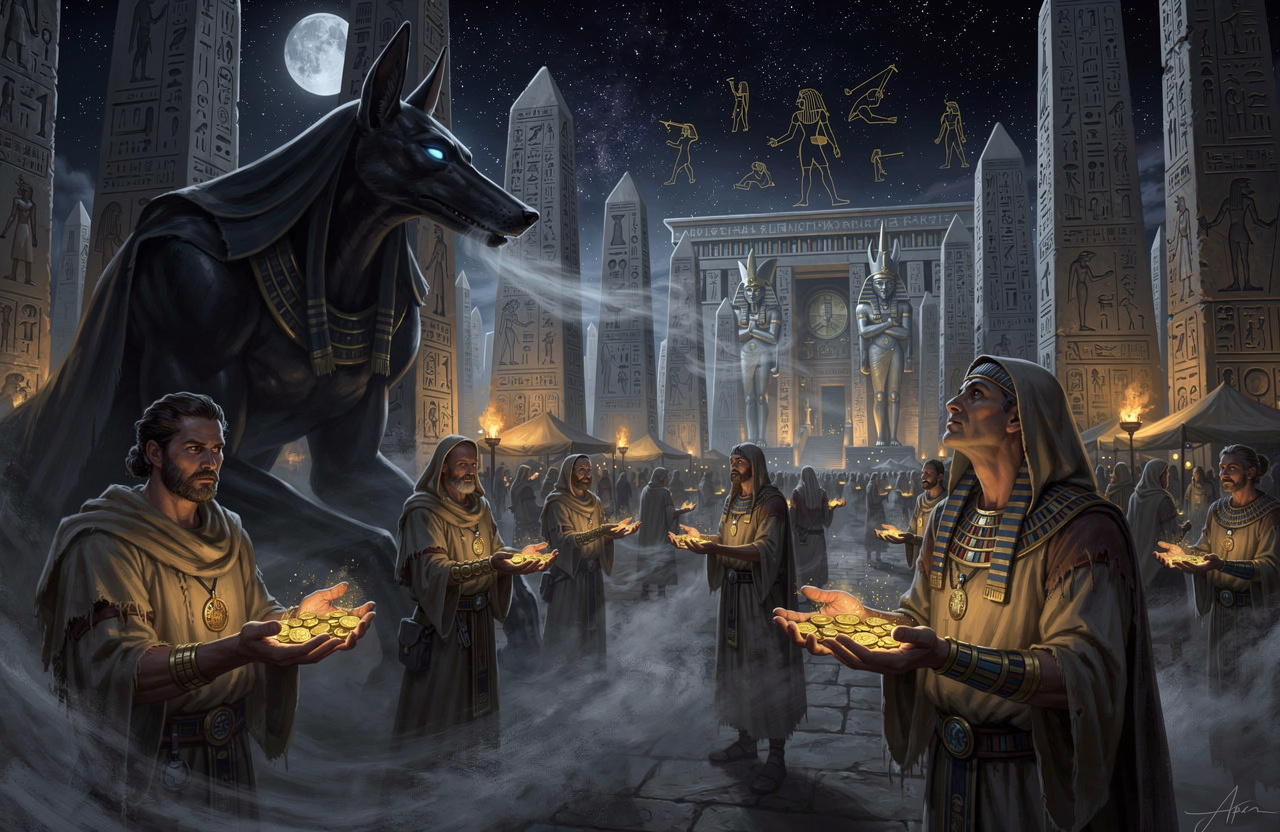
A tax is when the state says honestly: hand over this percentage, here's the rate, here's the deadline. You can be angry, you can argue, but you can see it. Then there's a way to take your money so that you never even realize who took it or how much. You'll blame "expensive shops," "greedy sellers," "the times we live in." That way is called inflation, and it is the most perfect tax ever devised — because it has no rate written on paper and no name attached to the recipient.
Where rising prices actually come from
Ask an ordinary person why everything keeps getting more expensive and you'll hear: "corporate greed," "the war," "sanctions." Sometimes that's part of the truth. But the fundamental cause is simpler and more unpleasant: there is more money than there are goods.
Picture an island with a hundred coins in circulation and a hundred apples — one apple costs one coin. Now someone with a printing press prints another hundred coins for themselves. There are still a hundred apples. Very quickly an apple costs two coins. Question: who got poorer? Everyone who already held coins — their savings were halved. And who got richer? The one who printed and spent the new coins first, before prices had risen.
That is the hidden tax. Nobody came at you with a bill. The purchasing power of your money simply leaked away — to whoever holds the press. In IT we'd call it a silent background write-off: the process runs, the indicator is green, and memory quietly drains to another thread.
Who holds the press
Money can be printed from nothing by whoever is permitted to keep the master record. At the top of the world system that's the Fed — a private consortium of twelve reserve banks whose shareholders are the largest commercial banks. Plus, as we covered in the fractional-reserve article, ordinary banks also create new money with every loan. Since 2020 the US reserve ratio is zero — there is no longer a limiter on issuance.
An important detail almost everyone misses: new money does not enter the economy evenly, "a little for everyone." It first reaches those nearest the press — banks, big players, government contracts. They spend it at the old prices. Prices rise as the money works its way down the chain. And it reaches the ordinary person — the teacher, the pensioner, the programmer — last of all, already debased. This is called the Cantillon effect, and it means a simple thing: inflation pumps wealth from the bottom upward systematically, by its very mechanics.
Fact versus myth
Let's draw the line honestly.
Myth: moderate inflation is normal and even healthy, a sign of a "growing economy." So say the textbooks.
Fact: "moderate" 2–3% a year isn't kindness, it's the speed at which the robbery doesn't trigger panic. Do the math: at 3% a year, money loses half its purchasing power in about 23 years. Over a single working life, half of everything you set aside in money is quietly taken from you. And when the press is switched to full power, the masks come off entirely.
A real example from our book: the Turkish lira. Someone with a hundred thousand lira of savings in 2018 owned, in purchasing power, roughly ten thousand by 2024. The lira lost about ninety percent. Nobody announced a "90% tax on savings" — there would have been a revolution. It was collected through inflation, quietly, and most of the victims still blame "the high cost of living" rather than the mechanism.
Why this is Isfet
Our book has a precise word for a structure that takes from the system and puts nothing back — Isfet, the inversion of fair exchange. Inflation is its purest monetary embodiment.
The ancient Egyptians measured justice on the scales of Maat. The 42 Confessions contain plain lines: "I did not falsify the measure," "I did not move the weight of the scales." Inflation is exactly that weight, constantly moved: the unit you measure your labor in quietly shrinks year after year. You seem to earn "more dollars," yet you live worse. Real wages in the US have barely grown in real terms since 1980, while housing, education, and medicine have risen severalfold. That's not market chance. That is the hidden tax doing its work.
Where is the ordinary person in this
You are last in line for the new money and first to pay in debasement. Every dollar you set aside slowly melts in your pocket while you sleep. Defending yourself alone is nearly impossible: you have no press, no access to cheap first-in-line money, none of the instruments big players use to wait out any inflation. You are that battery whose energy is drained imperceptibly, through the fall in value of the very unit you store your life in.
The answer: the MAAT token and DAO
Inflation works because the press is in private hands while you are scattered and can't see the mechanism. So the answer isn't to "guess the safe-haven asset" alone, but to gather into a system where the record is transparent and value can't be quietly diluted for someone else's gain.
That is MAAT. The MAAT token is membership and a vote in a cooperative with a shared, transparent treasury run by a decentralized DAO: issuance and every movement of funds are visible to all, and nobody can secretly print more for themselves and dilute the rest. And crucially, the principle here is "one human, one vote," not "whoever holds the press decides."
A hidden tax is strong precisely because it's hidden. We make it impossible: in a transparent treasury, not a single extra coin can be concealed. The entry is simple: read the book, take the token, get your vote — and stop paying a tax you never chose.