Here is a number that should stop you cold. A US dollar has lost more than 95 percent of its purchasing power since the Federal Reserve was created in 1913. What one dollar bought then takes more than twenty-five today. No parliament voted for that transfer. No bill was signed. No taxpayer got a notice in the mail. And yet, decade after decade, value drained out of every dollar you held — quietly, continuously, without a single ballot.
That's inflation. And the thing to understand is that it is a tax. It's just a tax that skips the part where you get to say no.
A tax is a transfer — so is this
A tax takes purchasing power from you and moves it to someone else. That's the whole mechanism. When the government taxes your income, it's visible: a line on your paycheck, a rate you can point to, a vote in a legislature you can, in theory, protest.
Inflation does the identical thing — moves purchasing power away from you — but through a hidden channel. When more money is created faster than the economy produces goods, each existing unit of money buys less. The $10,000 in your savings account doesn't shrink in number; the number stays $10,000. It shrinks in power. Next year it buys what $9,500 bought this year. The missing $500 didn't vanish into thin air. It was transferred — to whoever received the newly created money first, before prices rose to catch up.
That's the part they don't put on the poster. Inflation isn't random weather. It's a transfer with a direction. And the direction is set by who touches the new money first.
First in line wins: the Cantillon effect
This is the mechanism almost no one is taught, and it explains everything.
When new money enters the economy, it does not arrive everywhere at once. It enters at specific points — banks, governments, large financial institutions, holders of assets the central bank buys. Whoever gets the new money first spends it at old prices, before the new money has rippled out and pushed prices up. By the time the money reaches the ordinary wage-earner — last in line — prices have already risen. The early receivers bought a house before the boom; the late receivers buy groceries after the spike.
Economists call this the Cantillon effect, after an 18th-century thinker who saw it clearly three hundred years ago. It means inflation is not neutral. It systematically enriches those near the money spigot and impoverishes those far from it. The closer you sit to where money is created, the more you gain; the farther — the more you lose. And the person living paycheck to paycheck, holding cash, owning no appreciating assets, sits at the very end of the line.
Now overlay the asset picture. When money floods in, it flows into assets — stocks, real estate, whatever's scarce. Asset prices soar. Who owns the assets? The people who were already wealthy. So the same event that erodes the saver's cash inflates the owner's holdings. Inflation quietly widens the exact gap it's never blamed for.
Our record
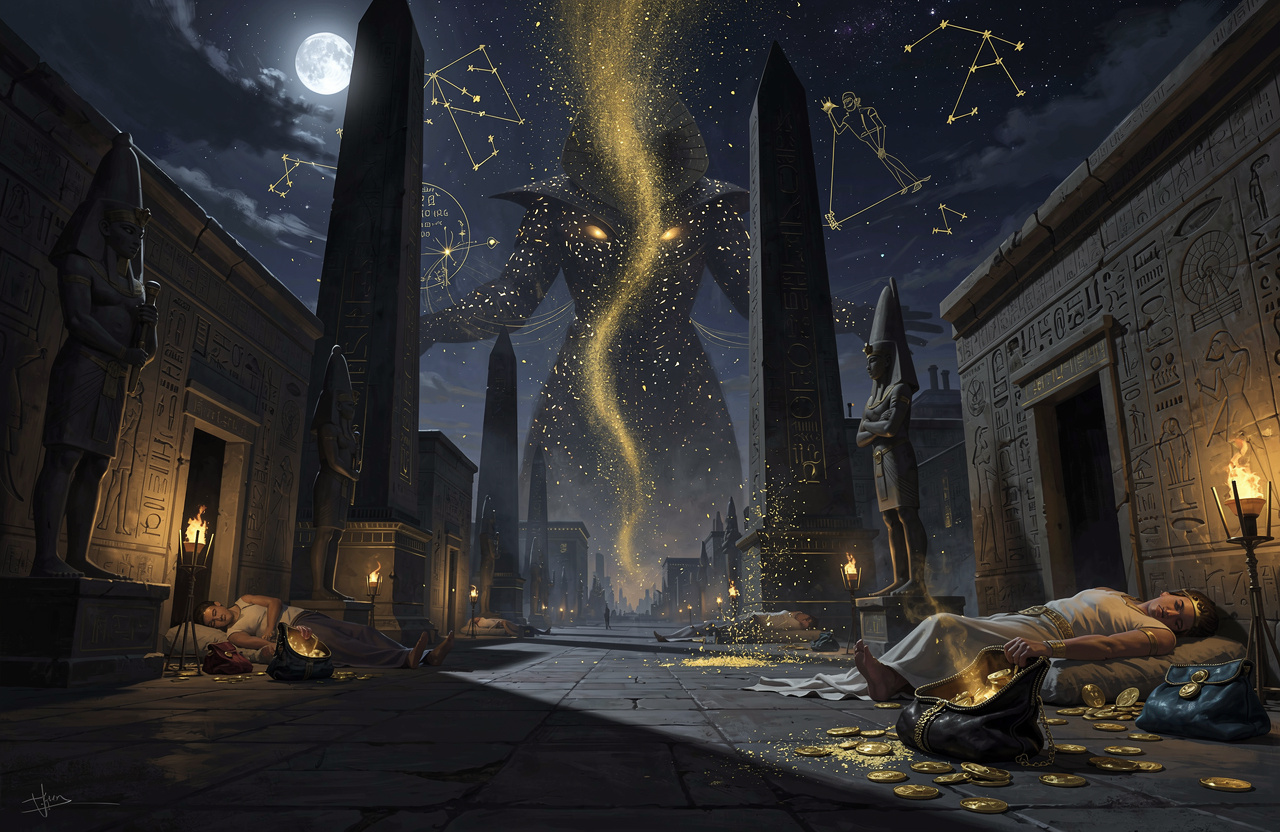
The Scales of Ma'at rest on one sacred thing: an honest weight. In old Egypt, falsifying the weights in the marketplace was not mere fraud — it was an offense against the cosmic order itself, a wound in Ma'at. A false balance cheats every exchange that passes over it, invisibly, forever.
Money is the master weight of a civilization — the standard every other value is measured against. Debasing it silently is the false balance at the largest possible scale. Every transaction in the entire economy passes over that scale, and every one is quietly shaved. This is Isfet at its most elegant: not a robber at your door, but a slow leak in the vessel that holds everyone's stored Sekhem at once. You work, you save your life-force into money, and the vessel weeps it out through a crack you were told not to look at.
The pump has no visible hand here — and that's the genius of it. The extraction happens through the unit of measure itself. Name it: a tax that skips the vote is a weight that skips the scale.
Why it persists
Ask the obvious question — if it's a tax, why does it survive without a vote? Because invisibility is the feature, not the bug.
A visible tax provokes resistance; people organize, protest, vote the rate down. An invisible one doesn't. Most people experience inflation as "prices going up" — a vague, blameless force of nature, like bad weather — rather than as "purchasing power being transferred from me to someone specific." That confusion is load-bearing. It's what lets the transfer run for a century without a single organized revolt against it as such. You can't fight a tax you don't know you're paying.
And there's a structural pull toward it. Governments and large debtors benefit from moderate inflation — it quietly shrinks the real value of the debts they owe. A government that owes a fixed number of dollars is happy for each dollar to be worth less. So there's a permanent, quiet incentive at the top to keep the leak leaking. The debtor-in-chief has every reason to prefer the tax nobody sees.
The lever
Never doom without door. Here's the door — and it's the most concrete one in this whole series.
The reason inflation works as a hidden tax is that you're forced to store your life's value in a unit somebody else can silently dilute. Break that, and you break the tax. The defense is simple to state: don't hold all your stored Sekhem in the leaking vessel.
Practically — hold things that can't be printed. Historically, people reached for gold and land precisely because no central bank can create more of them on command. The scarce, the productive, the asset that isn't someone's liability. The whole design principle is: store your value in something whose supply can't be silently expanded by the people who benefit from expanding it.
And this is exactly why hard-capped, transparent, decentralized money was invented. A protocol with a fixed, publicly auditable supply that no committee can inflate by decree is the literal technological answer to the Cantillon effect. No one is first in line, because no one gets to create new units at will. The weight is honest because the weight is fixed and the ledger is open for anyone to check. That's not a metaphor — it's the false balance replaced with a true one, in code.
You couldn't vote against the inflation tax. But you can decline to hold your entire life in the currency that levies it.
Store your Sekhem in a weight that can't be shaved. Keep the vessel that doesn't leak.