There is one number that explains why you run your whole life and never quite arrive. It isn't the dollar exchange rate or the price of oil. It's the interest rate on a loan. That little "%" sign nobody looks at closely, because it seems like a boring technical detail. In reality it is the most powerful mathematical construct humanity ever turned against itself. Interest is a machine that works while you sleep, and it does not work for you.
Money that demands more money
Start with a trick almost nobody notices. A bank creates money the moment it issues a loan — out of nothing, two lines in a database. Say it issued a hundred dollars of debt into the whole economy. But it demands a hundred and ten back: a hundred of principal plus ten percent.
Here's the catch question: where do those extra ten dollars come from? Nobody created them. The system physically contains only a hundred. The answer is cruel in its simplicity: they don't exist. To pay the interest, someone has to take out a new loan — and bring still more debt into the system. Debt chases debt. This is not a glitch, it's the design. A system where there is always less money than is owed back is doomed to borrow forever. That's why total global debt doesn't shrink, it only grows — it's already past three hundred trillion dollars.
In IT we call this an unclosable memory leak: the process keeps requesting a little more than it returns, and one day the system crashes. Only here the "process" is you, and the "memory" is your life.
Compound interest: interest on interest
Simple interest is almost merciful. The real trap snaps shut when compound interest kicks in: interest is charged not only on the principal but on the interest already piled up.
Einstein is often quoted saying compound interest is the eighth wonder of the world: those who understand it earn it, those who don't, pay it. The quote is almost certainly invented (let's be honest — a nice legend, not a document). But the math behind it is entirely real.
Look at how it feels from the victim's side. A credit card: on the storefront, "a whole fifty days interest-free." In the fine print — miss the grace period by a single day, and interest is charged for the entire term. The effective rate comes out to thirty or forty percent a year, sometimes more. Payday loans, "money in five minutes," run from three hundred sixty-five to five hundred percent a year. This is legalized robbery, and its math is built so that a person takes a new loan to close the old one and ends up in a spiral they don't escape for years.
Fact versus myth
Let's draw the line honestly.
Myth: interest is a fair price for a service. The bank risks its own money and waits to be repaid, so it deserves a reward.
Fact: in most cases the bank does not risk its own money — it created the money from nothing (there's a separate article on fractional reserve for that). It invested no labor and gave up nothing real. It composed a record and demands real interest on it, paid for with your real time. That isn't a fee for a service — it's rent for permission to use something it never had.
The ancients saw the difference more clearly than we do. The ban on usury appears in almost every old tradition, not out of superstition but because people understood: interest is a channel through which life-force flows one way, giving nothing back. Our book calls this Isfet — the inversion of fair exchange. Every interest-bearing debt contract is essentially a one-way pipe: labor at the bottom, rent at the top, and no exchange in any honest sense.
Why it really is servitude, not just "hard times"
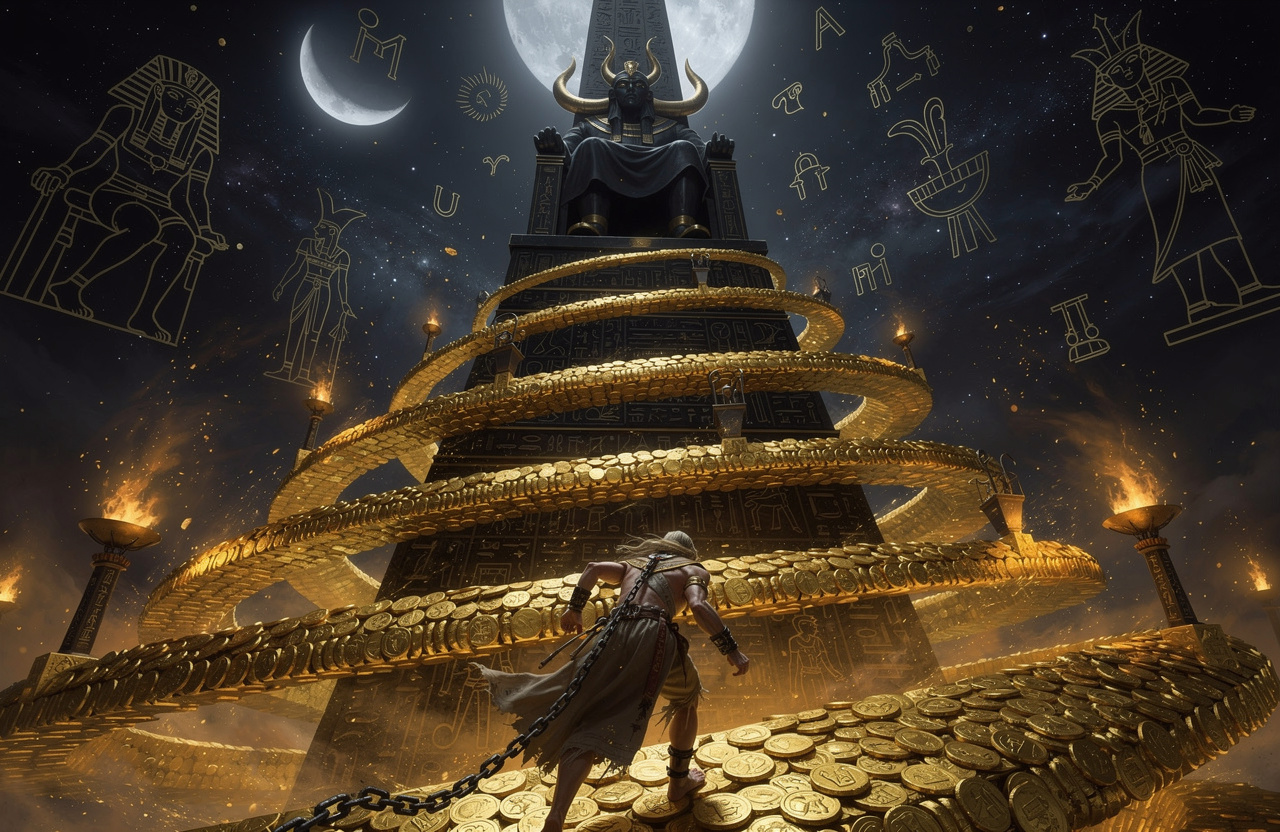
The word "servitude" sounds strong, and I don't use it for effect. In antiquity a slave was held by a chain. The modern person is held by a payment schedule.
The slave worked because otherwise — the whip. The modern person works because otherwise — late fees, penalties, eviction, a ruined credit score. The mechanism of coercion is different, softer-looking, but the result is the same: your time is no longer yours. You get up in the morning and go to earn not a living but the interest. A high-rate mortgage turns a home worth seven million into payments of fifteen or twenty million over twenty years — meaning you pay for the home three times over, and two-thirds of your labor goes not for the walls but for the interest.
And the main trap is psychological: it all looks voluntary. Nobody held a knife to you. You "chose it yourself." But a choice between "loan" and "no home, no education, no treatment" is not a choice. The system is engineered so there is no choice. That's not a bug, it's a feature.
Where is the ordinary person in this
At the very bottom of the pipe. Your interest is the energy that leaks upward every month while you sleep, work, fall ill, celebrate. Alone you can't stand against compound interest: the math is on the side of whoever collects the rent, not whoever pays it. One debtor is a single arrow, easily snapped by a payment schedule.
The answer: the MAAT token and DAO
If interest is a pipe through which your strength flows upward, then the answer isn't to become a better moneylender. The answer is to gather together and turn the pipe around: to build shared capital that works for its members instead of milking them.
That is MAAT. The MAAT token is membership and a vote in a cooperative where the treasury is shared and transparent: it's run by a decentralized DAO, and every movement of funds is visible to all. No intermediary quietly accrues interest for itself. And crucially, the principle here is "one human, one vote," not "whoever has more money collects the rent."
For two hundred years compound interest worked for those with capital and against those who had only time. We don't abolish the math — we change the side it works for. The entry is simple: read the book, take the token, get your vote — and stand, for the first time, where the interest flows toward people instead of away from them.