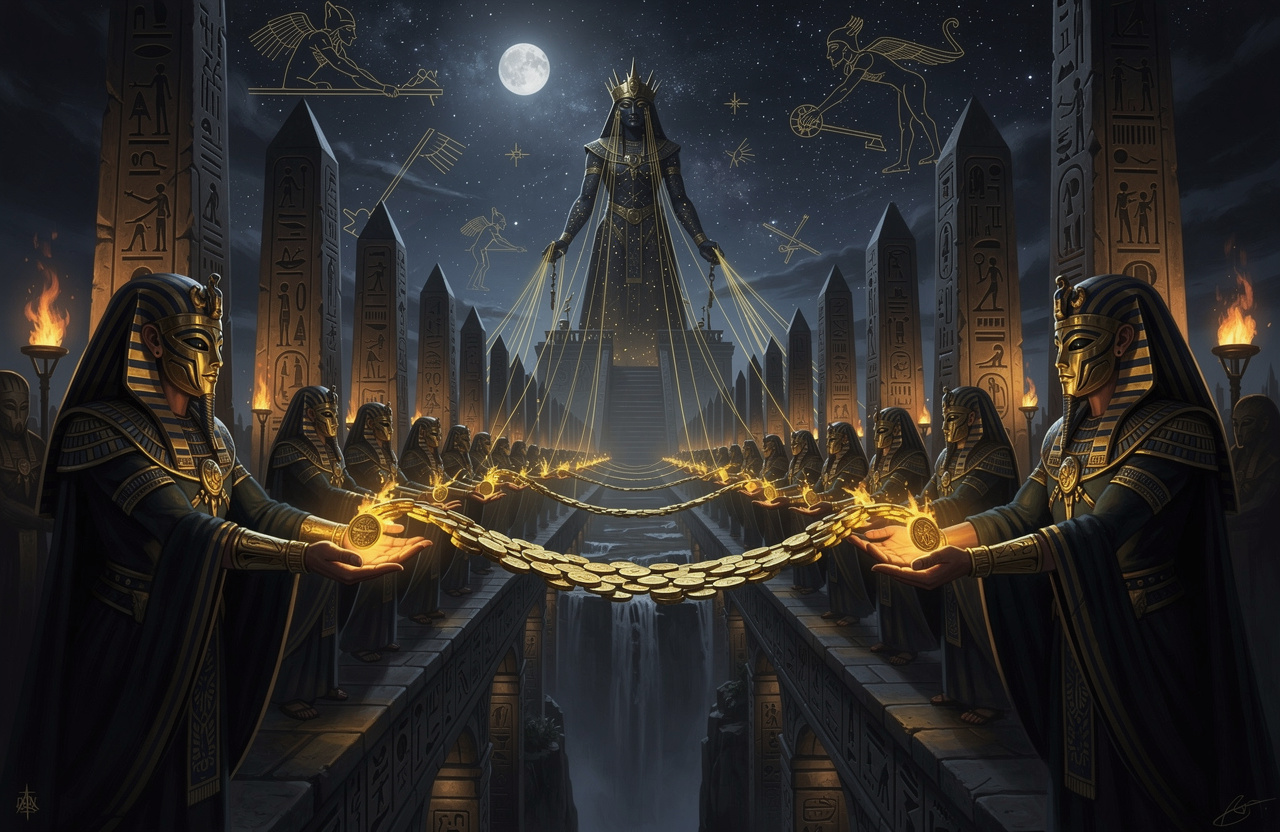
In networks there's a concept: latency and loss at every node. A packet of data travels from point A to point B, and at each intermediate router it loses time, and sometimes part of the data. In the world of money it's the same, except what's lost isn't time — it's your money. Every time a sum moves from one person to another, an intermediary sits in its path. And he charges for passage. A small percentage. But he sits at every node.
Money almost never goes directly
Think how rarely you pay someone directly, hand to hand. Almost always there's a chain between you and the recipient. You pay by card: processing, the acquiring bank, the payment network, the merchant's bank. You send money abroad: your bank, a correspondent bank, currency conversion, the recipient's bank. You invest: a broker, an exchange, a custodian, a manager, a fund.
At every junction sits someone who produced nothing and created nothing, but without whose permission the money won't move on. And for that permission he takes his cut. Individually it's crumbs: one and a half percent here, a fixed fee there, a spread on the rate somewhere. One at a time it's invisible. Add it up across the whole economy over a lifetime, and it's an enormous, invisible tax you pay simply for the right to move your own money.
Why it works like a tax
A tax is a mandatory payment for doing something, and it can't be avoided. Intermediary fees are built exactly that way. You can't "not use" the payment network if you want to buy food. You can't bypass the bank if your salary lands on a card. You can't skip the broker if you want to invest your savings. No one asks you — you're presented with the fact: want to move money, pay for passage.
There's one difference from a government tax, and it isn't in your favor. A government tax at least nominally goes to roads, schools, hospitals — you can argue about how it's spent, but the direction is known. The intermediary's tax goes into the pocket of a private structure that simply got lucky standing on the pipe. You're not paying for a service — you're paying for the fact that you can't go around it.
Friction someone lives on
In a sound system, moving money would cost almost nothing — it's a movement of a record in a ledger, pure information. Technically, sending a message halfway around the world costs a fraction of a cent. Yet "sending money" somehow costs percentages. Where does the difference come from? That's artificial friction.
Intermediaries have no interest in money moving easily and cheaply. Their income is precisely in the friction. The more steps, permissions, checks, and conversions, the more points where a cut can be skimmed. So the system doesn't simplify on its own, though technically it could. Complexity here isn't a bug — it's the business model. Every extra node in the chain is someone's paycheck.
And the subtlest part: the intermediary sells you his friction as "reliability" and "security." Yes, protection is needed. But very often you're paying not for protection, but for the very necessity of asking his permission.
Who feeds on the flow
The global intermediary industry is trillions a year skimmed off other people's movements. Payment giants take a percentage of every purchase in the world. Banks, from every transfer and account fee. Exchanges and brokers, from every trade. Funds charge an annual percentage just for holding your assets (a separate conversation in other articles).
Not one of them made the product you're buying. They stood between you and your goal and charge for passage. It's the oldest model — a tollgate on the road, a bridge with a booth, a gate with a keeper. The technology changes, the essence is one: control the bottleneck and collect tribute from everyone who passes through.
Where is the ordinary person
He pays at every step and barely notices, because each bite is small. Over a year it adds up to a vacation. Over a lifetime, to years of work handed over just so his own money could travel from point A to point B. He didn't choose these intermediaries and can't opt out of them — they're built into the pipes he's forced to walk through.
The question isn't to scold the fees. The question is whether money can be moved at all without paying tribute to someone who simply stands in the road.
The answer: the MAAT token and DAO
The technology that removes the intermediary already exists. A transparent public ledger lets two people exchange value directly, without a chain of gatekeepers skimming a cut at every node. Money becomes again what it essentially is — information traveling from A to B with no tollgate in the middle.
The MAAT token is membership in a cooperative built on such an architecture. The treasury is run through a DAO — a decentralized organization where every movement of funds is visible to all and passes through no private pocket. No one sits on the node and charges for passage on the quiet. And here it's the human who decides, not the size of the wallet: the principle is one human, one vote, not "one dollar, one vote." The old system lives on friction and on your being forced to ask permission. We remove the tollgate. The entry is simple: read the book, take the token, get your vote — and stop paying tribute at every step to those who simply stood on the pipe.