Count the years. Jamie Dimon became CEO of JPMorgan Chase at the end of 2005 and was still running it two decades later. Twenty years at the helm of the largest bank in the United States — an institution steering trillions of dollars in assets, sitting at the center of the world's financial plumbing. Presidents came and went. Congresses turned over. Fed chairs cycled. Dimon stayed.
That's not a story about one talented man. That's a story about a structure that doesn't let go.
The Boss Who Survives Everything
Here's what makes the tenure remarkable — not that it was long, but what it survived.
Under Dimon's watch, JPMorgan absorbed the 2008 crisis (buying Bear Stearns and Washington Mutual as they fell), ate the "London Whale" trading loss of some six billion dollars in 2012, paid out a running tally of regulatory fines and settlements that reached into the tens of billions of dollars over the years, and in 2023 scooped up the failed First Republic Bank. Any one of those, at a normal company, is a CEO-ending event. A six-billion-dollar loss from a rogue trading book? At most firms, you clean out the corner office.
Dimon didn't just survive them. He came out of each one larger — more assets, more market share, more indispensable. The bank got bigger every time the system convulsed, and the man on top stayed exactly where he was. The board didn't remove him. The board kept extending him.
That's the tell. When outcomes that would end anyone else's career instead entrench the person, you're not looking at a job. You're looking at a throne.
Why the Chairs Don't Turn Over
Now widen the lens, because Dimon isn't unique — he's the clearest instance of a pattern across every systemic bank.
The people who run the too-big-to-fail institutions tend to stay for a very long time, and when they finally move, they move sideways within the same circle — to a rival bank's board, to a central-bank advisory role, to the Treasury, to a private-equity chair, and sometimes back again. It's the same small pool of names rotating through the same small set of chairs. The revolving door isn't a scandal at the edge of the system. It is the system.
And it's structurally self-sealing. Systemic banks are deemed too important to fail, so the state backstops them. That guarantee removes the ordinary force that would clear out a failed leader — bankruptcy. A company that can't go under is a company whose boss can't be forced out by failure. Add a board stacked with allies, a pay package that aligns everyone upward, and shareholders too diffuse (hello again, the index coil) to mount a challenge, and you get a seat that failure cannot vacate. Irremovability isn't a personality trait. It's an emergent property of the structure.
Our Record
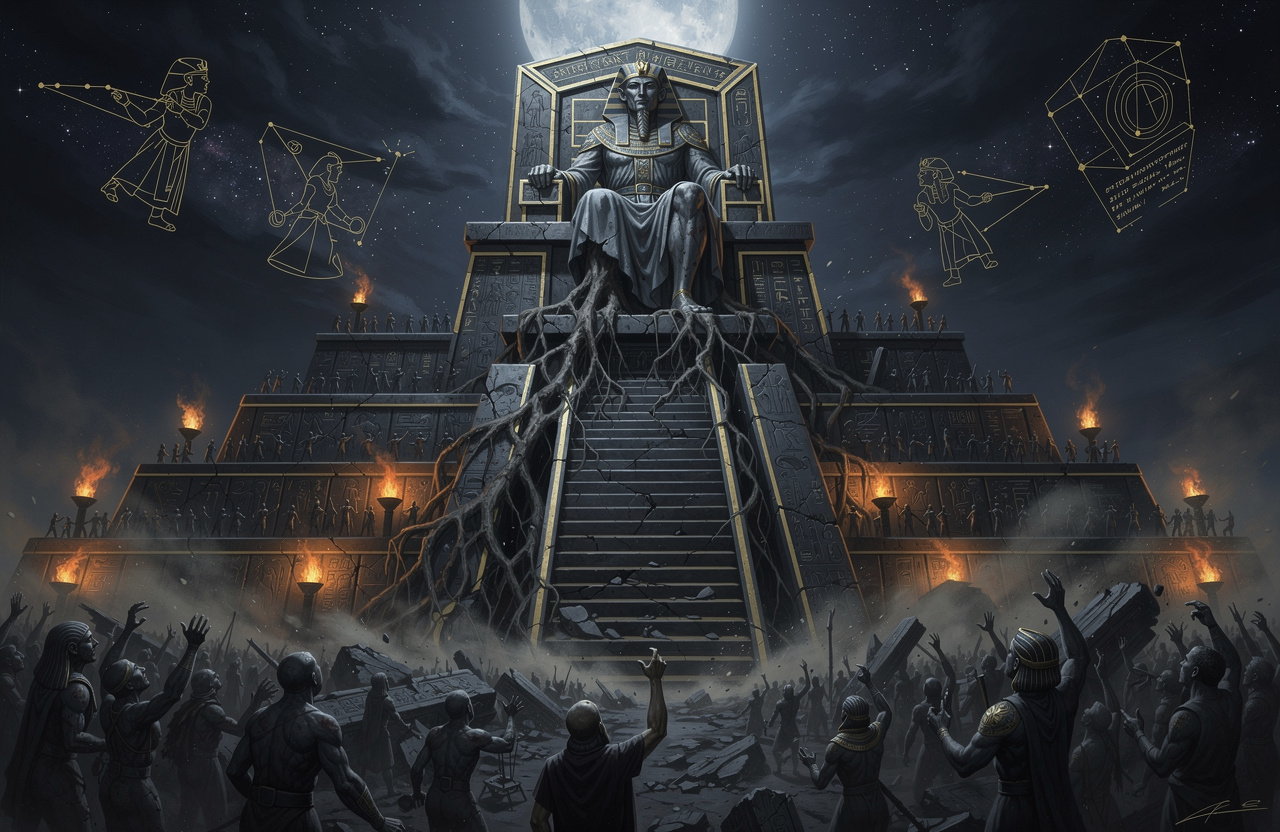
The temple texts drew a hard line between two kinds of authority. There is the king who reigns for a season — bound by Ma'at, weighed at the end, whose office passes onward so the order stays alive. And there is the coil that does not pass — Apophis, the ring that returns each night unchanged, unweighed, un-removed.
A leader who cannot be removed by any outcome has slipped out of the first category into the second. He is no longer an office holder subject to the Scales. He is a fixed point in the ring — a node the coil has decided not to release. That's why the tenure feels less like a career and more like a coil that won't uncoil: the same head, in the same place, through every convulsion, unbound by the weighing that's supposed to move power along.
Name it plainly: this is Sekhem hoarded at a fixed point. The stored life-force of the whole economy runs through this one seat, and the seat does not rotate, so the force does not redistribute. Order lives by circulation — power that passes on, gets weighed, makes room. A seat that never empties is a place where circulation has stopped and constriction has begun.
Why "The Market" Would Never Allow This — Except It Does
Here's the contradiction they'd rather you not hold in your head.
You were told the market is a brutal meritocracy: fail, and you're replaced; underperform, and capital flees; no one is safe. Fine. Then explain a CEO who booked a six-billion-dollar rogue loss, paid tens of billions in fines, and stayed for two decades, growing more powerful with each crisis. A real market clears out failure. This one rewards it — at the top. The "discipline of the market" applies with full force to the worker who's one bad quarter from a layoff, and with zero force to the seat at the center of the ring.
The rules bite downward. They dissolve upward. That asymmetry isn't a market. It's a hierarchy pretending to be one.
The Lever
Irremovability at the top is real — but it rests on something you can move.
- Read the tenure as a diagnostic. When a leader survives events that would end anyone else, don't read it as brilliance — read it as entrenchment, and ask what structure makes them un-removable. The answer is always the same: no accountability loop reaches them.
- Stop mistaking longevity for legitimacy. "He's run it for twenty years" is not proof he should. It's proof the mechanism to remove him doesn't exist. Those are opposite facts wearing the same suit.
- Build systems where the seat rotates by design. This is the quiet radicalism of a real DAO or cooperative: term limits written into code, roles that expire, power that must pass on because the protocol won't let it pool at a fixed point. No throne, because there's no chair welded to the floor. Governance where the weighing is automatic and the seat empties on schedule — that's Ma'at rendered in software.
- Route your weight to structures that circulate. Every bit of your economic life you place under a coil that never uncoils is one more year the seat doesn't move. Every bit you route to something that rotates power by design is a vote for circulation over constriction.
The old priests knew the deepest danger was never a bad king. It was a king who could not be removed — and a people who forgot that removal was ever possible.
Power that never passes on is a coil, not a crown. Build the room where the chair empties on time.