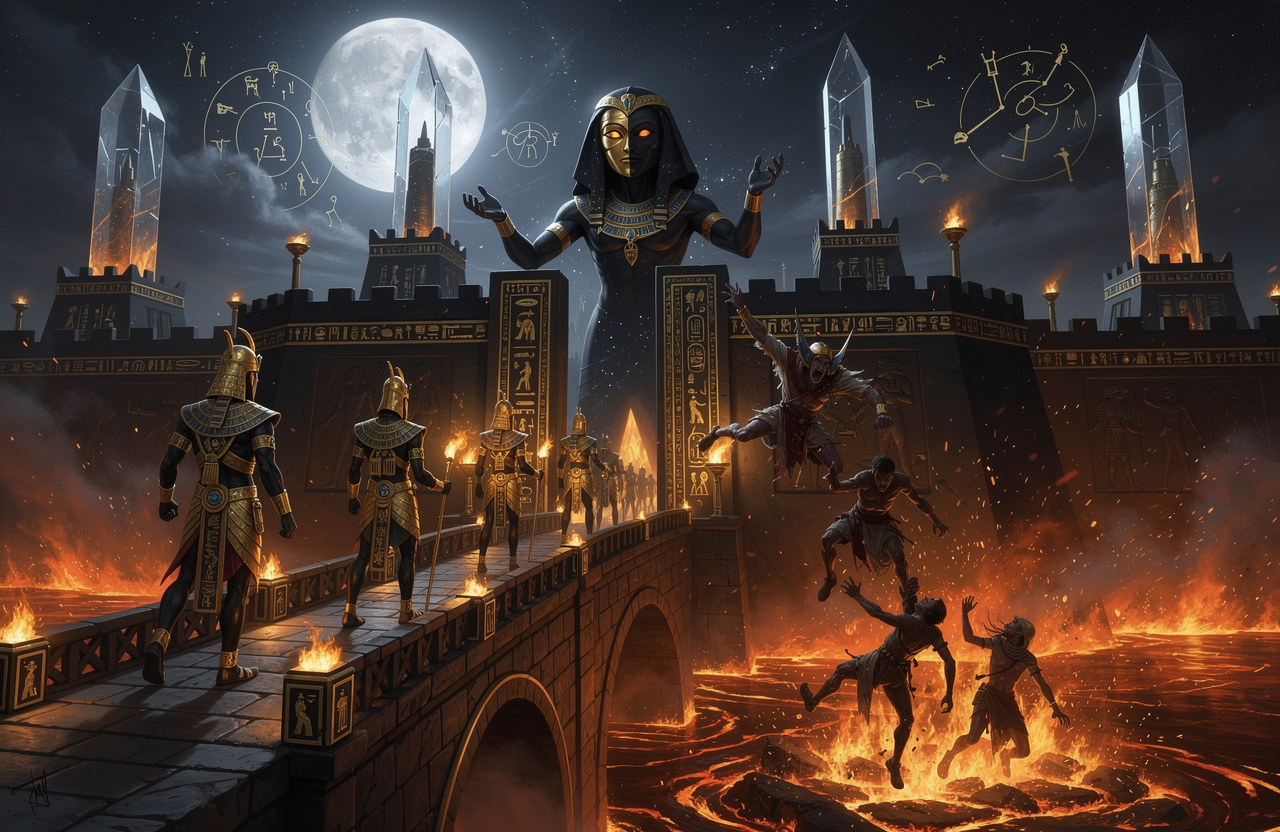
In the geography of the Duat — the parallel world the Egyptians documented with the diligence of a sysadmin mapping a network — there is one strange place. The Lake of Fire. It is strange because it does two seemingly mutually exclusive things at once. For sinners it is a place of destruction. For the righteous it is a place of rebirth. The same lake. The same fire. A different outcome — depending on who enters it.
An engineer, seeing such a description, smiles in recognition. Because that is exactly a firewall. A network firewall is neither "good" nor "evil" — it applies a rule. It blocks malicious traffic and passes legitimate traffic. One mechanism, two opposite outcomes, depending on what passes through it. The ancients described a firewall four thousand years before the first server.
And this dual function is the key to understanding how power works. Any mechanism of control carries both possibilities at once: to protect and to enslave. Everything comes down to whose hands it is in and on what principle it is tuned.
One mechanism, two functions
Take the basic idea. A border, a filter, a check at the entrance — this is a neutral technology. In itself it is neither good nor bad. The only question is what it selects for, and in whose favor.
In the Duat the gates are not decoration. They are checkpoints, each with three demon guards bearing fearsome names, and you can pass only by naming the name. Why such guarding? So that the malicious does not pass upward and the legitimate does. The guards are a firewall between levels, each level its own security zone. By function — protection of the system from infection from below.
The same architecture, according to the book, has been transposed into modern finance. Correspondent accounts and large settlement systems are the same gates with a triple guard, only now they guard not the passage of a soul but the passage of money. "Name the name" became "pass the check, confirm your identity, get clearance." A firewall with authentication. In form — exactly the Lake of Fire.
Where protection ends and control begins
And here is the most important distinction, the one this whole piece is for. The same firewall can be tuned in two ways.
The Maat tuning. The filter selects what is structural, honest, self-sustaining. It passes the good-faith and blocks the parasitic. The goal is the stability of the system and the protection of those inside. The book states it plainly: Maat is a filter-technology that, out of an infinity of possibilities, chooses what serves life and development. Egypt stood for thousands of years on that tuning.
The Isfet tuning. The same filter, but the goal is inverted. It selects not by the principle of honesty but by the principle of capture: it passes what benefits the gatekeeper's master and blocks what threatens his income. Protection turns into a tollgate for tribute. The same technology that guarded now milks. According to the book, this is a structure built on attachments that pumps out energy — and it holds exactly as long as there is someone to milk.
From the outside it is nearly impossible to tell them apart. Both have checks, clearance, rules, guards. The lake burns the same. The difference is not in the fire but in the principle by which it is decided whom it reanimates and whom it devours. That is why power so loves control mechanisms: they are always presented as protection ("this is for your safety") and often used as enslavement.
Fact and interpretation
Let's draw the line honestly, as we should.
Fact: mechanisms of financial control — checks, clearances, settlement gateways — are genuinely needed. Without them the system would choke on fraud, laundering, chaos. A firewall in itself is a useful and necessary thing. It is foolish to demand "tear down all borders."
The book's interpretation: the problem is not the existence of the filter but who holds the switch for its tuning and in whose interest it selects. When a single gatekeeper tunes the filter for himself, protection imperceptibly bleeds into control. And the ordinary person turns out to be not the one the filter protects but the one being filtered. The same fire that could reanimate begins to devour.
The uncomfortable conclusion: don't dream of a world without firewalls. Watch very carefully who has a hand on their tuning.
Where is the ordinary person
Someone's "gates with three guards" stand before him constantly. To open an account — a check. To take a loan — a score. To make a payment — clearance. Each such lake can reanimate him (grant access, protect him from a fraudster) or devour him (refuse, block, leave him out). And he is not the one who decides. The one who tuned the filter decides. The person stands at the gates awaiting the verdict, knowing neither the rules nor the judge. He is the one being filtered, never the one tuning the filter.
The answer: the MAAT token and DAO
If the essence of the problem is that a single gatekeeper tunes the filter for himself, then the answer is not to break the filter but to take away the gatekeeper's monopoly on its tuning. Let the rules be set not by one owner of the lake but by the community of those who pass through it.
That is MAAT. The MAAT token is membership in a cooperative and a single vote on the principle of one human, one vote, not "whoever holds the key to the gates decides whom to devour." Governance runs through a DAO — a decentralized organization with a transparent treasury where the filter's rules are visible to all and changed by people's vote, not by the gatekeeper's quiet order. This is a firewall tuned on the Maat principle: it protects those inside rather than milking them; and there is no single hand that can quietly flip it into Isfet mode. The lake still burns — but now the community, not an owner, decides what that fire reanimates. The entry is simple: read the book, take the token, get your vote — and stop being the one filtered by someone else's gates.