Take a five-dollar bill out of your pocket. Look at it. Now trace where it goes after you spend it at the big-box store on the corner.
It doesn't stay in your town. Most of it leaves within the day. It flows up the supply chain, past regional distributors, into the accounts of a holding company, into the treasury of a fund that owns that holding company. And a big chunk of the world's holding companies, if you pull the thread far enough, sits under the same two or three asset managers — BlackRock manages on the order of ten trillion dollars, Vanguard a similar order. Your five dollars becomes a rounding error in a machine that never sends anything back.
This isn't a conspiracy. It's plumbing. Money flows the way pipes are laid. And the pipes are laid to drain upward.
The good news: you can re-lay the pipes on your own street. Nobody's stopping you. This is a local task, and it's within reach today.
Where Your Money Actually Goes
Here's the mechanic nobody teaches in school. Every dollar you spend has a local multiplier — how many times it circulates in your community before it leaves.
Spend at a chain: studies of independent versus chain retail consistently show the local share leaving fast — a large majority of it out of the local economy almost immediately. Spend with a local producer who buys local flour, hires a local kid, banks at a local credit union: that same dollar turns over three, four times before it exits. It pays the baker, then the baker pays the mechanic, then the mechanic pays the teacher who tutors your kid.
Same dollar. Completely different life. One version feeds a fund's quarterly report. The other feeds your street.
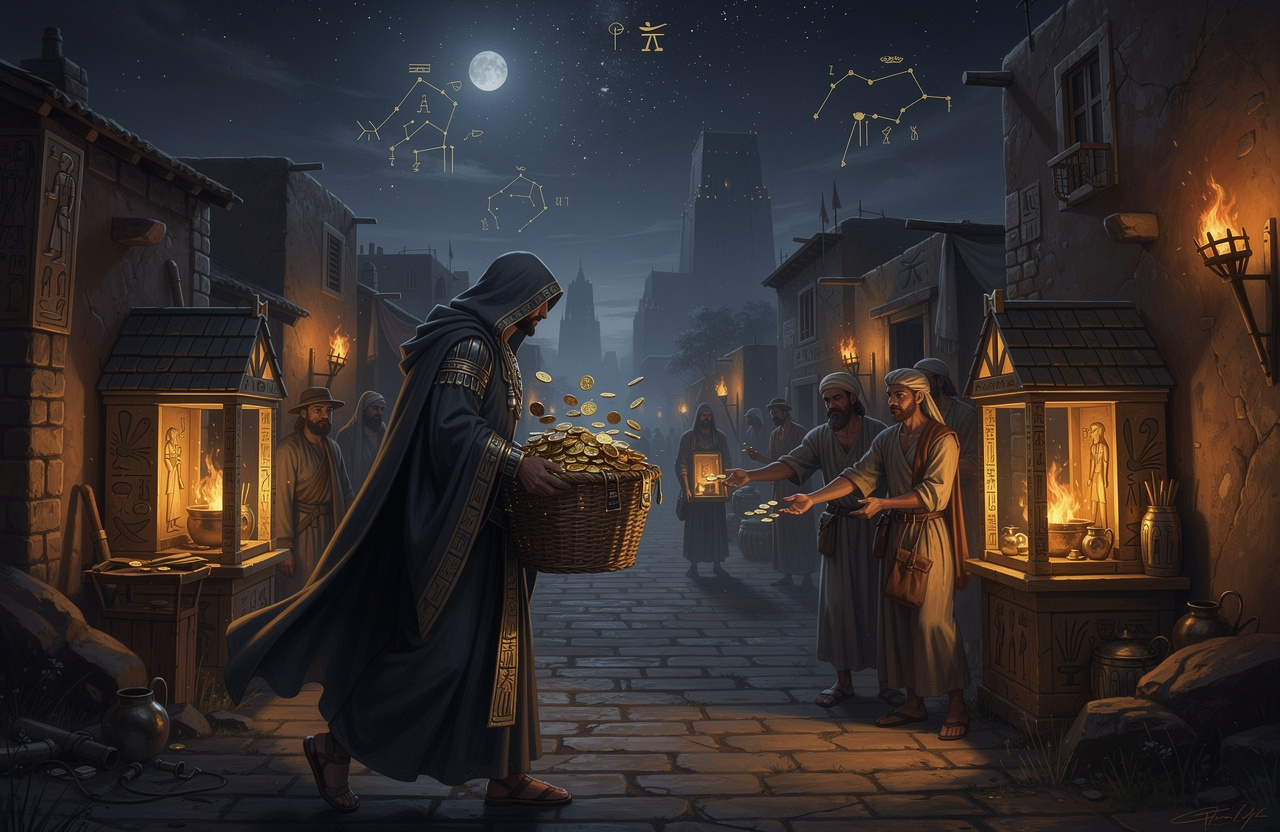
Our record. Money is condensed Sekhem — life-force made portable. When it drains upward and never returns, that is Isfet: energy leaving the circle, entropy winning. When it turns over inside the ring, feeding neighbor after neighbor, that is Maat: the current kept in balance, the circle staying alive. You are not "just shopping." You are deciding which way the Sekhem flows.
How to Find "Your Own"
You can't support local producers you can't see. So the first job is reconnaissance. Think of it as indexing your neighborhood — building a map that didn't exist before.
Walk the radius. Pick a one-mile circle around your home. Actually walk it, or bike it. Note every place that makes or grows something versus every place that just resells something shipped in. The maker is your target. The reseller is a pass-through pipe.
Ask the magic question. At any small shop, ask: "Who around here makes X?" Small owners know each other. One honest bakery will point you to a farm, a roaster, a repair guy, a seamstress. You're not searching a database — you're traversing a graph, node to node.
Find the market. Almost every region has a farmers' market, a craft fair, a food co-op, a "buy local" directory. These already exist. You don't have to build them — just show up and start using them.
Check the money's home. A local producer who banks at a national megabank still leaks. One who uses a local credit union or community bank keeps the loop tight. Ask. It's a fair question.
Write it down. A simple list — name, what they make, how to reach them. That list is an asset. Most people never build one, which is exactly why the drain works so well.
Redirect One Category at a Time
Don't try to localize your whole life this week. That's a refactor that fails. Do it one category at a time, like migrating a system module by module without taking the whole thing down.
Start with what you buy most often. For most people that's food. Move your bread, eggs, vegetables, and coffee to local sources first — highest frequency, biggest cumulative effect. Then repairs: the guy who fixes your bike or your laptop instead of the mail-in service. Then services: the local accountant, the local trainer, the neighbor who cuts hair.
Each category you move is a pipe you re-route. You won't feel it in a day. In a year, a meaningful share of your spending is circulating in your own ring instead of draining out. Multiply that by a hundred neighbors doing the same and you've quietly built a parallel economy that no fund controls.
You will pay a little more sometimes. Be honest about that. The chain is cheap because it externalizes everything — the wages, the environment, the hollowed-out main street. When you pay the local baker an extra dollar, you're not overpaying. You're paying the true price and keeping the change in your circle. The "savings" at the chain were always a loan against your own town, and the interest comes due.
The Community Is the Real Asset
Here's the part that isn't about money at all. When you buy from people you can see, you rebuild something that got quietly deleted: knowing your neighbors.
The person who grows your food, fixes your car, teaches your kid — when you have a name and a face for each, you're no longer a lone consumer facing a global machine. You're a node in a resilient mesh. When the supply chain hiccups — and it will, it's a single point of failure by design — the mesh routes around the damage. Your neighbor has eggs. You have a working generator. The account you can't withdraw from doesn't matter, because the wealth was never in the account. It was in the relationships.
That's the deepest reason to do this. Not to punish BlackRock — it won't notice. To make yourself and your street ungrindable. A community that feeds and repairs itself can't be starved by a decision in a boardroom you'll never enter.
The drain runs on autopilot. Redirecting it is a manual act, done by hand, one purchase at a time. That's not a weakness. That's the leverage — because they can't automate you back.
Do This Today
Pick one thing you buy every single week — bread, coffee, eggs, whatever it is. Just one. Today, find the closest person or small shop that actually makes it, not resells it. Use a search, ask a neighbor, or walk the block. Buy it there this week instead of at the chain.
One category. One producer. One redirected pipe. That's how the circle starts closing — not with a manifesto, with a loaf of bread bought from someone whose name you now know.