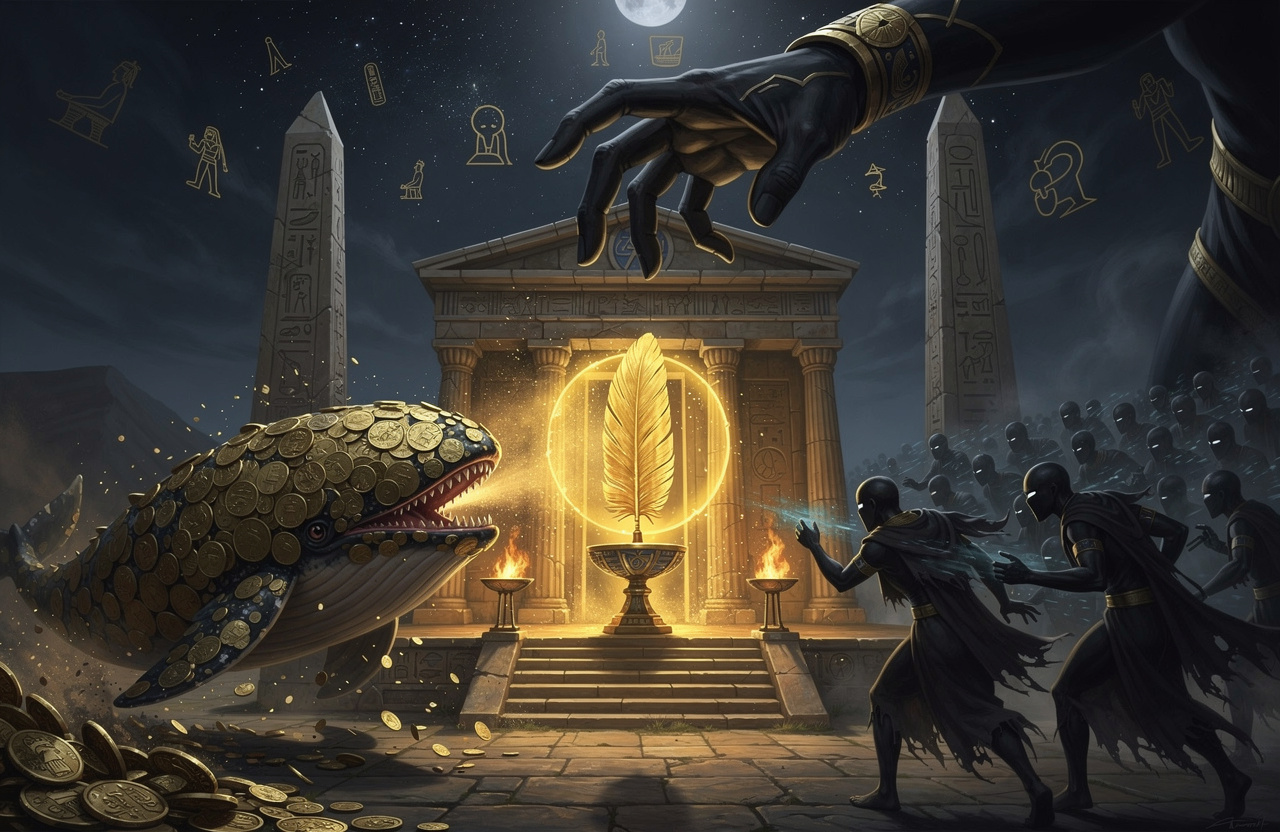
Every DAO faces the same three predators. We've walked through them in earlier pieces; now watch them stand together, because a governance system that stops one but not the others is a lock with two open doors.
- The Whale. One holder with enough tokens to swing every vote. Money buys control.
- The Sybil. One person masquerading as thousands of fake identities to fake a crowd and drown the real one.
- The Takeover. The flash-loan raid, the low-quorum ambush, the governance exploit that captures the machine in a single block.
Most projects patch one hole and leave the rest open. Beat the whale with delegation, and the Sybil floods you with fakes. Beat the Sybil with token-weighting, and the whale walks in the front door. The three threats are a system — and they demand a systemic answer.
Here is how MAAT is designed to close all three doors at once. Not with magic. With one root decision, and a stack of defenses built on top of it.
The root decision: one human, one voice — not one dollar, one voice
Almost every governance failure traces back to a single flawed assumption baked into standard DAOs: voting power equals token balance. One token, one vote. Which, since tokens are bought with money, means one dollar, one vote.
That equation is the whale's entire power. It is why accumulating capital equals accumulating control. Tune the timelock, raise the quorum, add a guardian — you're still defending a field tilted toward whoever has the most money.
MAAT's foundation is a different equation: one verified human, one voice.
Governance weight is anchored to personhood, not to purse. A wallet's power in the deciding votes comes from being a real, unique, verified participant in the cooperative — not from how large a bag it holds. Change that one variable at the root, and the whale's core advantage doesn't get patched. It evaporates. You cannot buy ten thousand humans the way you can buy ten thousand tokens.
Our record. In the Hall of Two Truths, the heart is weighed against the feather of Ma'at — and it is weighed one soul at a time. No one is heavier on the Scales for being rich. The measure is truth, not mass. MAAT's governance is built in that image: the Scales weigh each person as one, and gold cannot press the pan down. Isfet is the impulse to convert wealth into rule, to let the heavy purse outweigh the honest heart. To anchor the vote in personhood is to keep the Scales true. This is not a technical footnote. It is the whole moral architecture, written into code.
Closing door one: the Whale
With one-human-one-voice at the root, the whale's primary weapon is already broken. Accumulating tokens no longer accumulates decisive votes. A holder with a hundred times the tokens does not get a hundred times the say in the votes that steer the cooperative.
Capital still matters for economic upside — the point isn't to punish holders — but the steering wheel is uncoupled from the wallet size. On the standard field, the whale simply parks a big enough position and rules. On MAAT's field, that move does nothing to their governance weight. The single most common capture path is closed at the foundation, not patched at the edge.
Closing door two: the Sybil
But personhood-based voting has an obvious new attack surface: if one human equals one voice, then one human pretending to be ten thousand humans equals ten thousand voices. That's the Sybil attack, named for the case study of a single mind wearing many personalities. It's the mirror image of the whale — instead of one identity with too much money, it's one actor with too many identities.
So MAAT's second layer is proof of unique personhood — a verification that each voting participant is a distinct, real human, without turning the system into a surveillance database. The goal is a hard, honest answer to one question: is this one person, counted once? Get that right, and the Sybil's fake crowd never forms. The thousand masks collapse back into the one face behind them.
This is the piece that makes one-human-one-voice actually work. Personhood-weighting without Sybil resistance is a fantasy; the two defenses only function as a pair. The whale is beaten by anchoring to persons; the Sybil is beaten by verifying those persons are real and unique. Neither alone is enough. Together they seal two doors that, in most DAOs, can only be defended one at a time.
Closing door three: the Takeover
The third predator doesn't overwhelm the vote — it games the mechanics: flash-loan raids, low-quorum ambushes, malicious proposals that execute before anyone reacts.
Two things blunt it. First, once votes are anchored to verified persons rather than to instantly-tradeable tokens, the flash-loan raid loses its ammunition. You cannot borrow ten thousand verified humans for one block. The Beanstalk-style attack — rent a majority, execute, repay — simply has nothing to rent. The asset it needs to borrow doesn't exist in a personhood-weighted vote.
Second, MAAT layers the standard structural armor on top:
- Timelock. Passed proposals wait before they execute — visible, contestable, never instant. No proposal detonates in a single block.
- Honest quorum. A real share of verified participants must show up for a vote to count, so a small coordinated faction can't ambush a sleeping community.
- Guardian veto. A narrow safety brake that can stop a clearly malicious proposal during the timelock, but can never cause action — brakes, never the accelerator.
Timelock plus quorum plus veto is the same armor the best conventional DAOs use. The difference is what it's bolted onto. On top of one-human-one-voice and Sybil resistance, these defenses aren't patches over a broken foundation — they're the outer wall of a fortress that's already sound at the base.
Why the three defenses need each other
Here is the core of it, and the reason MAAT treats governance as one design and not three features.
Each threat, alone, has a known counter. The trap is that the counters conflict. Anti-whale measures (weight by person) create the Sybil opening. Anti-Sybil measures done the lazy way (weight by token) hand the whale the keys. Anti-takeover armor (timelocks, quorums) is worthless if a whale or Sybil already controls the votes it's supposedly protecting.
So the three cannot be solved in sequence. They have to be solved as a system, with one coherent root — personhood — that makes each defense reinforce the others instead of undermining them. Anchor to verified persons, and the whale loses their capital advantage and the flash-loan raid loses its fuel. Verify uniqueness, and the Sybil's answer to personhood-weighting collapses. Wrap it in timelock, quorum, and veto, and the whole thing is contestable and slow to subvert. Pull any single piece and the others weaken. Together they hold.
Never doom without a door — and this is the door. Not a promise that MAAT is unbreakable; nothing is. A promise that the three most common ways a DAO gets captured are answered at the root, as one design, instead of one at a time with the others left ajar.
The Scales weigh each heart as one. Build the vote the same way — and gold stops being able to press the pan down.