Every organization you've ever trusted with money has asked you to believe their books. The charity, the fund, the company, the government — they publish a report, months late, prepared by people they pay, and you nod. You cannot see the account. You cannot watch the money move. You are trusting a statement about reality, not reality itself.
Now here's the thing almost nobody stops to appreciate: a public blockchain address destroys that entire arrangement. The treasury isn't described to you. It's shown to you. Live. Every coin, every transaction, in and out, timestamped, permanent, checkable by anyone with a browser — including you, right now, without asking anyone's permission.
MAAT's treasury sits on-chain for exactly this reason. So let me hand you the tools to verify it yourself. Not trust us. Check us.
What "on-chain treasury" actually gives you
When funds live in a public wallet — a multisig Safe, say — the ledger has three properties that no traditional financial report has ever had at once:
- Real-time. Not a quarterly PDF. The balance you see is the balance right now, this second. A transaction that happened five minutes ago is already visible.
- Complete. Every movement, ever, since the wallet's first block. Nothing selectively omitted, because the chain doesn't have a "hide this one" button. The full history or nothing.
- Independently verifiable. You don't check our copy of the books. You check the books — the same shared ledger thousands of independent nodes agree on. There is no second set.
Put those together and you get something genuinely new: an organization whose finances cannot lie to you, because they were never yours-to-be-told. They're just there, in the open, whether we like it or not.
How to actually check it — the concrete steps
This is not for experts. It's a five-minute skill. Here's the drill:
- Get the address. MAAT publishes its treasury address(es). One string of characters — that's the whole key to the vault, and it's public on purpose.
- Open a block explorer. A block explorer is a free website that reads the public ledger in human-friendly form (Etherscan for Ethereum, and equivalents for other chains). No account, no login. Paste the address into the search bar.
- Read the balance. Right at the top: exactly how much the treasury holds, right now, across each token. That's not a claim. That's the chain.
- Read the transactions. Scroll the list. Every payment in, every payment out, with a timestamp and the counterparty address. You can see money arrive. You can see money spent. You can click any single transaction and inspect it down to the gas.
- Follow the money. Click an outgoing transaction's destination and you can see where that went too. The trail doesn't stop at our wall, because there is no wall. Funds are traceable across the whole graph.
Do this once and something shifts in you permanently. You stop hoping an organization is honest with its money and start seeing whether it is. That's a different relationship to power entirely.
Our Record
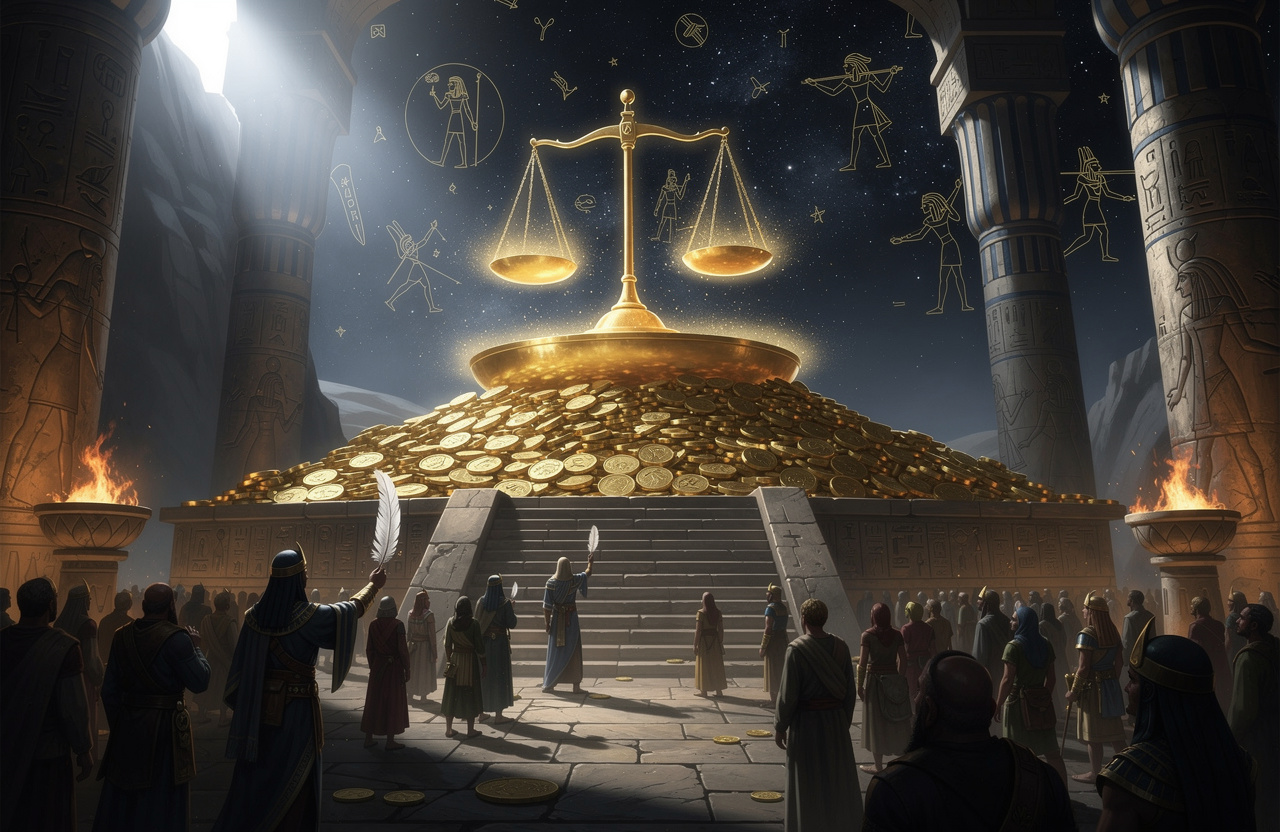
The Scales of Ma'at were never a private instrument. The weighing happened in the open, before witnesses, on a balance anyone could read — that was the whole point: truth that does not depend on trusting the priest. Isfet is the closed book, the account you're forbidden to see, the "trust us" that hides the skim. A public treasury is the Scales rebuilt in code: every movement of value laid on the balance for all eyes, the feather against the coin, in real time, forever. We do not ask you to believe MAAT is honest. We hand you the balance and say — weigh it yourself. An organization that cannot hide its books cannot quietly betray them. That is Ma'at made structural.
The honest limits — because transparency isn't omniscience
Seeing the ledger is powerful. It is not the same as understanding everything. Be clear-eyed:
- The chain shows the what, not the why. You can see a payment of X went to address Y. Whether that was a fair price for real work, or a sweetheart deal to a friend, the ledger alone won't tell you. Transparency exposes the transaction; judging its wisdom still takes you thinking.
- Addresses aren't names by default. You see wallet Y received funds. Who controls wallet Y may take extra context — labels, disclosures, off-chain accountability. On-chain transparency and human accountability are two layers; you want both.
- It doesn't cover off-chain assets. If value sits in a bank, a legal entity, or the physical world, the chain can't show it. A fully honest picture needs on-chain proof plus honest disclosure of the off-chain parts. Anyone claiming the chain shows everything is overselling.
- Reading it well is a skill. The raw data is complete but not always self-explaining. Good treasury dashboards translate the ledger into plain terms — use them, but know they're an interpretation layer on top of the source of truth.
- Transparency only works if someone looks. Open books nobody reads guard no better than closed ones. The power of a public treasury is realized the moment even a few members actually check it, regularly. The tool lays the scales on the table; someone still has to do the weighing. Be that someone — and call others to do the same.
None of this weakens the point. It sharpens it: on-chain transparency removes the excuse for hidden finances. What it demands from you in return is the ten minutes to actually look.
The lever
Stop accepting "trust our report." For MAAT, and for any on-chain treasury, the check is in your hands.
Go get the address. Open the explorer. Read the balance. Scroll the transactions. Follow one payment to where it landed. Ten minutes, no permission, no expert required — and you'll know, not believe, what the treasury holds and where it went.
Then hold every organization to that standard. The ones that put their books on the open ledger are handing you the scales on purpose. The ones that won't are telling you something too. Weigh them all yourself. That's the whole point of Ma'at — and now it fits in a browser tab.