Open your phone right now and check screen time. That number is a receipt. It tells you, in hours, how much of your one life you handed to systems that sell your attention to the highest bidder. Not lent. Handed. And here is the part nobody says out loud: the feed was never built to inform you. It was built to hold you. Engagement is the product. You are the raw material.
Think about the incentive for one second. A social platform does not make money when you learn something and log off satisfied. It makes money when you stay. When you scroll. When you come back at 2 a.m. because a notification lit up the dark. Every design choice — the pull-to-refresh, the infinite feed, the red badge, the autoplay — is an A/B-tested hook optimized against your self-control. You are playing a slot machine that studied your face.
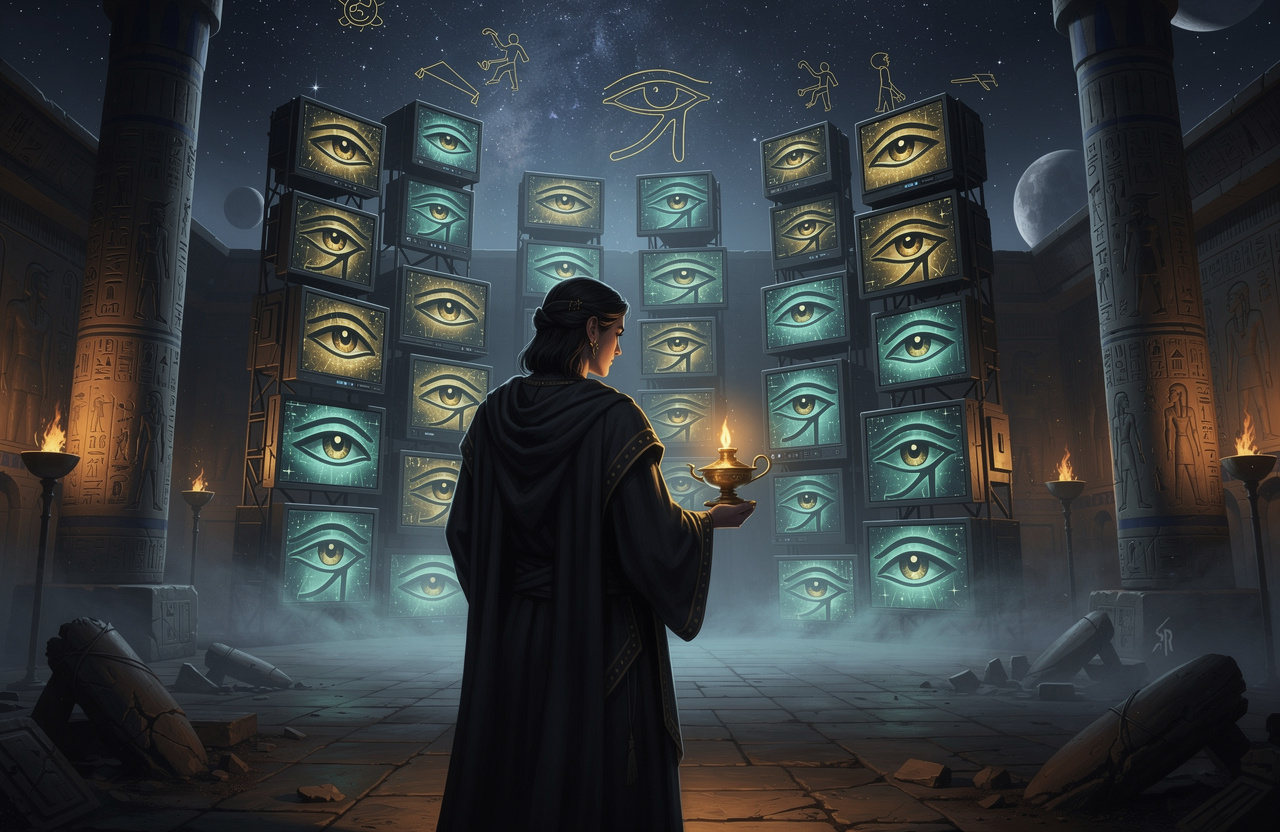
The Egyptians had a word for the force that eats order and gives nothing back: Isfet. Chaos that feeds on Maat. The algorithmic feed is a small, elegant engine of Isfet in your pocket. It converts your attention — your Sekhem, your life-force — into someone else's revenue, and returns to you agitation, comparison, and a vague sense that you are behind. That is not a bug in the firmware. That is the firmware.
The feed is not neutral, and it is not yours
Here is the uncomfortable architecture. The content you see is not chosen by you and not chosen for your good. It is chosen by a ranking model whose only true objective is to predict what will keep you engaged. Truth ranks below outrage. Nuance ranks below conflict. Your calm ranks below your reaction. The system does not hate you — it is indifferent to you the way a fishing net is indifferent to a fish. It simply optimizes.
And it optimizes with more compute than you can imagine. The recommendation engines behind the major platforms run on the same class of hardware — NVIDIA GPUs by the tens of thousands — that trains frontier AI. That firepower is not pointed at curing anything. A meaningful slice of it is pointed at one question: how do we get this specific human to scroll for four more minutes? You are up against a proprietary black box tuned by thousands of engineers. Willpower alone loses that fight. Willpower always loses to architecture.
So stop fighting on their terrain. You do not out-discipline a slot machine. You change the machine.
Our record. An attention economy is a system that mines Sekhem and pays back in Isfet. Every unchosen scroll is a small transfer of your life-force into a ledger you will never see. To reclaim it, you do not need more willpower. You need to change the terms of the exchange — take back the choosing.
Take back the choosing
The core move is this: convert consumption from push to pull. Right now the feed pushes at you — it decides, it serves, you react. A sovereign flips it. You decide what you want, you go get it, you leave. Pull, not push. Everything below is a way to install that one principle.
Kill the notifications first. Not silence them — kill them. Go into settings and turn off every non-human notification. Keep messages from actual people you know. Remove badges, banners, sounds, vibrations for every app that wants to interrupt you. A notification is another entity deciding when you should think about them. Take that decision back. This single change breaks more of the hook than anything else, because it removes the trigger that starts the loop.
Uninstall the feed apps from your phone. Keep them in the browser if you must, logged out, so every visit costs you a deliberate act of typing the address and logging in. Friction is your friend here. The whole business model depends on zero friction between impulse and scroll. Add ten seconds of friction and the impulse dies before it becomes an hour. `net.timeout` on your own habit.
Replace the feed with a queue you control. RSS is old tech and it is beautiful precisely because it is dumb. It gives you exactly the sources you chose, in order, with no ranking model deciding what you deep-need to see. Follow the writers and outlets you actually respect. Read them on your schedule. When you finish the queue, you are done — there is no infinite bottom. Newsletters do the same job: they arrive, you read, they end.
Batch it. Time-box it. Decide when you consume, and for how long, before you start. Twenty minutes, twice a day, is a lot of information. Set a timer. When it rings, you are out. This is the difference between drinking water and drowning in it — same substance, different relationship.
Curate ruthlessly, and re-curate. Every account you follow is a vote for what colonizes your mind. Unfollow anything that leaves you agitated, envious, or dumber. You are not obligated to consume something because it exists. Prune the list every month like a garden, because the algorithm will keep trying to reintroduce weeds.
What you get back
This is not about becoming a monk in a cave. It is about ownership. When you switch from push to pull, three things return that you may have forgotten you owned.
First, boredom — which is the raw material of thought. The mind that is never idle never wanders anywhere useful. Every good idea you have ever had came in a gap the feed would have filled.
Second, the ability to sit with a single thing. Deep attention is a muscle, and the feed has been quietly training you to lose it, one micro-interruption at a time. Reclaim it and you can read a book, hold a plan, finish a hard piece of work. That capacity is economic power now. In a world where most people are optimized into distraction, the one who can focus for two hours is operating with an unfair advantage.
Third, mood. Notice how you feel after twenty deliberate minutes of chosen sources versus ninety accidental minutes of the feed. The difference is not subtle. Agitation is the by-product the machine hands back to you. Remove the machine and the agitation goes with it.
Look at the screen-time number again. Now imagine getting even half of it back — as reading, building, sleeping, being with people who are physically in the room. That is not a small quality-of-life tweak. Over a year that is weeks of your life returned to your own ledger.
The feed wants you to believe resistance is impossible, that everyone lives this way now, that opting out is quaint. That is the Isfet talking. It is not impossible. It is a settings menu and a decision. Name the mechanism — the push, the hook, the harvest — and it starts losing its grip. You are not weak. You were outgunned by architecture, and now you know it.
Do this today
Open your phone's settings and turn off every notification except direct messages from real people. All of them. Then delete one feed app from your home screen — the one you open on reflex. Ten minutes of work. You just took back the trigger and raised the friction. That is the whole game, started today.