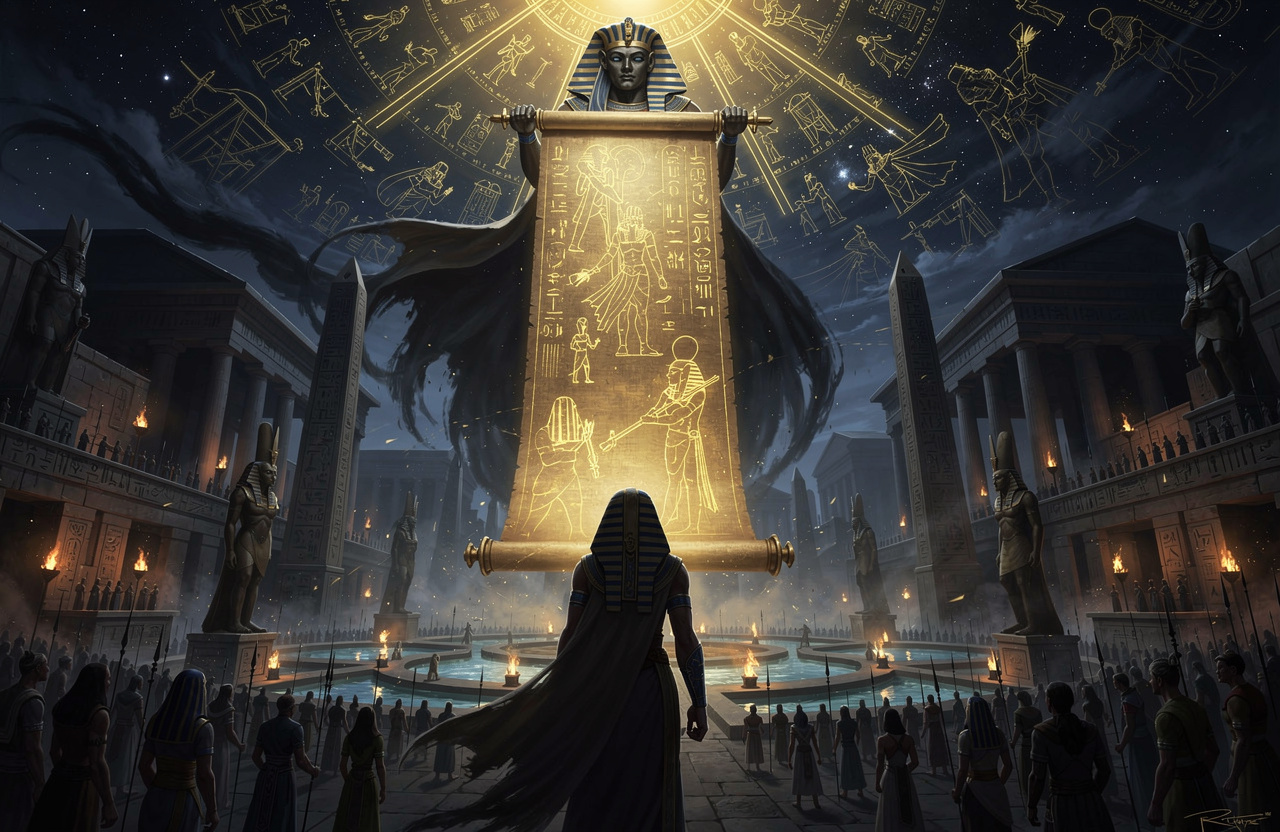
The most powerful weapon in the world doesn't fire. It punches through no armor and levels no cities. It does something cleverer: it decides for you what you consider truth, normal, and common sense. That weapon is control of the narrative — the story you carry in your head about how the world works. And its main carrier today is the media.
An engineer sees it simply. A person has "firmware" — a set of assumptions through which he interprets everything. Whoever controls the updates to that firmware controls his behavior without touching him. No need to give orders — just set the frame inside which the person reaches "his own" conclusion. That is the highest form of soft power.
Control of meaning is an ancient resource
The book names this as one of the three key resources of power. Simplified: there were always three levers — control of resources (land, factories, money), control of the interface (the ruler, the president), and control of meaning — the right to say what is true.
Once the temple governed meaning, then the church. Today, as the book states plainly, control of meaning has passed to the media, rating agencies, "experts," and educational standards. This is no trifle next to money and armies — it may be the main lever. Because a person with the desired picture of the world in his head doesn't resist. He himself treats someone else's interests as his own.
The shadow of the function "to carry knowledge" is described precisely in the book: a lie passed off as truth; empty words served up as fact. Propaganda isn't necessarily a crude poster. More often it's a carefully tuned frame in which some questions get asked and others don't.
How exactly the media bend reality
A crude lie is rare and dangerous — it gets caught. The real weapon works more subtly. A few techniques visible to the naked eye, if you know where to look:
- Selection, not falsehood. They don't lie in the facts — they lie in the choice of facts. One thing is shouted about for a week, another is met with silence. What wasn't shown, for the viewer, effectively doesn't exist.
- The frame of the question. "Who's to blame for the crisis — the left or the right?" — and you're already arguing inside their frame, not noticing that the real beneficiary isn't mentioned in the poll at all.
- Appointing the experts. An "independent analyst" in the studio — but who decided he's an expert, and who invited him? Legitimacy is handed out selectively.
- The ready-made label. A complex event is folded into one word: "dictator," "spring," "reforms," "aggression." The label thinks for you.
- Control of tempo. What's important today, what to forget tomorrow. A constant stream of anxiety leaves you no strength to think any thought through to the end.
Recall Sri Lanka in 2022: the country went bankrupt, and the media explained it in unison — "China lured it into a debt trap." The numbers said otherwise: Western bonds were 47% of payments, China 20%. But the ready-made label, not the numbers, was placed in the viewer's head. Control of the narrative in a single frame.
Who owns the "firmware"
The key question is whose megaphone it is. Major media don't hang in the air: they have owners, advertisers, and investors. And the largest funds — the ones this whole book is about — hold stakes, including in media companies. You get a loop: whoever owns the assets also influences the story told about them.
The book has a telling example from the world of algorithms: a vote inside a media corporation over who sets the agenda — an algorithm tuned to maximize anxiety and clickbait, or an editorial team striving for quality. The anxiety-maximizing algorithm benefits the owner (more engagement, more money) and is convenient for control. A calm, thinking person is a poor consumer and a poor object of management. So the default firmware is tuned for anxiety.
Fact and myth
Fact: the media systematically shape the picture of the world through selection, framing, and labels, and major financial players hold stakes and influence in this sphere. Control of meaning is a real, and perhaps the most important, lever of power.
Myth: that there's a single secret headquarters sending every newsroom one unified daily playbook. In most cases that isn't needed. Common incentives suffice: who owns the assets, what brings traffic, who gets invited as an expert, which topics the advertising feeds. The system bends reality on its own, with no single center — because that's how the incentives are built. And that's scarier than a single headquarters, because there's no one to catch red-handed.
Where the ordinary person stands
He is the end device onto which the firmware is flashed. He sincerely considers his opinions his own, not noticing that the frame, the labels, and the set of "facts" were handed to him. He argues inside someone else's question, frets on someone else's schedule, votes for a frame in which his interest isn't listed. His head is used as a venue, while he neither controls nor answers for its contents.
The answer: the MAAT token and DAO
Control of the narrative works as long as the channel through which "truth" reaches you belongs not to you but to an interested party. There's only one way to break it: make the key facts about your own shared structure directly verifiable, without a narrating intermediary.
That is one of MAAT's principles. The MAAT token is membership in a cooperative where decisions are made on the principle of one human, one vote, not "whoever holds the megaphone is right." Governance runs through a DAO — a decentralized organization with a transparent treasury where every movement of funds, every asset bought, and every vote is visible to all directly. You don't have to believe anyone's narrative about what's happening with the shared money — you open it and check for yourself. Transparency by default — because all control of meaning feeds on darkness and a closed door.
The media weapon is strong exactly to the degree that you're forced to trust the narrator. MAAT removes the narrator where it matters most — in the question of the community's power and money. The entry is simple: read the book, take the token, get your vote. And start verifying reality yourself instead of carrying someone else's firmware.