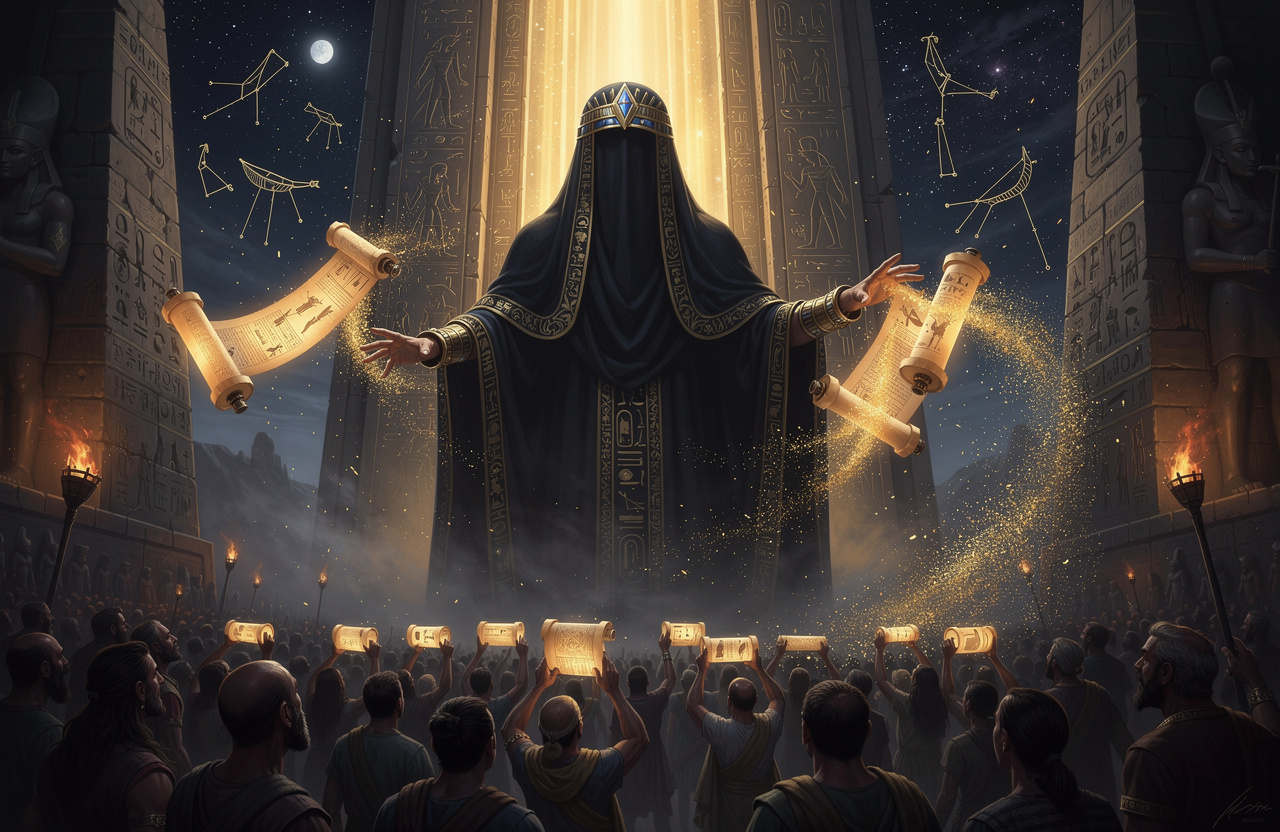
Nobody told you your post was buried. That's the whole design. There was no banner, no warning, no email — just silence where the reach used to be. Your words went out and hit a wall you can't see, made of an algorithm you can't read, enforcing rules that aren't written down. You weren't censored the old, honest way, with a stamp that says BANNED. You were quietly turned down until almost no one could hear you.
This is the new shape of the gate. Not a wall around the town square — a dimmer switch on every voice inside it, controlled from a room you'll never enter.
Deletion is loud. Deamplification is silent.
The old censorship had a courtesy: it announced itself. A banned book is a banned book. You know. You can protest, appeal, smuggle, fight. Visible suppression creates martyrs and lawsuits and headlines.
So the smart move was to stop deleting and start dialing down. The industry word is deamplification. Your content stays up — technically you're not censored, they'll insist — but the algorithm quietly stops showing it. Fewer feeds, lower ranking, buried in replies, dropped from recommendations. The reach evaporates and there's nothing to point at. This is what people mean by shadow-banning: not removal, but throttling in the dark.
For years platforms flatly denied shadow-banning existed. Then the internal machinery started leaking. Twitter's own systems, revealed in 2022–2023, included "visibility filtering" — tools to reduce a specific account's reach without telling the user, sometimes called blacklists internally. Meta has a documented tier of "borderline" content: posts that don't break the rules but get algorithmically demoted anyway, because they flirt with the line. LinkedIn, YouTube, TikTok — every major platform runs some version of the dimmer.
The point is not "they remove bad things." The point is a system that decides, invisibly and at scale, whose voice carries and whose fades — and never has to admit it did.
The machine can't read meaning, so it reads patterns
Here's what makes it worse than a censor with a red pen: at this scale, no human is reading your post. Billions of items flow through daily. The gatekeeper is an AI classifier, and a classifier doesn't understand meaning. It matches patterns.
It sees a word, a link, a co-occurrence, a cluster of signals that correlate with things flagged before, and it acts on the correlation. A cancer survivor's support group gets throttled because the model can't tell health discussion from something to suppress. A historian, an artist, a journalist covering violence gets swept up because the pattern looks like the thing, and the pattern is all the machine has. Context — the whole of human meaning — is exactly what it cannot see.
And the rules it enforces are not law. They're private policy, changed without notice, applied by a model tuned on a training set you can't inspect, at a company accountable to advertisers and governments, not to you. There's no court, no appeal that reaches a human, no way to read the code that judged you. It's a proprietary black box rendering verdicts on what a civilization is allowed to say — and returning no error message, just a quiet drop in reach.
The Shadow Neteru who narrows the world
Thoth — Djehuty — is the keeper of the word, the scribe of the gods, the one through whom Heka moves: the creative, world-shaping power of language. To speak, to write, to be heard — this is sacred function. A voice reaching other souls is Heka doing its work. The old world knew that whoever controls the word controls the shape of what can be thought.
There is a Shadow Neteru who apes the scribe. He doesn't burn the scroll — too loud, too visible. He copies it, files it, marks it do not read to the people, and shelves it in a vault no one knows exists. The word survives; its Heka is severed. It can no longer reach a soul, so it can no longer shape the world. This is the subtlest censorship there is: not silencing the voice, but cutting the wire between the voice and every ear. You still speak. The room has simply been emptied around you, and no one will tell you when.
Our record: In the order of Maat, the word is meant to travel — truth spoken must be free to reach the scale and be weighed. A system that lets you speak but severs your reach, that judges your Heka in the dark by a rule you cannot read and cannot appeal, has not kept order. It has seized the scribe's seat and quietly decided which truths are allowed to exist in public. That is Isfet's masterwork: censorship that leaves the voice intact so it can deny it censored anything at all. The Overton window is not weather. Someone owns the frame, and now the frame is an algorithm.
The lever: route around the gate
Never doom without a door. A gate only controls the paths that run through it. Build paths that don't.
- Diversify your channels — don't sharecrop. If your voice lives on one platform, that platform owns your reach and can dim it overnight without a word. Own the ground you can: an email list, an RSS feed, a site, a channel where the connection to your people can't be throttled by someone else's classifier. Rented reach can be revoked in silence.
- Test for the dimmer. Suspect a shadow-ban? Check from a logged-out account, ask followers if your posts appear, watch your reach curve for silent cliffs. You can't fight a dimmer you can't detect — so detect it. Daylight is the counter-move.
- Curate your intake, not just your output. Remember that what you see is filtered too. Seek sources directly. Read across platforms. Assume any single feed is a narrowed window, and widen it on purpose. The censor of your output is also the editor of your input.
- Back the open stack. The structural fix is architecture that has no dimmer room: decentralized, protocol-based networks where moderation is transparent, portable, and chosen by users — not a black box run by one company for advertisers and states. That's the point of open, federated, and DAO-governed platforms: a public square whose gate you can actually see, and help hold.
The Shadow scribe rules only the shelves he controls. Carry your word by roads he never built, and its Heka reaches the ear again. A voice routed around the gate was never his to dim.
Name the dimmer. Find your other roads. Keep your word traveling — the wire between voice and ear is yours to protect.