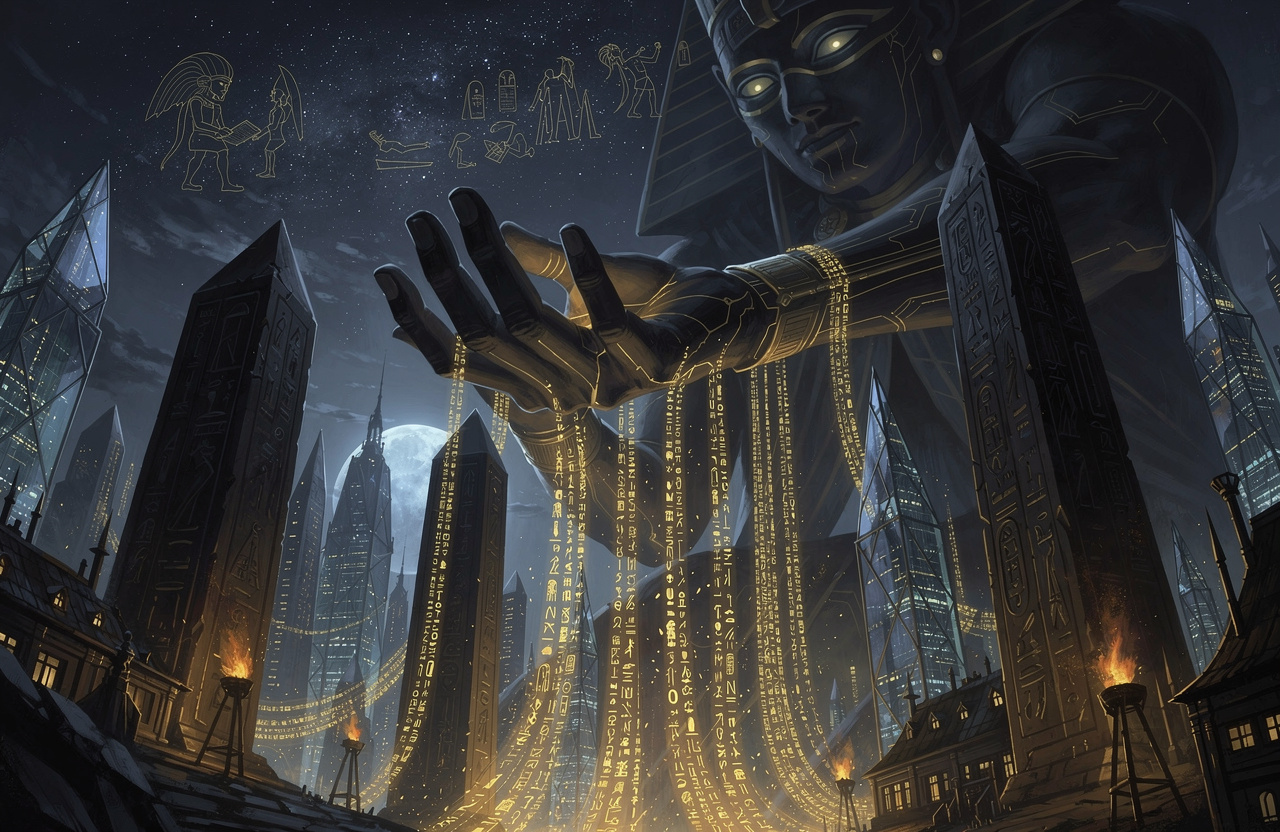
I spent twenty years looking at systems from the inside. And when I first asked myself what money actually is, I landed on something simple and unsettling: money as a "thing" hasn't existed for a long time. There is only a record. A row in someone's database. When your salary arrives, no one ships a crate of coins — the bank changes one number into another in its ledger. Money is information. And whoever controls the ledger controls the money.
The coin was more honest
The old coin was at least honest. A piece of silver is a piece of silver: you can weigh it, test it, bury it in the ground. The metal itself carried the information about its value. No one in the middle was needed: I hand you the coin, you take the coin, the exchange is closed.
Paper money was already a promise — a receipt that gold sat somewhere in a vault. Modern money is not even a promise. It is pure record inside a system you don't control and can't inspect. Around 90% of the world's money never existed as banknotes. It was born as digits on an account the moment a loan was issued, and it dies as digits when the loan is repaid.
The book this project stands on makes a precise point: blockchain is "just a way to store information, neither good nor bad in itself." Well — an ordinary bank account is also just a way to store information. The only difference is who holds the keys.
The ledger is power
In IT there's a sacred rule: whoever has admin rights to the database owns everything in it. Not the person whose name sits in the "owner" field, but the person who can rewrite that field.
Money works exactly the same. Your savings are a record in a bank's database. The bank can freeze it. The state can zero it out with inflation — that is, print new records and dilute yours. A payment network can decline your transaction, and you'll prove nothing. You think you own money. In truth you own an intermediary's promise to honor your row. For as long as it chooses to.
That is the architectural flaw. The information about your wealth is not stored with you. It is stored with the one who can edit it at any moment. In the world of code we'd call that system leaky: a single point of failure, with root access handed to a stranger.
Whoever writes to the ledger prints reality
It gets more interesting. If money is information, then creating money is just making a new record. And the right to make that record is worth more than any factory or oil field.
Central banks "print" money without printing anything: they add zeros to the ledger. Commercial banks create money out of thin air every time they issue a loan — it's called fractional reserve, but in essence it's the right to enter new sums into the shared database that did not exist before. Those standing at the ledger's keyboard get the new money first, at full value. By the time it reaches us, it is already diluted — through rising prices.
That is the silent tax no one voted for. Not a hand reaching into your wallet, but an edit to the database after which your row is worth slightly less. You did everything right — worked, saved — and the number stayed the same while the world around it grew more expensive.
Trust is the protocol
Why does this whole construct hold up at all? Because we agreed to believe in it. Money works as long as enough people accept that these records mean something. It is a pure protocol of trust — like the agreement that all nodes on a network treat a certain packet format as valid.
And here is the question an engineer asks first: who, exactly, are we trusting to store this information? Today the answer is a handful of intermediaries. Banks, payment giants, issuers. We handed them the right to keep humanity's master ledger, and then we're surprised they keep it in their own favor.
Where is the ordinary person
The ordinary person is a row he does not control. His labor, his years, his savings are compressed into a number that someone else's hands can rewrite at any moment. He is not the villain of this story, not even a player — he is a record in someone else's database. And the cruelest part: he doesn't realize he owns not money, but a promise.
Until you control the ledger your money lives in, you don't control the money either. That's not philosophy. It's an engineering fact.
The answer: the MAAT token and DAO
If money is information, and the whole problem is who holds the ledger's keys, then the solution sits right there: we need a ledger whose keys can't be confiscated and whose records can't be quietly rewritten. The technology already exists — a transparent public ledger where every movement of funds is visible to all and editable by no single hand.
The MAAT token is membership in a cooperative built on such a ledger. The treasury is run through a DAO — a decentralized organization where the treasury is transparent and every transaction is in plain sight. And here you don't vote with money: the principle is one human, one vote, not "whoever has more records decides." The old system survives because an intermediary stores the master information for you. We change the architecture: the information about money is stored by everyone and seen by everyone. The entry is simple — read the book, take the token, get your vote, and stop being a row that gets rewritten behind your back.