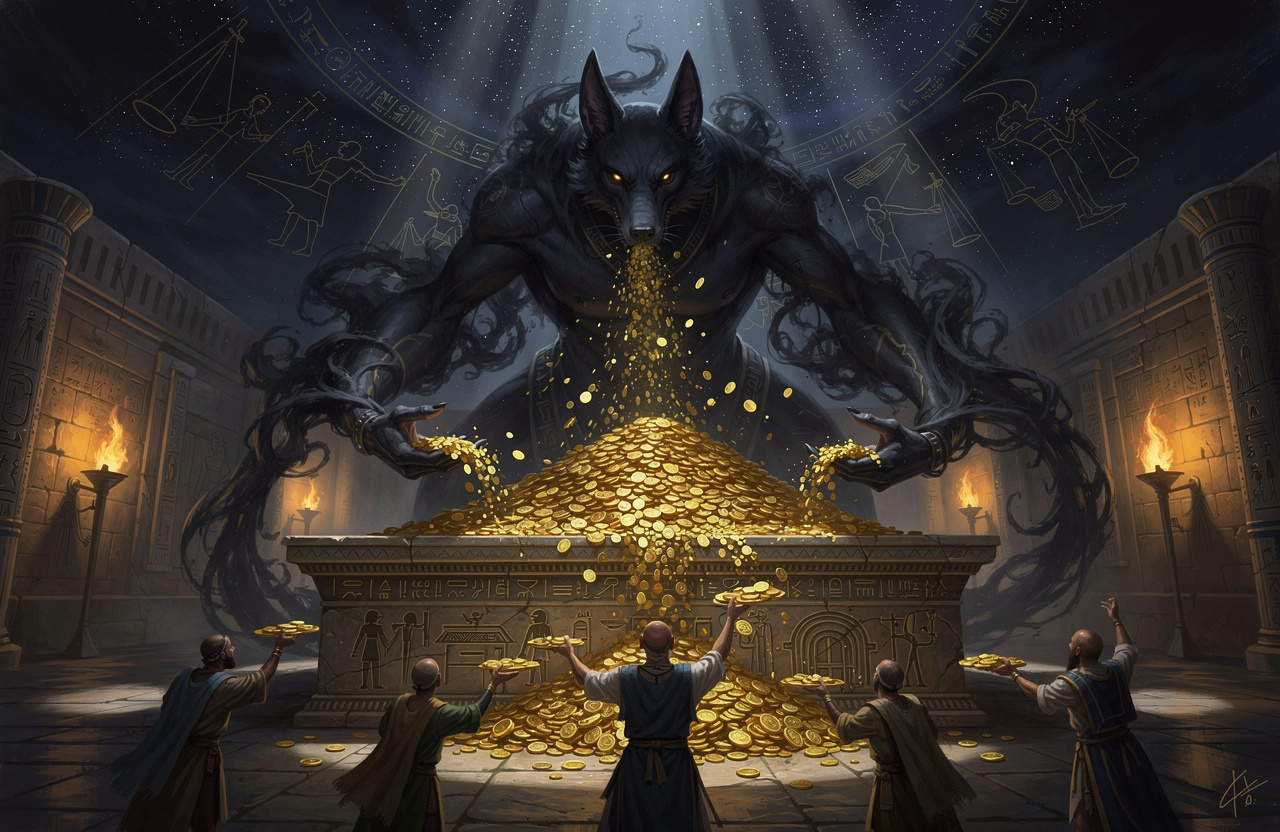
"Making money from thin air" sounds like a magic trick or an accusation. In fact it's an accurate technical description. A large fund really does earn from almost nothing — not because it has magic, but because it is wired into the financial system at the right point. Let's walk through the mechanics step by step, with no mysticism. Once you see the whole scheme, you stop being surprised that one company manages more money than the GDP of a large country.
Step 1. Other people's money as raw material
First and foremost: the fund barely risks its own money. It manages yours. Pensions, savings, insurance premiums, the money of people who set aside a little for thirty years. That's the raw material.
An engineer would put it this way: the fund doesn't own the data center, it's a tenant on someone else's servers charging for "administration." The capital is someone else's. The risk is someone else's. But the lever of control and the fee — those are its own.
Step 2. A fee on the whole mountain, not on your gains
Here's the key trick most people miss. The fund charges a fee not on the profit it earned for you, but on the total amount under management. Those are different things, and the difference is enormous.
Say the fee is just half a percent a year — sounds trivial, "pennies." But the half percent is taken from the whole mountain. The book counts it directly: half a percent a year on thirteen trillion is sixty-five billion in near-automatic profit.
Dwell on the word "automatic." The fund doesn't need to guess the market or trade brilliantly. The money is already under management — so the fee drips on its own. Market up or down, whether grandma got her pennies of growth or lost money, the half percent is deducted anyway. It's rent on the mere fact of holding other people's money.
Step 3. Passive funds — a fee with no work
It gets even more elegant. Most money today sits in so-called passive (index) funds. Their idea: don't pick stocks by hand, just buy "the whole market" by a list and hold it.
It sounds fair and cheap, and the fee really is tiny. But look at it from the fund's side: the work is near zero (buy a list, hold it), while the money under management is in the trillions, because cheap passive funds are exactly where everyone brings their money. A tiny percent of a giant mountain again yields colossal income. And it does so with almost no staff, no costs, no risk.
Step 4. Cheap money from above
Add to this access to nearly free capital. A large fund borrows at a minimal rate — it's reliable, it's systemic, after all. It invests that cheap money in assets that yield more. The difference settles in its pocket. An ordinary person takes a mortgage at 7%, the fund borrows at 2–4% — and on the same deal it is by definition in the black where you are in the red.
Step 5. Money that "left and came back"
The book describes a neighboring move at the state level, but the logic is the same. Greece, for instance, was helped to hide the size of its debt to enter the eurozone — Goldman Sachs got a $300 million fee. Then the same bank earned again on Greece's collapse, betting against it. Create the situation, take a fee on the "way in," take a profit on the "way out." The book calls it a triple profit exploit — triple profit from a single victim.
The principle is universal: you produce no value, you position yourself at the point through which someone else's stream passes, and you skim from it at every step. That is "money from thin air" — and the air is someone else's labor flowing past.
Why this is Isfet, not "business as business"
Let's name it plainly, as this tradition does. Normal exchange is when you created something and were paid for it. The farmer grew grain. The engineer built a bridge. That is Maat — a fair exchange of value for value.
But when a structure creates nothing, yet is wired into the stream and skims a percentage off the mere movement of money — that is Isfet, the inversion of exchange. Not fairy-tale "evil," but parasitism in the technical sense: latch onto a working organism and take the resource while putting nothing back. The fund builds no houses and heals no people. It holds what belongs to others and takes a cut for it. The air from which money is made is you.
Where is the ordinary person in this
You are that stream. Your pension, your salary, your savings pass through the fund, and at every meter of the way a cut drips off. You pay for "access to markets," but you're paying for the privilege of having your control taken away and a fee charged. You are the raw material in a mechanism sold to you as a service.
The answer: the MAAT token and DAO
If the fund makes money from thin air because it stood between you and your own money and charges a fee for the intermediation, the answer is obvious: remove the intermediary and rebuild the mechanism — transparently, and in your favor.
That is MAAT. The MAAT token is membership in a cooperative where people pool their strength directly, with no Fink in the middle quietly skimming his percent. Here the principle is one human, one vote, not "whoever has more money under management decides." Governance runs through a DAO — a decentralized organization with a transparent treasury where every movement of funds is visible to all. No one skims a fee from thin air on the quiet: everything is in plain view by default.
The funds are counting on you never figuring out the mechanics and continuing to pay for having your control taken away. MAAT bets the opposite: understand the scheme and rebuild it in your favor. The entry is simple: read the book, take the token, get your vote — and stop being the thin air from which others make money.