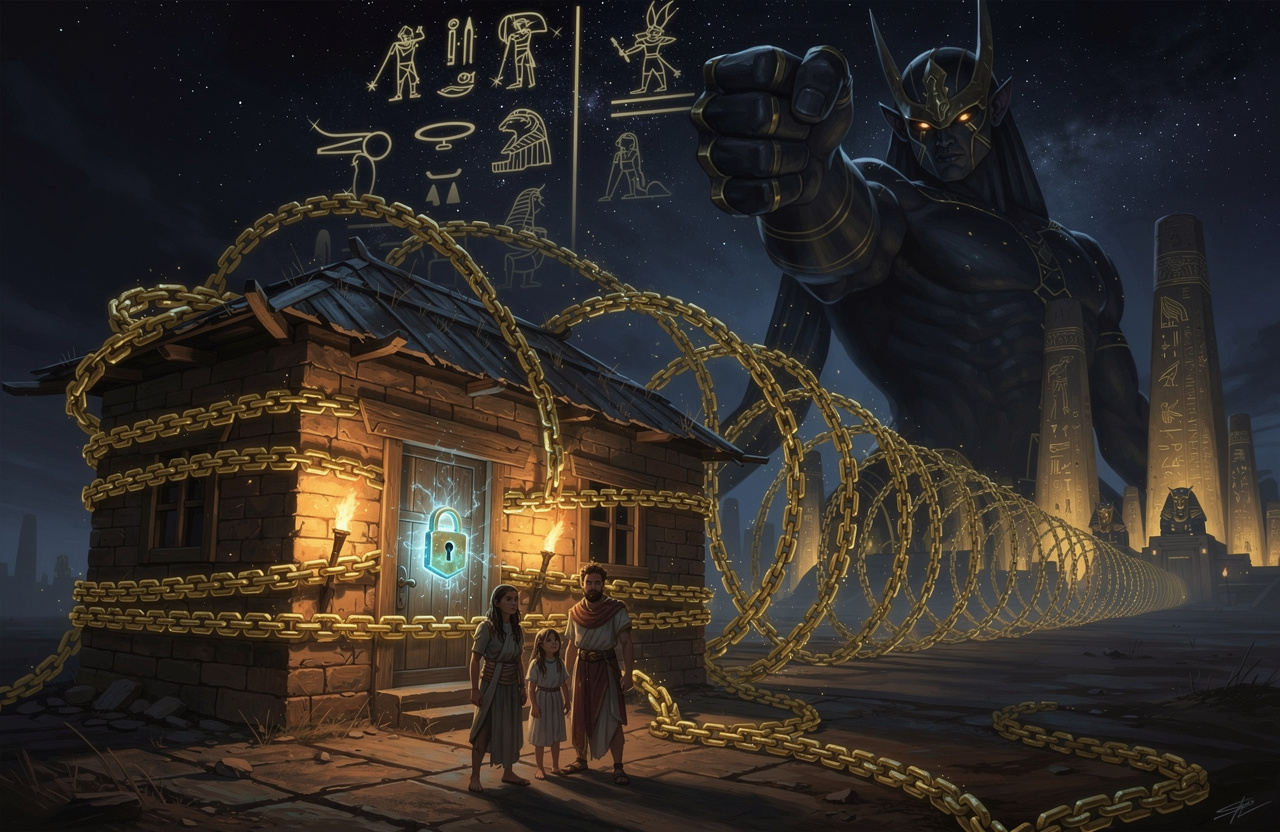
In the popular imagination the word "mortgage" glows warm: your own home, a nest, finally "working for myself, not for someone else." It is the most expensive illusion in most people's lives. Because for the first years — often the first decades — of the mortgage term, you aren't paying for walls. You're paying for interest. And legally, until the final payment, the house belongs not to you but to the bank. You live in a house that isn't yours, and you work thirty years so that someday, maybe, it will become yours. Let's read this contract honestly.
First you pay only for air
Here's a detail mortgage calculators hide, and wrongly — it's the key one. A mortgage payment splits into two parts: principal (for the house itself) and interest (for the use of the money). And the payment schedule is structured so that at the start of the term almost your entire payment is interest, not principal.
The first years you are effectively paying the bank rent on money, while "buying back" the house in tiny crumbs. Only around year ten or fifteen does the principal share become meaningful. Which means a simple thing: if you sell the house after five to seven years (and life often forces it), you'll find you've bought back almost nothing — all those years you fed the interest. You paid for the illusion of progress toward ownership while standing nearly still.
The arithmetic that chills you
Take an example straight from our book. An apartment in Novosibirsk for seven million rubles. The rate — from Russian reality in 2024–2026: sixteen, eighteen, twenty-four percent a year. Add up the mortgage overpayment over twenty years and you get about fifteen million on top.
That is, for an apartment worth seven million, the person pays out more than twenty million. They pay for it more than three times over. Two-thirds of your labor goes not for walls, not to the builder, not for concrete — but as interest to whoever created that money with two lines in a database.
Compare around the world. In the US a mortgage runs six to seven percent. In Germany or the Czech Republic — three to four. In Russia — sixteen to twenty-four. It's not that "our banks are worse." Banks everywhere work the same way: borrow money at one rate, lend at a higher one. The difference is in the price of the money itself, and that traces upward along the chain — to the Fed's rate, to the cost of dollar funding, which doesn't break even under sanctions, it just becomes less visible.
Why you have no choice
It's important not to slide into the moralizing of "don't take a mortgage." That would be a mockery. Our book says it plainly and honestly: the person who takes a loan is not to blame.
Housing costs more than you can earn and save in any reasonable time. Without a loan, no home. Without a home, no family, no stability, no foothold. The system is engineered so there is no choice: real-estate prices and credit availability inflate together, like two wheels of one machine, and the person is caught between them. That's not a bug. It's the feature — to herd you into a thirty-year contract through which the energy of your labor will flow upward for decades.
Fact versus myth
Let's draw the line honestly.
Myth: "a mortgage is always worth it, since real estate appreciates and rent is money thrown away."
Fact: sometimes worth it, sometimes not — it depends on the rate, the term, and the city. But at a twenty-percent rate the "real estate appreciates" argument almost always loses: paying three times over eats any price growth. The myth exists precisely so you'll feel rather than calculate — that "saving is foolish, you've got to buy." The feeling profits the bank; the calculation profits you.
And one more distinction. A house is a real, needed thing; there's no Isfet in that. The Isfet is in the structure of the contract: in the fact that an intermediary is wedged between you and the roof over your head — one who created money from nothing and takes your labor threefold for it. The ancients would say the weight on the scale was swapped. The house is honest; the scale is crooked.
Where is the ordinary person in this
You are the one who carries the debt for thirty years, often without realizing that most of it is interest, not walls. Your mortgage is one of six or seven channels through which the energy of your labor leaks upward: along the chain of rates, Fed to central bank to your bank. You pay, you dread the late notice, you fear losing your job — while somewhere up top that anxiety and those payments are booked as a stable cash flow. Alone you cannot stand against this machine.
The answer: the MAAT token and DAO
A mortgage strangles precisely because a private intermediary with the right to create money is wedged between the person and the home, and you stand before it alone. So the answer is to gather into a system where capital is shared and transparent and works for its members instead of milking them for thirty years.
That is MAAT. The MAAT token is membership and a vote in a cooperative with an open treasury run by a decentralized DAO: every movement of funds is visible to all, no intermediary creates money from nothing only to charge you interest on its own invention. And crucially, the principle here is "one human, one vote," not "whoever has more money sets the rate."
Thirty years for the illusion of ownership is no law of nature; it's a construction that profits the holder of the record. We build a different construction, where shared capital helps people instead of turning a roof over your head into a lifelong tribute. The entry is simple: read the book, take the token, get your vote — and stop spending thirty years buying back from a bank the right to live under your own roof.