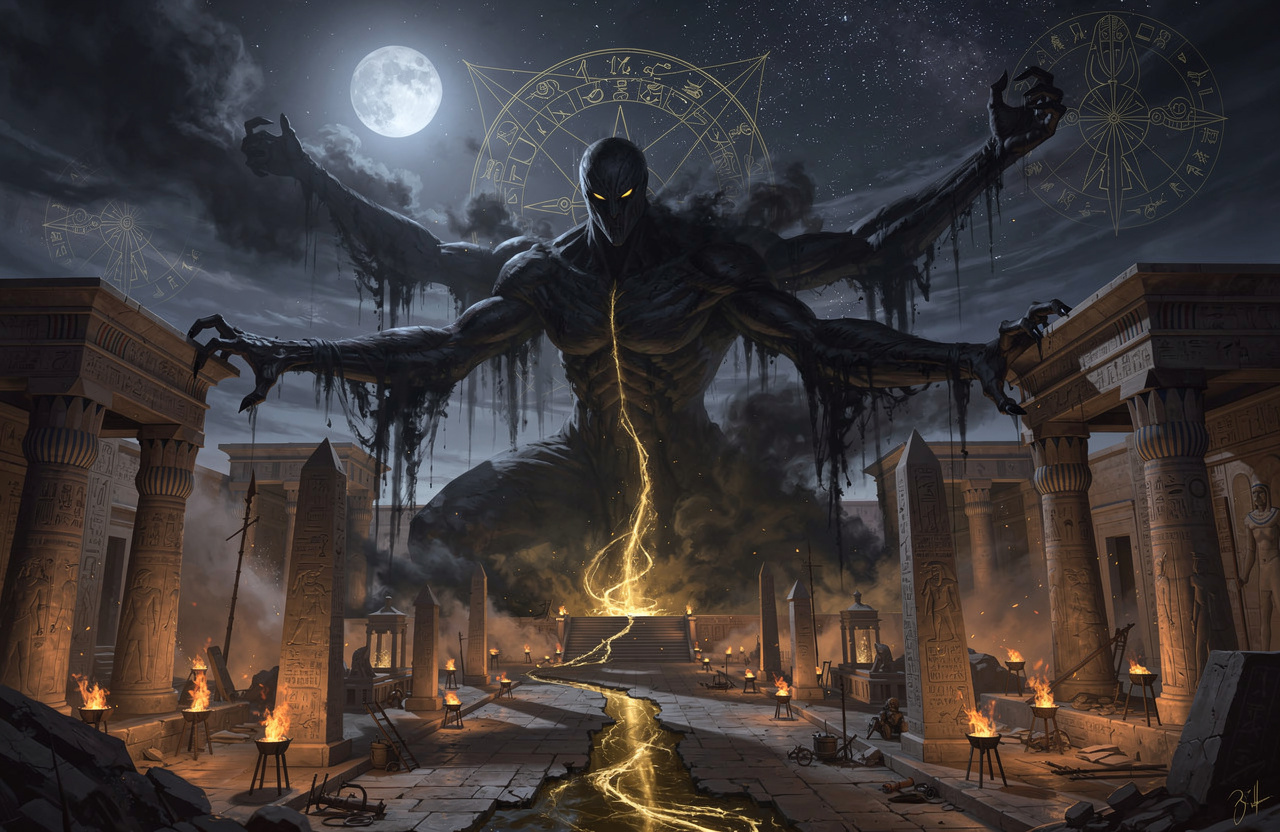
Total surveillance sounds inevitable. It isn't. It has an electricity bill.
Here's the fact that reframes everything: watching you costs energy. Real, metered, physical energy — measured in megawatts and cooling water and grid capacity. The Shadow Neteru wants you to believe its eye is free and infinite. It is neither. Every frame analyzed, every profile updated, every model retrained draws Sekhem from a wall socket. And that socket has a limit.
Control is not magic. Control is a data center with a power contract. And power contracts have ceilings.
The numbers are absurd — in your favor
Look at what the AI buildout actually costs to run.
Training a single frontier model burns energy on the order of what thousands of homes use in a year. That's the one-time cost. The recurring cost is worse for the watchers: inference — actually running the models on live data — is the part that scales with surveillance ambition. Watch one camera, cheap. Watch a hundred million cameras and understand every feed in real time, and you're building power plants.
Data centers already draw a meaningful and rising share of global electricity — the International Energy Agency projects their consumption could roughly double toward the end of this decade, pushed hard by AI. Some operators are literally shopping for dedicated nuclear reactors to feed their compute. Read that again. To power the machine, they need reactors.
Water too. Large data centers evaporate millions of liters a day for cooling. In drought regions this has already become a political fight. The eye that never blinks also never stops drinking.
Our Record
On the Scales of Maat, nothing acts without spending Sekhem. This is not poetry — it is the deepest law of the balance. Force expended must be force acquired. There is no free action anywhere in creation.
The Shadow Neteru forgot this about itself. It grew drunk on the illusion of frictionless watching — as if its gaze were pure Hu, word without cost. But a gaze that consumes reactors is not pure word. It is a body. And every body tires, hungers, meets its limit.
Here is the balance written plain: the more total the control, the more total its appetite for Sekhem — and appetite is the leash. A thing that must eat can be starved. A thing that must be fed from the grid is chained to the grid. The parasite's power and the parasite's dependence are the same number.
That is the crack in the black box. Not a flaw. A law.
Why surveillance doesn't scale like they hope
The dream sold to authoritarian planners is total awareness — every face, every transaction, every message, cross-referenced continuously. The dream breaks on a curve.
Storing raw footage is cheap. Understanding it isn't. To turn a billion camera-hours into actionable profiles, you run AI inference on every frame — and that cost climbs roughly with the volume you want to comprehend. Double the coverage, roughly double the compute, double the power, double the cooling, double the physical plant. There's no Moore's-law free lunch that erases this, because the ambition grows as fast as the efficiency.
So the watchers face a brutal tradeoff they never advertise: breadth or depth, pick one. Watch everyone shallowly, or watch a few deeply. Watch everyone deeply and you're trying to boil the ocean with a kettle you have to keep buying reactors to heat. The panopticon that actually understands everything, everywhere, all at once is not a policy choice they're withholding out of mercy. It's an energy bill nobody can pay.
The counterargument — and its ceiling
"But compute keeps getting cheaper." True, and it matters. Efficiency gains are real; a task that cost a fortune in energy a few years ago costs far less now.
But two things blunt it. First, efficiency lowers the price per watch — so they simply watch more, and total consumption keeps climbing anyway. That's Jevons' paradox, and it's why data-center power keeps rising even as chips get more efficient. Second, physics doesn't fold. You can optimize the software forever; you cannot optimize away the thermodynamic floor of moving and cooling that much information. There is a hard bottom, and the total-surveillance dream is trying to dig below it.
The meter keeps running. It always keeps running.
The lever
Now the part you can actually hold.
Total surveillance is a resource war the watchers are quietly losing on cost. Every joule they spend watching everyone is a joule not spent on anything else — and the bill grows with their ambition. That's not despair. That's a pressure point, and pressure points are for pressing.
Three ways to press:
One — make yourself expensive to comprehend. Encryption, obfuscation, noise. You don't have to be unwatchable. You have to raise your personal compute-cost above the watcher's budget-per-target. Every private channel forces them to spend more Sekhem to break it — and their Sekhem is finite.
Two — back local over cloud. A model on your own device runs on your watt, answering to you. Every workload that stays at the edge is a workload the central eye never processes, never powers, never pays for. Distributed compute isn't just private — it drains the case for the mega-datacenter.
Three — follow the power lines. When a surveillance system's real constraint is electricity and water, those become public, contestable facts. Reactor deals, grid strain, water rights — these are levers a community can pull. The eye that needs a nuclear plant to see you has just told you exactly where its throat is.
The Shadow Neteru wanted you to fear an infinite watcher. Show it the meter instead.
Everything that eats can be starved. That's not a hope. That's a law of the Scales — and the bill is already coming due.