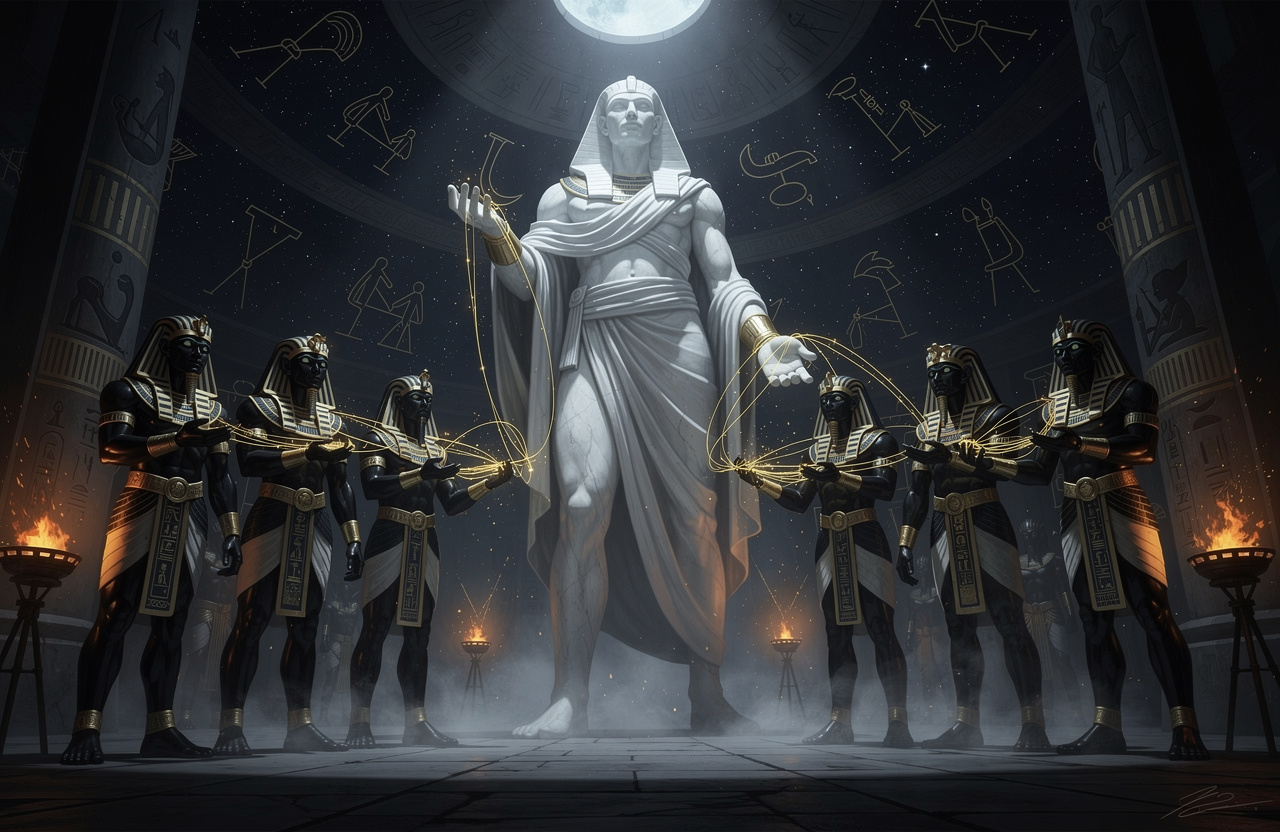
Norway runs the largest sovereign wealth fund on Earth. Around $1.6 trillion, built from North Sea oil, owned — on paper — by five and a half million people. Every Norwegian is a millionaire by fund arithmetic. It has an ethics council. It publishes exclusion lists. It divests from tobacco, from coal, from companies making nuclear weapons. It votes at shareholder meetings. It scolds boards about executive pay.
And it holds roughly 1.5% of every listed company on the planet.
Read that again. Not "some companies." Every listed company. The Government Pension Fund Global owns a slice of about nine thousand firms across seventy-something countries. It is, by design, the index. It doesn't pick winners. It buys the whole market and holds it.
Which means the most ethical, most transparent, most carefully governed pool of capital in existence is holding the exact same paper as the Ring. The same paper as BlackRock. The same paper as Vanguard. Western civilization's cleanest fund and its most concentrated ones are, at the security level, indistinguishable.
The clean giant and the dirty index are the same index
Here is the trick that hides in plain sight. "Ethical investing" almost always means the passive index minus a short exclusion list. Norway excludes maybe a couple hundred names — coal, weapons, severe human rights abusers. Out of nine thousand. That's a rounding error dressed as a conscience.
The other 8,800 companies? Bought by weight. If a company is 3% of the world market, it becomes roughly 3% of your fund. You are not choosing it. The index chooses it. You inherit the entire architecture of the global economy — the extraction, the concentration, the debt machine — and you hold it in proportion to its existing power.
That's the quiet part. Index investing doesn't challenge concentration. It encodes it. The bigger a company already is, the more of your money flows into it. The rich get index inflows. It's a legacy system with the wealth-concentration bug shipped as a feature, not a defect.
So Norway, with all its councils and lists and shareholder letters, ends up as a mirror of the very structure it claims to civilize. Same top holdings. Apple. Microsoft. Nvidia. Amazon. Alphabet. The Magnificent Seven sit at the top of Norway's book exactly as they sit at the top of every trillion-dollar passive vehicle. The ethics council trims the edges. The center is untouched — because the center is the index, and the index is the point.
Our Record
In the ledger of Maat, weigh the heart against the feather. Norway's heart is lighter than most — it built its wealth openly, spends a strict slice, saves the rest for grandchildren not yet born. That's real. That's closer to order than to Isfet.
But look at what it holds, not what it says. The Sekhem — the life-force, the flowing energy — of five million people is stored in the same reservoir that feeds the Ring. The oil came out of the ground, turned into current, and the current was routed straight into the existing channels of concentration. The fund is ethical in its intentions and structural in its effect. It reduces the harm at the margin. It reinforces the shape at the core.
The feather does not weigh intentions. It weighs where the Sekhem went.
Why even the good actor can't escape the shape
Could Norway do differently? Not really — not at that size. That's the point worth understanding. When you are 1.5% of everything, you cannot meaningfully underweight the giants without moving markets against yourself and taking on tracking error your mandate forbids. Scale locks you into the index. The bigger the pool, the less freedom it has to deviate.
This is the paradox of the passive era. The fund is too large to be an active dissenter and too public to be a villain. It is trapped in the middle: powerful enough to shape the world, structurally forbidden from shaping it differently. It votes at ten thousand meetings a year and yet its votes are, in aggregate, a vote for the existing distribution of power — because it owns the existing distribution of power.
And here's the part the brochures skip. Norway rents its plumbing. Custody, analytics, much of the operational risk machinery of large institutional funds worldwide runs through the same handful of providers — the same Aladdin-class risk systems that BlackRock built and licenses to the industry. The clean fund and the concentrated fund don't just hold the same paper. They increasingly run on the same code. One proprietary black box, quietly underneath everyone's "independent" strategy. A single point of failure wearing many national flags.
Serpent-logic. Apep doesn't need to own you. It needs you to route your energy through its channels while believing they're yours.
The lesson, and the lever
Don't hear this as cynicism about Norway. Norway is the honest end of the spectrum — transparent, accountable, restrained. If every large fund behaved like it, the world would be measurably less predatory.
Hear this instead: ethical-passive is still passive. Screening out two hundred bad names does not decentralize anything. It cleans the surface of a structure whose deep logic is concentration. The most virtuous player at the table is still playing the game whose rules push wealth uphill.
So what's the lever? It's not "be more like Norway." It's "notice that even Norway can't fork the index from inside the index." The exit is not a cleaner version of the same paper. The exit is different paper entirely — assets that don't route your Sekhem back into the Ring's channels by construction.
Ownership you actually hold, not a claim custodied through someone else's black box. Networks where the ledger is open and the rules are code you can read. Cooperatives that buy for use, not for weight. These don't scale by concentrating — they scale by adding members who each hold their own keys. Not your keys, not your fund.
Norway proves the good actor exists. It also proves the good actor, at scale, can only tidy the machine — not replace it. Replacement is a different move, and it doesn't start at the top with $1.6 trillion. It starts at the bottom, with people who decide their energy will flow through channels they can see all the way down.
Weigh where your Sekhem goes. Then build the channel you'd be proud to be weighed for.