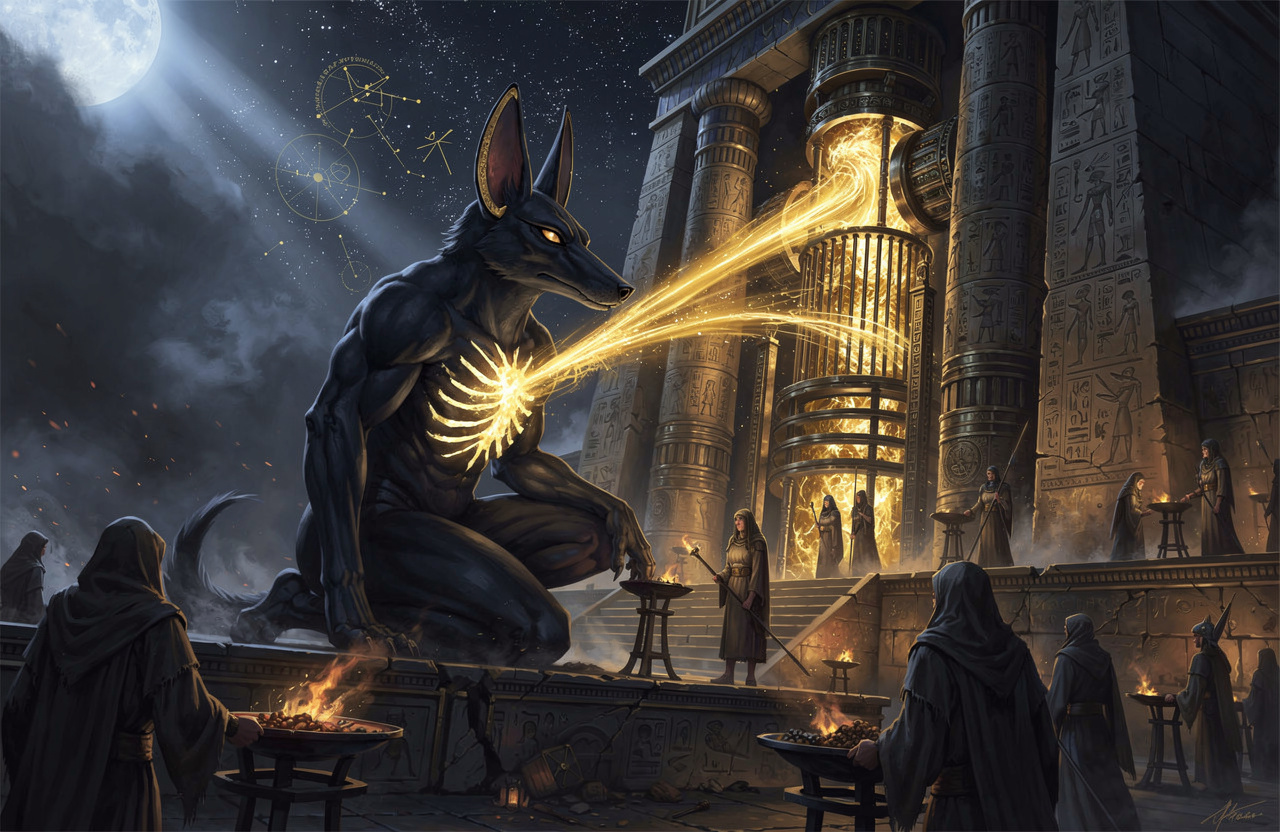
In 1979, the Three Mile Island nuclear plant became the most famous industrial accident in America — the word "meltdown" entered the language there. In 2024, Microsoft signed a deal to restart a reactor at that same site, on a twenty-year power contract, to feed its artificial intelligence.
Let that land. The most infamous nuclear name in the United States is being brought back from the dead — not by a utility, not by a government, but by a software company, to power machines that think.
This is not a stray headline. It is the shape of the entire coming decade. The giants of AI have realized something the public hasn't fully caught: the bottleneck of machine intelligence is no longer chips, or data, or even talent. It is electricity. And so they are moving, quietly and fast, to own the power itself.
The Body of the God Must Eat
Every living thing in the old cosmology had Sekhem — vital force, the energy that let a body act. A statue could have a perfect form and be dead, because Sekhem did not flow through it. Life was never the shape. Life was the current in the shape.
The machine mind is the same. A data center full of the finest chips is inert metal until the current flows. And the current it demands is staggering. A single large AI data center can draw as much power as a small city — hundreds of megawatts, some approaching a gigawatt, which is roughly the output of an entire nuclear reactor. The projected build-out over the coming years is measured not in more power plants but in fleets of them. The mind of the new age is, above all else, a mouth. And it is hungry in a way nothing in industrial history has ever been.
So watch where the giants go. They are not just buying chips anymore. They are buying reactors.
Reactors, Rivers, and Whole Grids
Microsoft's Three Mile Island deal is the famous one, but it is not alone. Across the industry, the AI giants are signing long contracts for nuclear power, funding next-generation small modular reactors, and racing to lock up every reliable, carbon-light, always-on source of electricity they can find. Nuclear is prized because AI data centers cannot flicker — they need power that runs at full tilt, day and night, forever. Wind and sun blink. A reactor does not.
Think about what this means. The corporations that already own the machine mind — the clouds, the models, the chips — are now moving to own the energy that animates it. Vertical integration all the way down to the atom. They will own the thought, the machine that thinks it, and the fire that powers the machine. Sekhem itself is being enclosed.
And the fire has to come from somewhere. When a handful of trillion-dollar companies start buying up firm power at this scale, they are competing with cities, hospitals, and homes for the same grid. In some regions, data-center demand is already straining the local supply and pushing up prices for everyone else on the wire. The god eats first. You get what's left.
Our Record
Our record: in the old order, whoever controlled the source of life-force controlled everything downstream of it — the Nile's flood, the granary, the fire. The Shadow Neteru understands this in its bones. It is not enough to own the mind of the machine; you must own its Sekhem, or someone else can starve it. So the enclosure moves down the stack, from software to silicon to the power plant itself. When a company owns the reactor that feeds its AI, that AI can never be switched off by anyone else. It has become sovereign — a body with its own captive sun. Isfet does not just want to think for you. It wants to own the fire, so that even the light in the room is rented.
Why This Is a Control Move, Not Just an Engineering One
It is tempting to read all this as neutral. Machines need power; companies buy power; the end. But look again, and you will see a control layer being built in plain sight.
Energy is the deepest infrastructure there is. Whoever owns firm, always-on power at civilizational scale owns a form of sovereignty older than any nation. When the same three or four companies that own the clouds and the models also own the reactors, the concentration stops being about "tech" and becomes about the literal physical basis of modern life. A company that controls both the mind of the machine and the fire that feeds it is not a vendor. It is closer to a utility, a state, and a temple fused into one — a thing that owns your thinking-tools and the power in your wall.
And there is a quieter danger. Power infrastructure invites permanent capture. A twenty-year contract on a reactor is a twenty-year fact on the ground. Once the AI giants own the energy layer, the barrier to competing with them isn't just money for chips — it's the ability to secure a nuclear reactor. That is a moat almost no one can cross. Concentration at the level of energy is the deepest, stickiest concentration of all.
The Lever
Do not read this as doom. Read it as a map that points, for once, toward something you can actually touch.
Here is the turn: energy is the one layer where decentralization is already winning in the physical world. Rooftop solar, home batteries, community microgrids, and small-scale generation are spreading precisely because they let people and towns own their own Sekhem instead of renting it from a giant. The same logic that says "run an open AI model on hardware you own" says "generate power you control." The counter-move to enclosed energy is distributed energy.
And notice the deeper opening. If the AI giants have declared that energy is the real prize, then they have told you exactly where the leverage is. Power that a community owns cannot be captured by a distant boardroom. A grid built from ten thousand small sources has no single valve to seize. The very thing that makes centralized reactors a control layer — their scale, their scarcity, their singularity — is inverted the moment power becomes something ordinary people generate and hold.
Your move is not to buy a reactor. Your move is to see energy for what it now is — the deepest layer of the fight — and to back the distributed alternative wherever it appears. Own your compute. Own, where you can, your power. Refuse the world where even the fire is rented by the token.
Name the enclosure. See the god reaching for the fire. Then remember: the sun was never the property of the temple. It only felt that way while the priests owned the only fire in town.