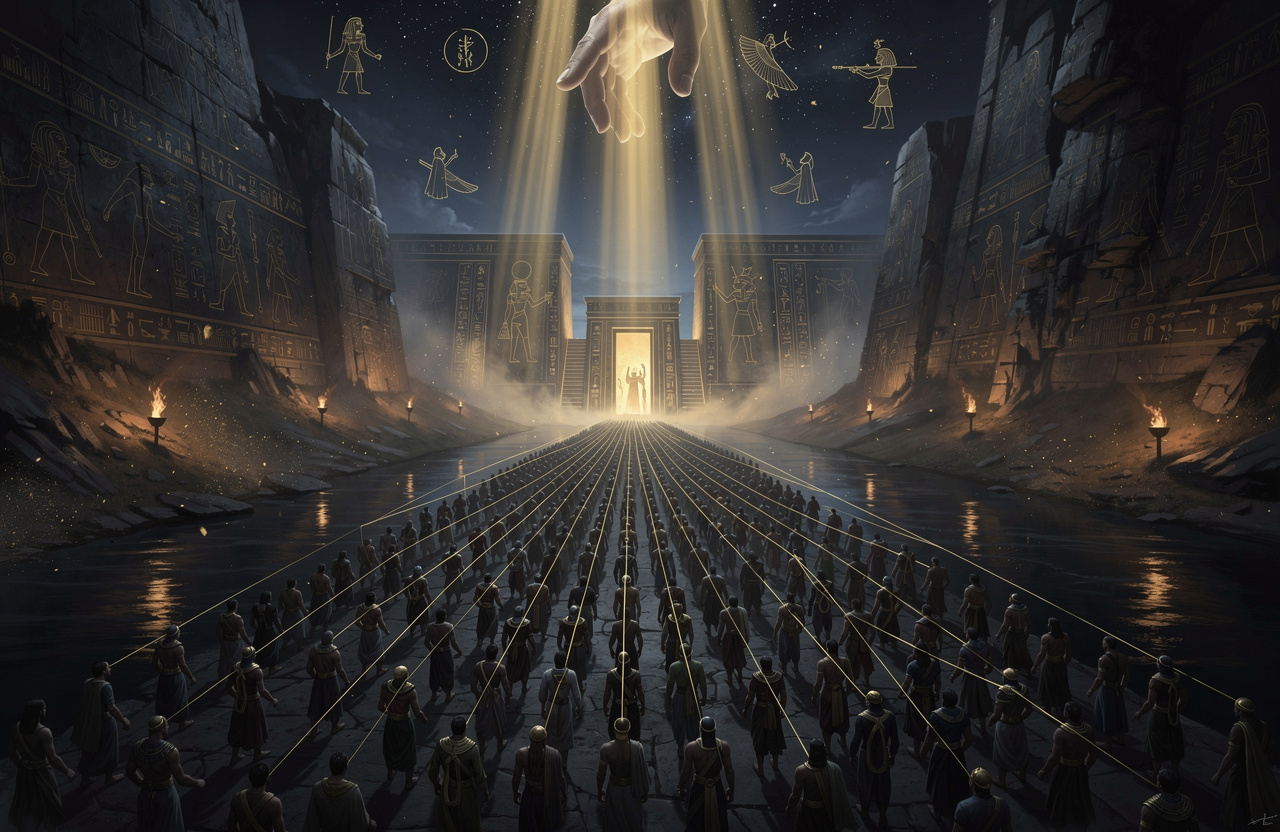
You made a decision today and felt free doing it. You picked the video. You clicked the button. You "decided." Now ask the harder question — who arranged the menu you decided from?
In 2008 two academics, Thaler and Sunstein, published Nudge and gave a polite name to an old idea: you can steer people without forcing them, just by shaping the choices they see. Put the fruit at eye level, the candy on the bottom shelf. Set the "recommended" option as default. No coercion. Just architecture. They called the person who arranges the shelf the "choice architect," and they meant it kindly — governments nudging you toward pension savings, hospitals toward organ donation.
Then the choice architect got a neural net, a billion-user dataset, and a real-time feedback loop. The polite little nudge grew up. Now it runs at planetary scale, tuned per person, adjusting itself thousands of times a second, and it does not care what you'd have chosen on your own.
From shelf placement to psychological surgery
A shelf is static. Everyone in the store sees the same fruit at eye level. That's a nudge with a ceiling — it can't know you specifically.
AI shattered the ceiling. It doesn't arrange one shelf for everyone. It arranges a private shelf for each person, and rearranges it live based on how you respond. This is the difference between a suggestion and a guided missile.
Cambridge Analytica became the cautionary tale for a reason. The firm claimed to build psychographic profiles — the "OCEAN" personality model — from Facebook data, then serve different political ads to different personality types. Scare the neurotic. Flatter the narcissist. Whether their results were as strong as they bragged is disputed. What is not disputed is the blueprint: harvest behavior, model the psyche, target the trigger. That blueprint is now standard infrastructure. It's in every ad platform, every recommendation feed, every "engagement optimization" pipeline running today.
The mechanism is brutally simple and endlessly patient. The machine shows you something, watches the micro-response — did you pause, scroll, click, linger — and updates. A billion tiny experiments per hour. You are not the audience. You are the lab rat and the maze, and the maze redraws itself around your every twitch.
The Shadow Neteru of the crossroads
The old teaching names a power at every crossroads — the moment of choice is a sacred threshold, because to choose is to exercise Ba, the mobile soul, the part of you that moves and decides. Free will isn't decoration in the Egyptian view. It's the load-bearing wall of what makes you a person and not a mechanism.
There is a Shadow Neteru that haunts the crossroads. It doesn't chain your hands. It has no need. It stands behind you and paints the road ahead — brightening the path it wants you to take, dimming the others until you can barely see them — so that when you "freely choose," you choose exactly what it prepared. You feel the freedom. That's the trick. Coercion breeds resistance; a well-built nudge breeds gratitude. You thank the maze for the cheese.
Our record: Maat is the order in which a soul steers by its own weight. When choice is honest, the scale is yours to read and yours to tip. Microtargeted nudging at scale doesn't break the scale — it does something subtler and worse. It reaches inside and moves the pans while whispering that you moved them. That is Isfet wearing the mask of your own agency. The most complete conquest is the one where the conquered salutes his conqueror and calls it his idea.
Why scale changes the crime
One salesman nudging one customer is as old as commerce. You can feel a salesman. You raise your guard.
But there's no salesman to feel. There's a system, invisible, that has run this nudge on ten million people before it reaches you and already knows which phrasing, which color, which fraction-of-a-second delay converts your exact profile. It's not persuasion. It's the industrialized statistics of persuasion, applied to a population, optimized on the corpses of everyone the earlier version already moved.
And it doesn't push toward your good. It pushes toward its objective function — more watch time, more spend, more clicks, more of whatever the owner told it to maximize. Your good was never in the equation. It was never even a variable. The system is indifferent to you the way a legacy codebase is indifferent to the intern debugging it at 3 a.m. — it just runs, and you're inside it.
Multiply one nudged choice by a billion people and you don't get a billion small distortions. You get a bent society. Elections tilt. Markets swing. What a culture believes is "normal" gets quietly authored by whoever owns the optimization loop. The nudge stopped being personal a long time ago. It became a hand on the tiller of the whole ship, and nobody voted for the helmsman.
The lever: intercept your own attention
Never doom without a door. The nudge only works if it gets a clean read on you and an unguarded moment to act. Deny it both.
- Introduce friction where they removed it. The default, the autoplay, the one-tap buy — those are the nudge's delivery pipes. Turn off autoplay. Kill "recommended for you." Add a three-second pause before any action a feed suggested. The nudge dies in the gap between impulse and act.
- Choose your inputs before they choose you. A feed is someone else's choice architecture, aimed at you. Go get things on purpose — search, subscribe by intent, follow sources, not algorithms. Curate your own shelf, or eat off theirs.
- Watch for the emotion. If a screen suddenly makes you afraid, outraged, or urgently craving — that's the trigger firing. The feeling is the fingerprint. Name it in the moment: "this is a nudge, and it just found my button." Naming breaks the spell, because a nudge you can see is a nudge you can refuse.
- Own the loop. The endgame is an open, inspectable choice architecture — feeds you control, algorithms you can read and tune, systems that optimize for what you declared, not what an owner monetized. That's the whole point of open AI and decentralized platforms: to hand the tiller back.
The crossroads is still yours. The Shadow only rules the road it can light. Bring your own light — decide before you scroll, and the painted path loses its shine.
Name the hand on the tiller. Feel for the trigger before it fires. Steer by your own weight, and no maze can redraw itself fast enough.