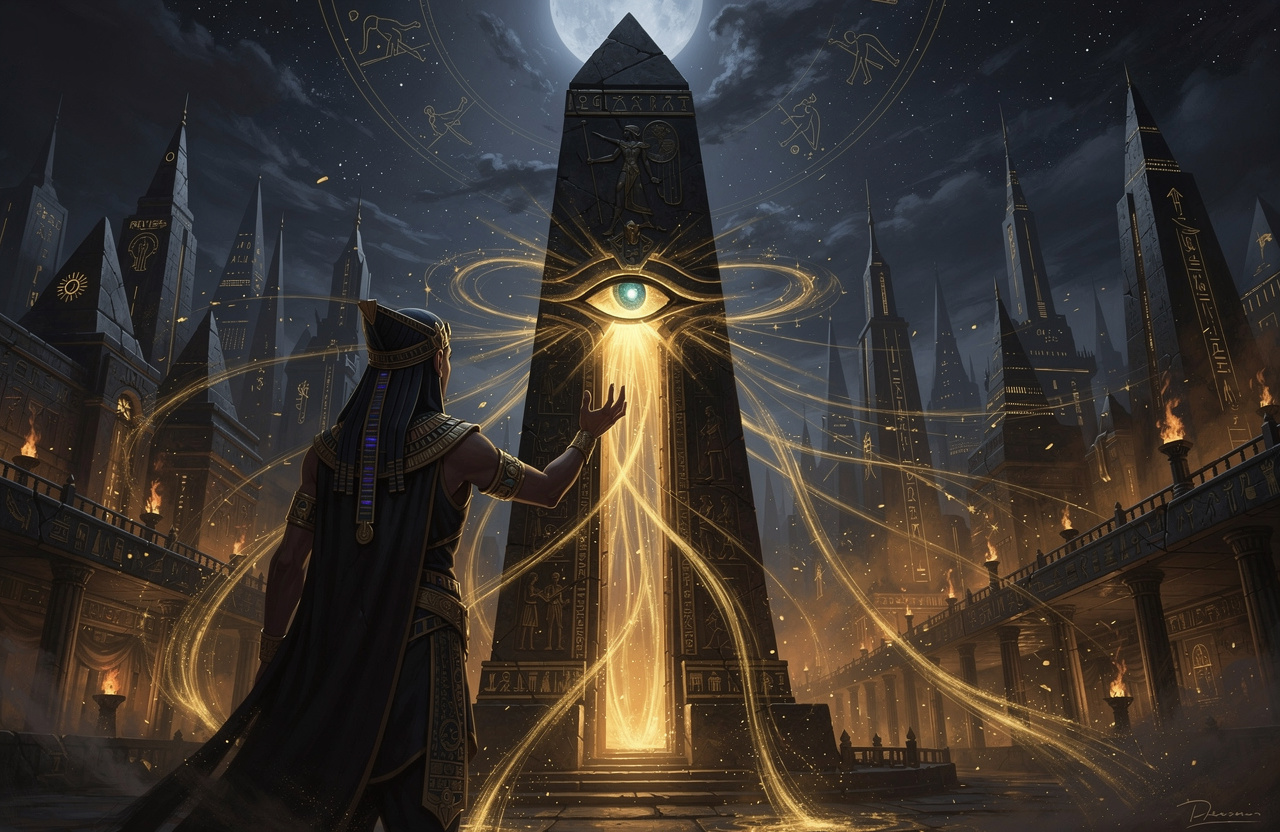
Every thought a machine has today passes through one company's silicon.
Not most thoughts. Not the important ones. Nearly all of them. When you talk to a chatbot, when a bank scores your loan, when a government agency runs facial recognition against a crowd — the math underneath runs on a chip designed by NVIDIA. The company holds somewhere north of 80% of the market for AI accelerators. In the data-center segment that actually trains and runs the large models, its share is even higher — closer to a near-monopoly.
Stop and feel the weight of that. The mind of the new age is being poured, and there is one foundry for the mold.
The Ka of the Machine
In the old language, the Ka was the vital double — the life-force that made a thing move. A statue without Ka was stone. A body without Ka was a corpse. The Egyptians understood that form is nothing without the animating current beneath it.
An AI model is form. Weights, parameters, architecture — beautiful, useless, inert. What animates it is compute. Raw parallel arithmetic, billions of operations per second, the electric current that turns a dead matrix into something that answers you. That current has a gatekeeper. Its name is NVIDIA, and it stamps its Ka onto the silicon with a proprietary language called CUDA.
CUDA is the real moat. Not the transistors — the software layer that every AI researcher on Earth learned to speak. Two decades of tooling, libraries, tutorials, muscle memory. A competitor can build a faster chip and still lose, because the entire priesthood of machine learning was trained to pray in NVIDIA's tongue. This is Heka — the creating word — turned into a corporate asset. Whoever owns the language owns the spell.
One Foundry, One Machine, One Island
Now go deeper, because it gets narrower.
NVIDIA designs chips. It does not make them. The physical wafers are etched by TSMC — Taiwan Semiconductor Manufacturing Company — on a single island the size of a modern nation-state's anxiety. The most advanced AI chips on the planet, the ones everyone fights over, are fabricated in a handful of buildings in Taiwan. One earthquake, one blockade, one bad afternoon of geopolitics, and the supply of the world's thinking-power seizes.
Go narrower still. TSMC cannot etch those chips without machines from one Dutch company: ASML. The extreme-ultraviolet lithography machine — EUV — is the only tool on Earth capable of printing circuits at the bleeding edge. ASML is the sole manufacturer. Not the leading one. The only one. Each machine costs a few hundred million dollars, contains hundreds of thousands of parts, and takes a fleet of aircraft to ship.
Read the chain again, slowly:
- ASML — one company, Netherlands — makes the only machines that can print the chips.
- TSMC — one company, Taiwan — runs those machines to fabricate the chips.
- NVIDIA — one company, USA — designs the chips and owns the language they speak.
Three needles. The entire future of artificial intelligence threads through three needles, in three countries, controlled by three boardrooms. This is not a market. This is a single point of failure wearing the costume of an industry.
Our Record
Our record: the Shadow Neteru does not always build a cage. Sometimes it finds one already forming and simply sits down on the throne inside it. Compute is Sekhem — force, capacity, the power to make things happen — and Sekhem has been funnelled into a corridor so narrow that three actors can pinch it shut. Isfet does not need to conquer the flow of the world's mind. It only needs to own the three valves. A river with three dams is not a river. It is a permission.
Why This Is the Real Control Layer
People argue about which AI company will "win." Which lab, which model, which app. Wrong altitude. Lift your head from the leaderboard.
The app doesn't matter if it can't get chips. The lab doesn't matter if it can't get compute. And access to compute is now a lever that a small number of hands can pull. When a government wants to slow a rival nation's AI, it doesn't hack the models — it restricts chip exports. That already happened: entire classes of NVIDIA's best accelerators were export-controlled overnight by a single policy decision. One memo, and a nation's access to machine intelligence gets throttled at the source.
That is what a chokepoint is. Not a company you dislike — a place in the pipe so narrow that whoever stands there controls everything downstream. The whole loud circus of "AI progress" runs on a substrate owned by three companies and rationed by a few governments. The mind of the age has a landlord.
And here is the quiet, ugly part: this concentration is convenient for power. A thousand independent chip-makers would be impossible to control. Three are easy. When the pipe is narrow, the hand on the valve is a throne. Concentration is not an accident of the market — it is the precondition for control. Isfet loves a bottleneck the way a spider loves a single strand.
The Lever
Do not read this as doom. Read it as a map of where the pressure lives.
A chokepoint is a weakness for the controller too. Everything narrow is fragile. Everything centralized can be routed around. The same tightness that lets three hands squeeze also means the whole structure is brittle — and brittle things get forked.
Watch the forces already pushing back. Open hardware architectures — RISC-V — that no single company owns. Competing accelerators from AMD, from Google's own silicon, from a dozen startups chipping at CUDA's moat with open toolchains. Nations building sovereign fabs so they never again beg one island for permission to think. Every one of these is a hand on a chisel, widening the needle.
Your move is not to buy a chip. Your move is to refuse the frame that says the future must run through three doors. Support open compute. Support decentralized AI that can run on hardware you actually own — not a black box you rent by the token. Not your silicon, not your mind. When the priesthood insists there is only one language, learn a second. When they insist there is only one foundry, fund a second. When they insist the mold is fixed, you already know the counter-spell.
Name the chokepoint. Map the three needles. Then start widening them.
The mold is not the metal. And you are not required to pour your future into a shape three boardrooms chose for you.