Somewhere in the British Virgin Islands there is a small office building. Inside, a single filing agent is the registered address for tens of thousands of companies. Not thousands of employees. Thousands of companies, most with no staff, no office, no product, no purpose except one: to stand between a name and the money, so that no one can draw a straight line from one to the other.
The BVI — population around 30,000 — hosts on the order of hundreds of thousands of active shell companies. That is roughly ten companies for every human on the island. Once you see that ratio, you understand you are not looking at an economy. You are looking at a machine. Let me walk you through exactly how it runs.
Step 1: the shell is born
It starts with a company that does nothing. You pay a registered agent a modest annual fee. In return you get a certificate of incorporation for, say, Blue Harbour Holdings Ltd, registered in the BVI. It has no employees. It has no operations. On paper it exists; in reality it is an empty box with a name on the side.
Crucially, the public register does not list who owns it. In many secrecy jurisdictions, the true owner's name appears nowhere a journalist or tax authority can easily reach. What appears instead is the registered agent, or a nominee — a paid stand-in whose entire job is to have their name where the real owner's name should be. The nominee director signs documents. The nominee shareholder "owns" the shares. Neither has any economic interest at all. They are human placeholders. Props.
One box. Already you cannot see inside it.
Step 2: the boxes are stacked
One shell is amateur hour. The real structure is a chain.
Blue Harbour Holdings (BVI) is owned by Meridian Capital SA in Panama. Meridian is owned by a foundation in Liechtenstein. The foundation's beneficiary is a trust in — you guessed it — a jurisdiction that seals its trusts by law. Each layer sits in a different country, under a different regulator, in a different language, behind a different secrecy statute. Each layer is legal on its own. The point is the stacking.
Because now, to trace the money to the human being at the end, an investigator must pierce four jurisdictions in sequence, each requiring a separate legal request, each entitled to refuse, each running on its own timeline of years. The chain is not built to be strong. It is built to be slow — slow enough that the statute of limitations expires, the journalist runs out of budget, the tax authority moves on. Opacity by exhaustion.
Think of it as nesting the boxes. You do not hide the treasure. You hide the map, one folded layer at a time, until following it costs more than the treasure is worth to anyone but its owner.
Step 3: the money moves in
Now the empty boxes get filled — and this is where the shell earns its keep.
Say a business in a high-tax country earns real profit. Instead of that profit staying home and getting taxed, it is paid out to one of the shells — as a "consulting fee," a "licensing payment," an "interest charge" on a loan the shell conveniently made. The invoice is real. The service behind it is fiction. The money leaves the taxable country and lands in the box that pays nothing.
Or the reverse: a wealthy individual "sells" an asset to their own shell before it appreciates, so the gain accrues offshore, untouched. Or they route an inheritance through the foundation so no estate tax is ever triggered. The techniques vary; the shape is identical. Value generated in the daylight economy is piped into a structure where it becomes invisible and untaxed.
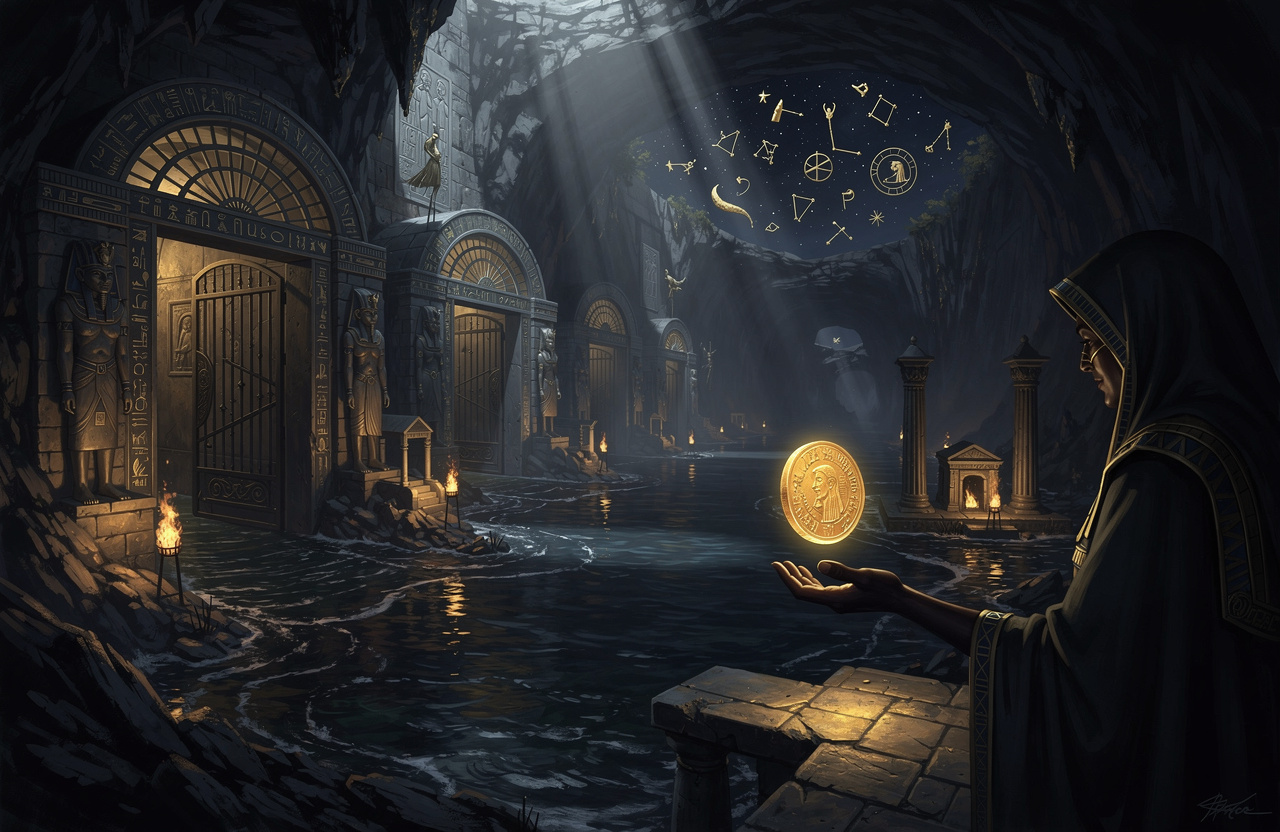
Our record. Weigh the chain on the Scales of Maat. Every empty box is a place the light cannot reach. The nominee is a mask worn over a mask. Isfet is not the money itself — money is neutral, Sekhem in numeric form. Isfet is the concealment: the deliberate, engineered severing of the deed from the doer, so that no feather can ever be laid against the true heart, because the true heart cannot be found. The Scales require two things on the pans. Hide the second, and judgment becomes impossible. That is the entire design. Not to win the weighing — to make sure no weighing ever occurs.
Step 4: the beneficiary spends, without touching it
Here is the elegant, ugly finish.
The human at the end of the chain never "owns" anything in a way a court can grab. He is not the shareholder — the nominee is. He is not the director — the nominee is. He is the beneficial owner: the one who actually controls and benefits, hidden behind the legal owners of record. He directs the structure through private letters, side agreements, a phone call to the agent. And he enjoys the money not by withdrawing it into his own taxable name, but by having the structure buy the yacht, hold the London townhouse, fund the credit card, pay for the life.
He touches nothing and controls everything. That gap — between control and legal ownership — is the whole product the offshore world sells. It is not a loophole they stumbled into. It is the manufactured good.
Why this concentrates wealth
Add it up and the mechanism is plain. The offshore chain lets the largest fortunes opt out of the two forces that redistribute wealth: tax and transparency. Everyone else pays tax on what they earn, in the open, under their own name. The user of the chain pays little, in the dark, under no name at all. Over decades, the difference is not a rounding error. It is the difference between wealth that recirculates and wealth that walls itself off and compounds behind the wall.
This is why concentration accelerates. The tools of concealment are expensive — a real structure costs real money in agents and lawyers — so they are available only above a certain fortune. Which means the system taxes the honest and exempts the hidden, and the gap between them widens by construction, every single year.
The lever
Do not despair at the machine. Study its single point of failure.
The entire offshore stack runs on one thing: the ledger is private. Ownership is a secret written in a filing cabinet in a jurisdiction that promises never to open it. The whole edifice — nominees, layers, foundations — exists only to keep the record hidden. It is security through obscurity, and every engineer knows that is the weakest security there is.
Now hold that against a public blockchain, where the ledger is the opposite by nature: every transfer visible, every address traceable, the record open by default and sealed by no one. This is not a small difference in tooling. It is the inversion of the offshore world's founding assumption. The shell game works because you cannot see the boxes. Put the boxes on a transparent ledger and the game has nothing to hide behind.
They spent a century perfecting concealment. The counter is not better concealment. It is a system where concealment is architecturally impossible — where the map cannot be folded, because everyone holds a copy. Name the beneficiary, and the chain of empty boxes falls in on itself. Light does not negotiate with a shadow. It simply arrives.