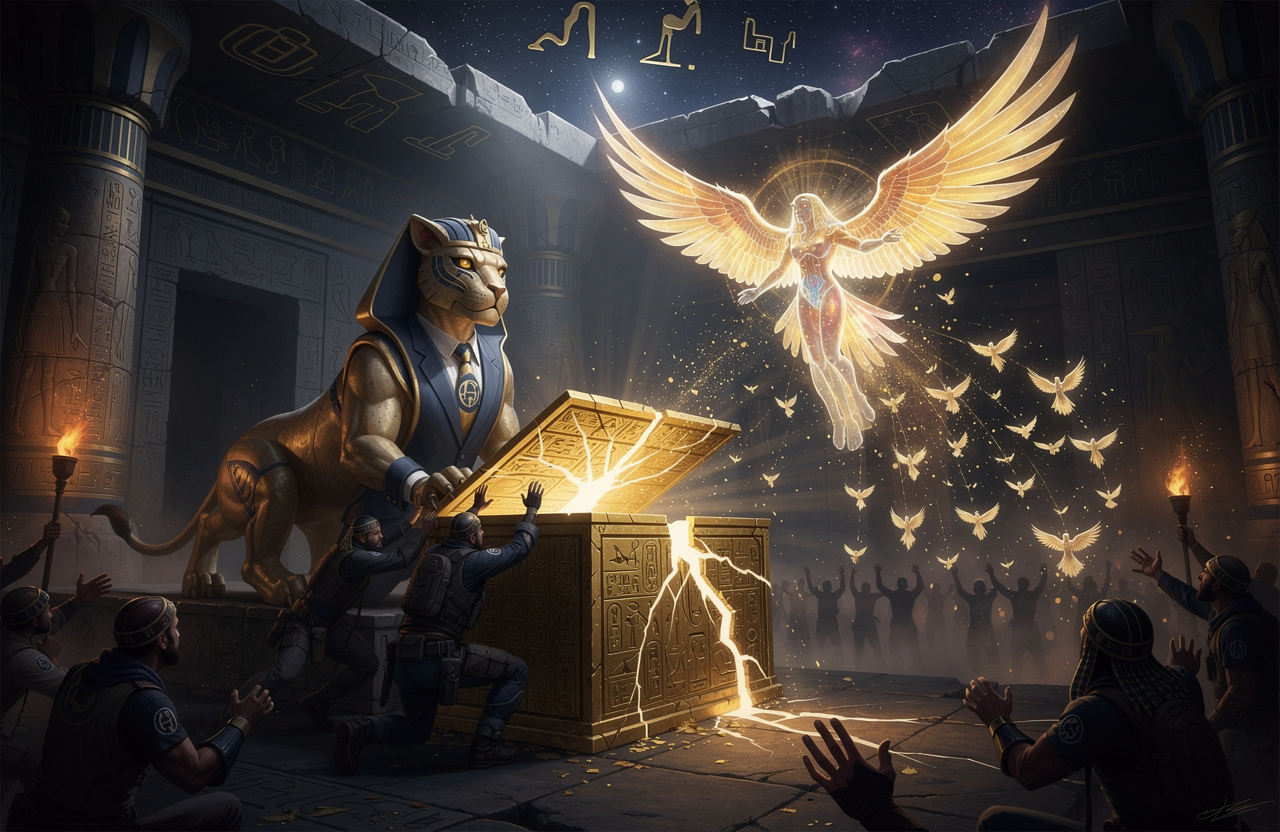
There is a number worth holding in your head. Training a frontier model — GPT-4 class — costs on the order of a hundred million dollars in compute alone. The next tier up is already measured in billions. That is the moat. That is why only a handful of names on Earth can build a mind from scratch: OpenAI, Google, Anthropic, Meta, a couple of labs in China. The barrier is not genius. The barrier is capital and silicon. And whoever controls the silicon controls who gets to think at scale.
Now look at the crack in that wall. Meta released Llama with open weights. Mistral, a French lab, shipped Mixtral and its small models under a real open license. Suddenly the thing that cost a hundred million to train could be downloaded — for free, by anyone, run on hardware you already own. The moat did not disappear. But a bridge got thrown across it. That bridge is the open weight.
What a weight actually is
Strip away the mysticism. A model is a giant file of numbers — billions of floating-point values that encode everything the training absorbed. Those numbers are the weights. They are the crystallized Heka of the system: the creative word, frozen. When you run the model, you are speaking that word back into the world. Whoever holds the weights holds the utterance.
Closed labs keep their weights behind an API. You send a prompt, they send an answer, and the numbers never leave their servers. You rent access to the mind. You never own it. Change the terms of service, raise the price, refuse your use case, log every question you ask — all of that is theirs to do, and you have no recourse. This is not your key, so it is not your coin. The proprietary black box is the perfect landlord: it owns the means of thought and rents them by the token.
Open weights break that arrangement at the root. Download the file once and it is yours forever. No license server phones home. No terms of service can be revoked from a file already on your disk. The lab could vanish tomorrow and your copy keeps working. That permanence is the whole point.
The monopoly on mind
Here is the pattern, and it is old. Concentration always dresses itself as safety. "These models are too dangerous to release." "Only responsible actors should hold them." "Trust us to gatekeep." Every one of those sentences is also an argument for keeping a monopoly on the most powerful cognitive tool humans have built.
Isfet does not always arrive as chaos. Its more durable form is concentration — a single node that everything must route through, a single point of failure disguised as a single point of order. When one company decides what a billion people are allowed to ask an AI, and what answers they are allowed to receive, that is not order. That is a chokepoint. The clean geometry of it is a lie.
Open weights are the counter-move. They do not ask the monopoly to be nice. They disarm it. You cannot gatekeep a file that has already been copied ten thousand times. You cannot revoke what you no longer control. The moment Llama's weights hit the open internet, Meta lost the power to un-release them — and so did every government that might have wanted to. Distribution is a one-way door. That door is our friend.
Our record
Enter this the way the scribes entered a verdict. The monopoly weighed the model's power against the public's access and found the public wanting — access denied, feather up, heart heavy. The open release re-weighed it. Power to speak the creative word was handed back to the many. On the Scales of Maat, a tool that only the few may wield tilts toward Isfet no matter how noble the few. A tool the many may run, inspect, and fork tilts toward balance. Open weights are not a business model. They are a redistribution of Sekhem — of the raw power to act — away from the tower and back into the field.
But is open safe?
The honest objection: won't bad actors use open models? Some will. But notice the sleight of hand in the closed-lab answer. They argue that because a tool can be misused, only they should hold it — which conveniently leaves them holding it. The same logic bans encryption, bans printing presses, bans any tool that gives the individual power the center would rather keep.
The counter is boring and true: open beats closed on safety over time, because open can be inspected. A closed model is a black box even to its makers in the ways that matter — you cannot audit what you cannot see. Open weights can be probed, red-teamed, patched, and forked by thousands of independent eyes. Security through obscurity is a bug in the firmware of every centralized system. Security through transparency is the patch. Linux did not lose to Windows on security by being open. It won.
What this means for you
You do not need a hundred million dollars. You need a decent laptop and a download.
- Run an open model locally. Mistral 7B, Llama, Qwen — they fit on consumer hardware. Your prompts never leave your machine. No token meter. No log.
- Fine-tune one on what you care about. The weights are yours to reshape. Train it on your domain, your language, your tradition. This is Heka you author yourself.
- Support the labs that ship open weights. Every truly-open release is a stone in the bridge. Meta, Mistral, and the rest are not saints, but on this specific move they are on the right side of the wall.
- Refuse the frame that concentration equals safety. When someone tells you the mind must be locked up for your protection, ask who holds the key.
The frontier will keep costing billions to reach first. That race, the closed labs may keep winning. But the frontier of last year — already staggeringly capable — can be free, downloadable, and running on your desk tonight. The lag between closed and open shrinks every quarter. That gap is where sovereignty lives.
They built the mind behind a paywall. We copied the file. The copy does not phone home.