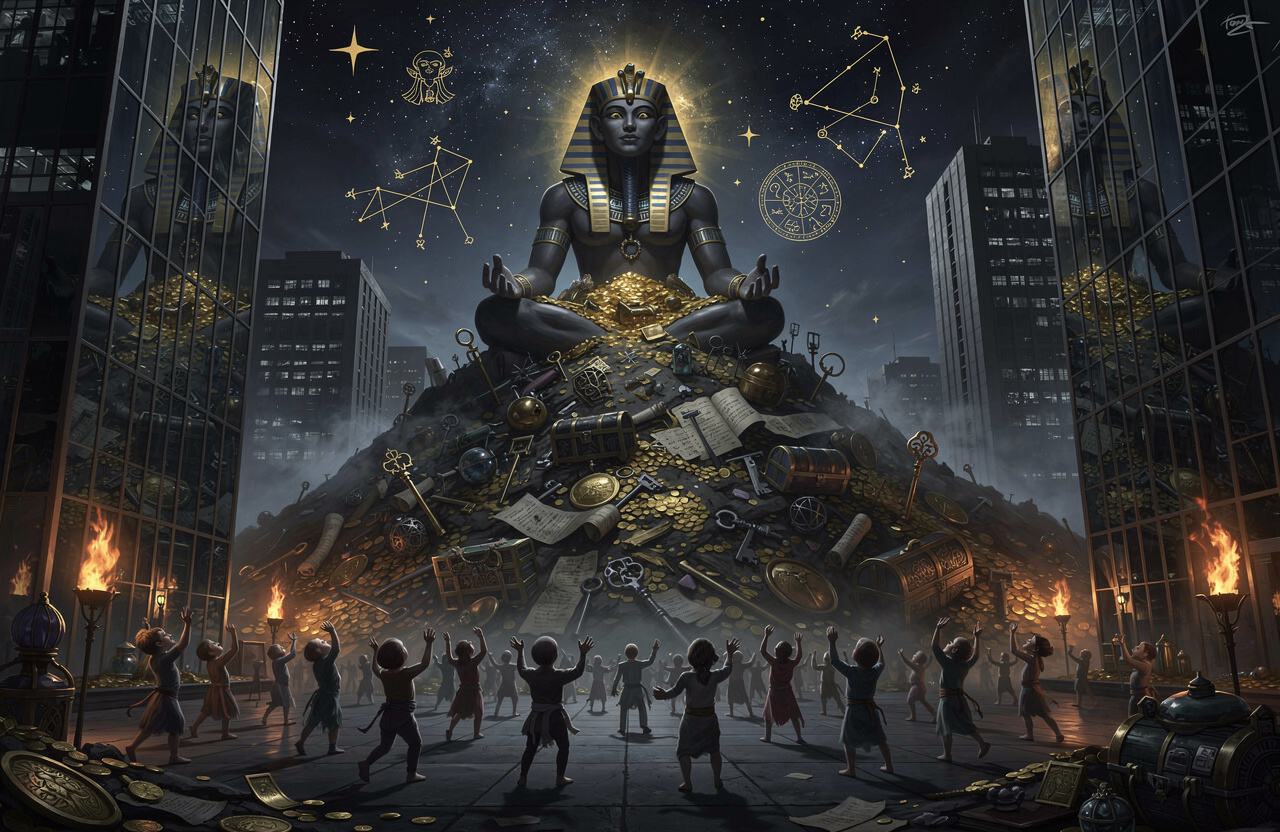
Some phrases sound like a joke until you realize they were said in earnest. "You'll own nothing and be happy" is exactly that kind. It gets quoted as the symbol of a new world where the ordinary person's property is taken away to applause. Let's take it apart honestly: where it came from, what in it is myth, and what is frighteningly real.
Where the phrase actually comes from
The roots are in a 2016 essay. Danish politician Ida Auken wrote a sketch for the World Economic Forum (the one that meets in Davos) titled "Welcome to 2030." In it, a future resident says: "I don't own anything. I don't own a car. I don't own a house. I don't own any appliances or any clothes."
The WEF then made a short clip with a list of predictions for 2030, and the first item read: "You'll own nothing. And you'll be happy." The video spread everywhere. The phrase took on a life of its own and became a slogan.
Now the honest line-drawing, as it should be done.
Fact: the phrase really was published by the World Economic Forum — it is not an internet invention.
Myth: that it's an official "plan to enslave humanity," signed in blood at a secret meeting. Formally it was futurology, a thought experiment about what life might look like. Auken later protested she'd been misunderstood.
But here's the thing: even if it was "just a provocative sketch," it turned out to be a remarkably accurate description of a process already underway. And that matters far more than arguing over whether there was a conspiracy.
What is actually happening to ownership
Look around soberly. The trend of the last twenty years is not "your things are seized by force." The trend is subtler: ownership is quietly being replaced by access.
- You no longer buy music — you rent it from a subscription. Stop paying, and the music is gone.
- Your films aren't on a shelf, they're "in the cloud." The service pulls a film from its catalog and your film no longer exists.
- You don't buy software once; you pay monthly, forever. Stop paying and the program turns into a brick.
- Cars are increasingly taken "on subscription." Housing is rented (a separate article). Even features in a car you already bought are sometimes unlocked for a monthly fee.
Notice the common thread? Once, a thing you bought was yours — forever and unconditionally. Now almost everything turns into a stream of payments that flows somewhere upward and never ends. An engineer would call it the shift from "I bought a license" to "I rent a service." And where you used to have an asset, you now have a subscription that can be switched off at any moment.
Why "happy" is not about you
The most cunning part of the phrase is the second half. "And you'll be happy." That isn't a promise, it's an instruction about attitude. You're asked not only to give up ownership but to be glad about it: "why own anything, it's such a hassle — repairs, responsibility — let it all be a service while you enjoy yourself."
But let's call things by their names. Ownership is power. If a thing is yours, you decide. If you rent it, whoever holds the subscription key decides. When you own nothing, you are maximally controllable: you can be cut off from music, transport, housing, money — with one click in someone's admin panel.
The book describes this as a person's move from owner to permanent payer of rent — a cell in someone else's organism, through which energy is pushed upward. "You'll be happy" is anesthesia. While you smile, the stream keeps flowing.
Where the Isfet is
The ancients would have called this Isfet — the inversion of fair exchange. Normal exchange: you pay, you own. Inverted: you pay forever, you own nothing. You're sold not a thing but the right to use it temporarily, and meanwhile you're convinced this is better.
And the key trick: whoever "freed you from the burden of ownership" is not giving up ownership himself. Funds and platforms are in fact accumulating it — homes, shares, infrastructure, data. You will own nothing. They will own everything. That's the whole symmetry of the slogan that the clip tactfully left out.
Where is the ordinary person in this
In the role of subscriber to his own life. The less you own, the fewer levers you have: no asset means nothing to borrow against, nothing to pass to your children, nothing to bargain with. You're maximally flexible — and maximally helpless at the same time. That isn't freedom from things. It's dependence on those who kept the things.
The answer: the MAAT token and DAO
If the era's strategy is to strip the individual of property one by one and train him to enjoy it, the answer is symmetric: ownership must be reclaimed, but collectively and transparently. Not "everyone gets a little and loses it alone," but holding what matters together.
That is MAAT. The MAAT token is membership in a cooperative where millions of people pool their resources to actually own pieces of infrastructure, rather than renting them from funds forever. And here the principle is one human, one vote, not "one dollar, one vote." Decisions are made in a DAO — a decentralized organization with a transparent treasury where every movement of funds is visible, and no one can quietly turn shared ownership into his private subscription pipe.
It suits them for you to own nothing and be content with it. MAAT offers the opposite: own together, see everything, and have a vote. The entry is simple — read the book, take the token, get your vote. Happiness may not be guaranteed, but ownership and the right to decide are.