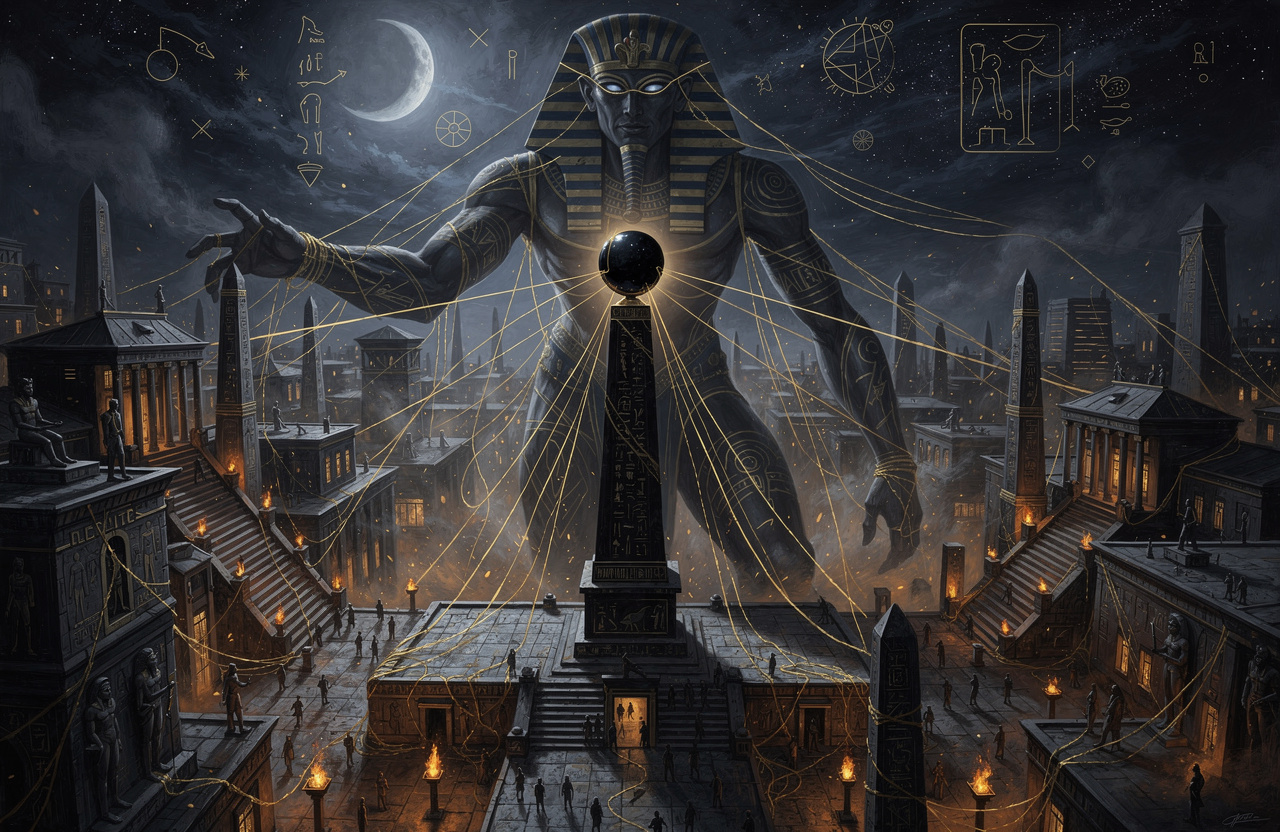
They named it after a stone that lets you see everywhere — and forgot to read to the end of the story, where the stone starts looking back and driving its user mad.
Palantir. The name comes straight from Tolkien: the palantíri, seeing-stones that let the powerful watch distant lands. In the books, whoever gazes into one thinks he is watching — but the stone is a two-way channel, and the darkest power on the other end quietly bends the watcher's will. The founders picked that name on purpose. You should take them at their word.
Palantir does not make a product you buy in a store. It makes a nervous system for the state. And it has spent two decades wiring itself into the spine of governments, militaries, police, and agencies — until the flinch reflex of power now runs through its software.
What It Actually Does
Strip away the mystique. At its core, Palantir does one thing: it takes data that was scattered and makes it one.
Imagine every database a government holds. Tax records here. Driver's licenses there. Immigration files in another building. Phone metadata, license-plate readers, welfare rolls, medical records, social media, criminal records, travel logs — each locked in its own silo, each guarded by its own agency, each in its own format. Historically that fragmentation was an accident, but it was also a protection. No single screen could see the whole of you. Your life was scattered across a hundred drawers, and no one hand could open them all at once.
Palantir's platforms exist to open every drawer and pour them onto one screen. They ingest the silos, resolve them, link them — this tax record is this person is this license plate is this phone is this face — and render a single, living dossier. Point at a name and the system assembles a person: where they've been, who they know, what they earn, where they'll likely go next. Then the newer layer — the AI platform — sits on top and turns that dossier into a recommendation. Not just here is who they are, but here is what to do about them. A targeting console for human beings.
The All-Seeing Eye Was a Metaphor. Now It Ships.
For thousands of years the Eye of Horus — the Wedjat — was a symbol: the completed, all-seeing eye, wholeness and protection and, in the wrong hands, total sight. It was mythology. A prayer. A carving on a temple wall.
Palantir turned the metaphor into a subscription.
The Wedjat now runs on servers. The all-seeing eye is a login. And the crucial thing — the thing that should make the hair on your neck rise — is that the eye is not inside the state anymore. It is rented from a private company. The nervous system of the government is a proprietary black box owned by shareholders. When an official points the eye at a citizen, he is using a tool he does not own, whose inner logic he cannot fully inspect, built by a firm whose incentives are its own.
This is the Panopticon completed — not a prison tower with one guard, but a mesh where every silo feeds the same screen, and the screen belongs to a vendor. Bentham dreamed it. Palantir shipped it. And it ships the same engine to the border agency, the war zone, and the city police, with the interface changed and the core the same.
Our Record
Our record: the Shadow Neteru's oldest hunger is not to punish — it is to see. To know before you act, to read the Ba while it still forms the intention. Scattered data is a kind of freedom the way scattered light is darkness; integration is the lens that focuses it into a burning point. Palantir is that lens. It does not create new information — it concentrates existing sight into a single beam and hands the beam to power. In the ledger of Ma'at, every soul is weighed one at a time, in the open, against a feather, with the outcome visible to all. Palantir inverts the scene: the weighing is secret, the scale is proprietary, and the accused never sees the eye that measures him. That inversion — judgment without transparency, sight without accountability — is the exact signature of Isfet.
Why "Just Efficiency" Is the Trap
Palantir's defenders have a clean answer: it's just efficiency. The data already exists. The agencies already have it. We're only helping them use it. Where's the harm in connecting dots the government is already allowed to collect?
Here is the harm, and it is not small. Integration changes the nature of the data, not just its speed. A hundred harmless facts, each legal, each mundane, become a weapon the moment they are fused into one profile. The scatter was the safeguard. Your tax record alone reveals little. Your location history alone reveals little. Fused with your associations, your purchases, your face, and a predictive model — they reveal a life laid open for pre-emptive action. "Efficiency" is the word that smuggles in a change of kind while pretending it is only a change of degree.
And a nervous system does not just sense. It acts. Once the state's reflexes run through one vendor's software, the vendor is no longer a supplier — it is an organ. You cannot easily remove an organ you have grown dependent on. That is the lock-in, and it is the whole business model: become the spine, and you cannot be cut out without paralysis.
The Lever
Do not despair at the eye. Understand its weakness — because concentrated sight is also concentrated fragility.
The palantír's flaw, in the story, was never the seeing. It was that the watcher forgot he was also being watched, and forgot he did not control the far end. Centralized surveillance has the same flaw: a single system that sees everything is a single system that can be audited, contested, regulated, and — where it violates the weighing of souls — refused. The mesh that concentrates power also concentrates the target.
Your levers are concrete. Demand that public power run on open, inspectable systems, not proprietary black boxes — you cannot hold accountable a scale you are not allowed to see. Push for data minimization and separation — the scatter was a safeguard; defend it, in law and in habit. Starve the fusion at the source: every field you decline to feed, every silo kept walled, every default you switch off is one less dot for the lens to fuse. And build the counter-current — decentralized identity you actually hold, encryption by default, tools where you own the keys and the eye needs your permission to open.
The stone shows everywhere. But the story is not finished on the page where the watcher feels powerful. Read to the end. The one who forgets he is seen loses. The one who remembers — and refuses to look away — is the one who is not ruled.
Keep your eyes open. That is the whole spell.