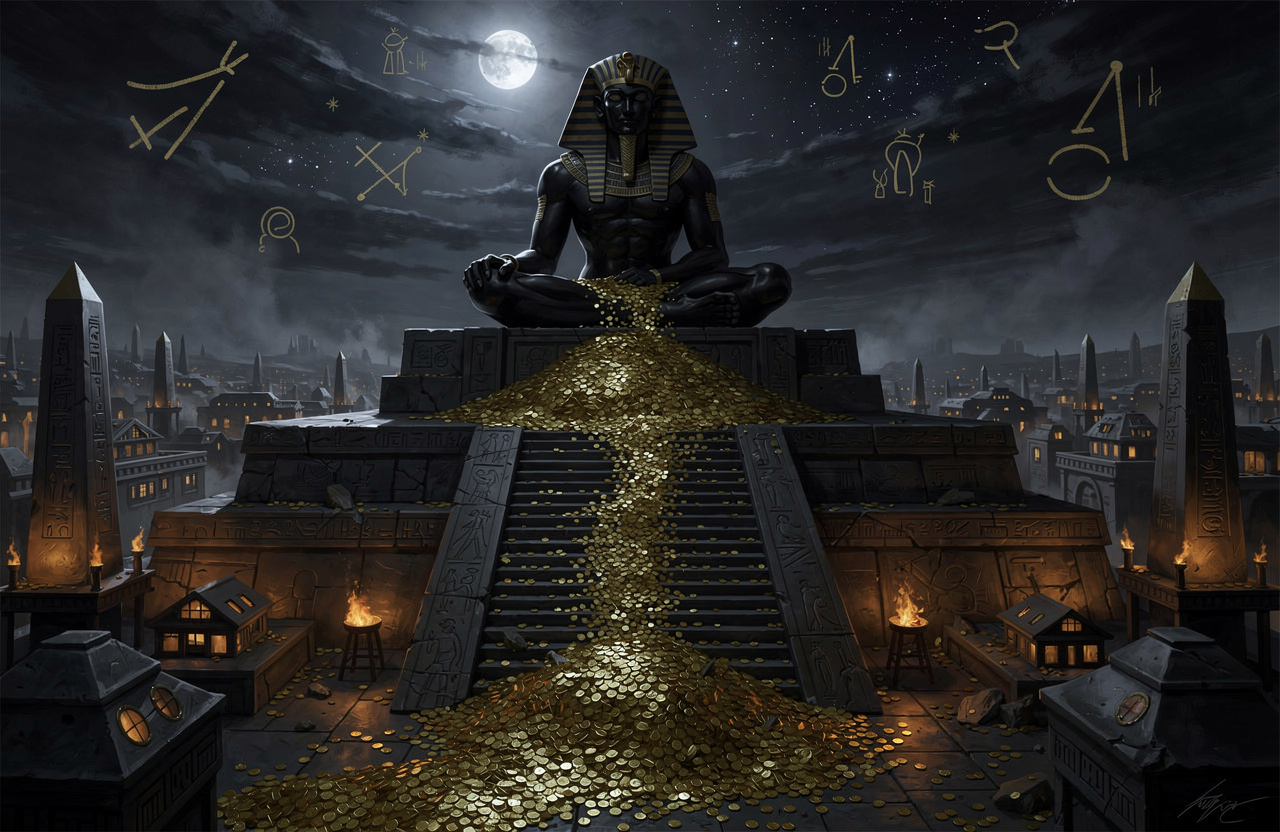
The word "passive" sounds harmless. A passive investor is someone who doesn't pick stocks, doesn't fidget, doesn't try to beat the market. He just buys "the index" — say, a basket of the five hundred largest companies in America, the S&P 500 — and sits still. This is considered smart, modest behavior: don't be clever, don't pay expensive managers, just follow the market.
And here is the paradox that runs a chill down your spine. The most modest, most passive financial behavior on the planet has built the most active, most concentrated power in history. "Do nothing" turned into "own everything."
What an index fund is
Let me put it simply. An index fund is an automaton. You put money in, and without thinking it buys a little of every company on the list — in proportion to their size. It doesn't pick "good" and "bad," doesn't analyze. It just takes the whole list at once.
John Bogle invented this in the 1970s out of noble motives: to give the ordinary person a cheap way to own a slice of the whole economy, without greedy managers. And the idea is brilliant — for the individual saver. Cheap, simple, and over the long run usually better than paying for "active management."
But watch what happens when everyone does it, for decades in a row.
An autopilot that buys up the planet
Every month, millions of people worldwide automatically send part of their paycheck into index funds — through pensions, through apps, through employers. This stream doesn't think. It just flows and buys "the whole list" again and again. And these automatic purchases are managed by those who run the largest index funds — the Big Three.
The result: money on autopilot trickles into the same hands for decades and buys up a little of everything. That's how you accumulate what we already know: BlackRock with around 7% of nearly every large company, Vanguard another 6%, State Street about 4%. No one planned this as a seizure of power. It is the byproduct of millions of "modest, passive" decisions gathered into a single stream.
In IT it's familiar: a background process, harmless on its own, but launched on a million machines and left running for years, quietly eats all the resources. "Passive" at the level of a person means "total" at the level of the system.
Passive money, a very active vote
And here is the key bait-and-switch. The money flows passively. But the vote attached to it is very much active.
An index fund doesn't pick stocks — but the owner of a share still gets the right to vote at the meeting. And that vote is wielded by the fund, not by you. So "passive" trillions hand the Big Three completely active power: to appoint boards, approve bonuses, dictate strategies. Passivity exists only at the entry, on the saver's side. At the exit, at shareholder meetings, this is the most active force in the economy.
In other words: you behaved passively and modestly, while your vote behaves very actively on your behalf — just in someone else's hands.
Who decides what's inside the index
There is one more layer of power almost no one notices. An index is a list. And someone compiles the list. Who decides which five hundred companies make it into the S&P 500? Special index-provider companies. Add a company to the index and billions in passive money automatically flow into it. Remove it and the money just as automatically flows out.
So mere inclusion in the list became a lever. Whoever maintains the list quietly steers flows of capital, without owning a single share directly. Another admin at the gate, elected by no one.
Where is the ordinary person here
You are that stream. You were convinced that passive investing is sensible and safe — and personally, that's often true. But no one explained the other half of the deal: while you are passive, your vote works at full power in the hands of the three. You gave up not just stock-picking — you gave up the right to decide. And you did it while thinking you were merely being modest.
Bogle wanted to democratize ownership. The result was unprecedented concentration. The idea was right, but it lacked one detail — what to do about the vote.
What to do about it: the MAAT token and DAO
Passive funds proved the power of the autopilot: small, regular actions by millions add up to a giant force. The only problem is that the steering wheel of that force — the vote — was handed to the three. So the wheel must be returned to the people, without breaking the convenience of the autopilot.
That is MAAT. The MAAT token is membership in a cooperative and a single vote. Not "one dollar, one vote" like the index giants, but one human, one vote. The money can work as "passively" as you like, but the vote stays with the person and is exercised through a DAO — a decentralized organization with a transparent treasury where every movement of funds and every vote is visible. Autopilot for the money — manual control for the vote.
Half a century before us, Bogle proved that the regular contribution of millions beats any genius manager. We add the missing detail: let your own vote, not the three's, come attached to that contribution. The entry is simple — read the book, take the token, get your vote — and stop being passive fuel for someone else's very active power.