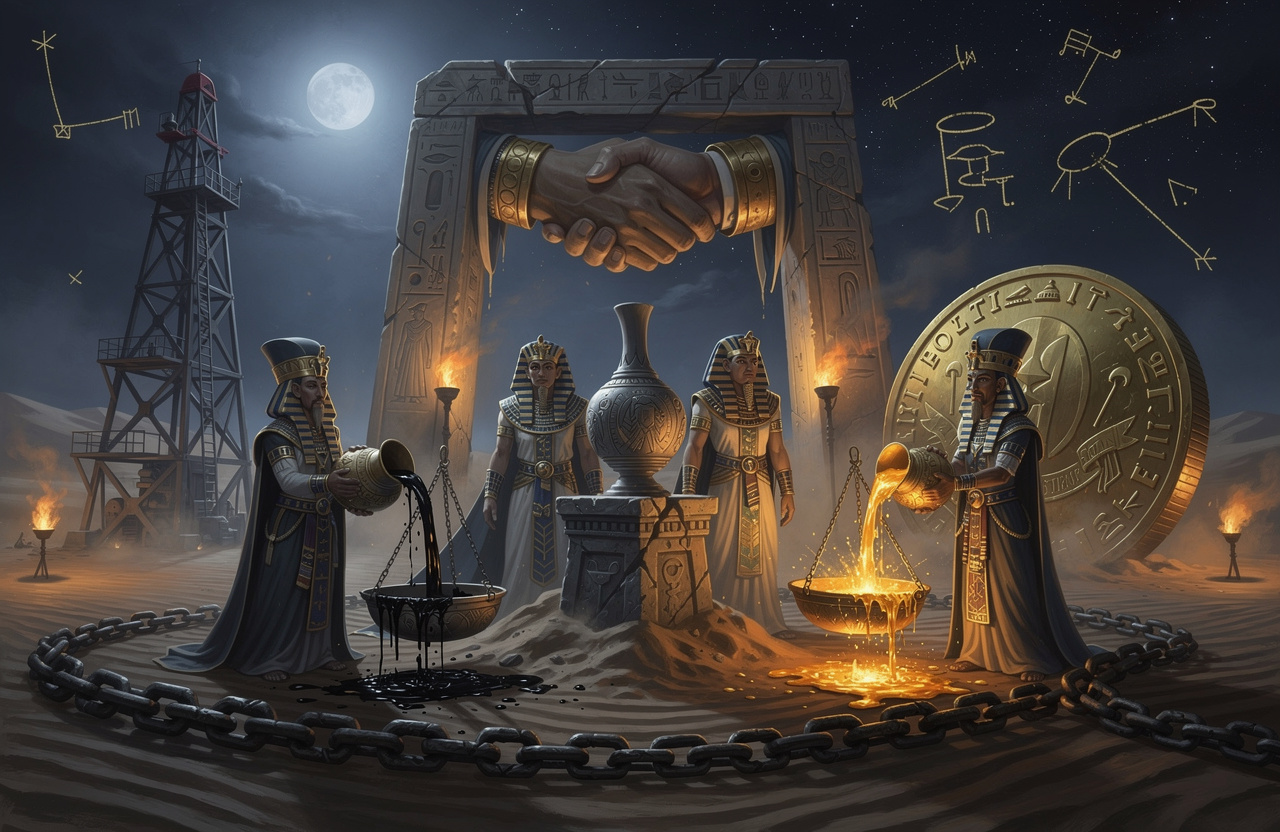
In 1971 the dollar lost its anchor. Until then it was pegged to gold: in theory you could trade the paper for metal. Then the United States unilaterally shut that door — the dollar became backed by nothing, just paper with a signature. The logical question: why didn't the whole world dump that paper right then? The answer lies in a single deal struck a few years later with a desert full of oil. It's called the petrodollar, and it may be the most elegant financial trick of the 20th century.
What happened in 1971
A brief backstory. After World War II, under the 1944 Bretton Woods agreement, the dollar became the world's reserve currency, pegged to gold, with all other currencies pegged to the dollar. Convenient: the dollar was "like gold, only easier to ship."
But the US printed more dollars than it had gold, and by the early '70s too many wanted to swap paper for metal. In 1971 President Nixon shut the "gold window." The peg ended. Now the dollar rested on trust and habit alone. And trust is volatile: let the world doubt, and a reserve currency turns into a candy wrapper. The system urgently needed a new anchor to replace gold.
The genius of the deal
And an anchor was found — not in metal, but in a commodity everyone needs, always: oil. In the mid-1970s the US struck a deal with Saudi Arabia, the largest oil exporter, on a scheme simple in appearance. The Saudis sell their oil only for dollars. In return, the US guarantees them military protection and takes the Saudi oil revenue back — investing it into US government bonds. Gradually the whole OPEC cartel fell in with pricing oil in dollars.
Consider what that achieved. Every country needs oil — for transport, factories, armies, everything. And since you can only buy it for dollars, every state on the planet has to hold a stock of dollars, even one at daggers drawn with the US. The dollar gained a new backing — not a chest of gold, but the world's need for energy. Before, you held the paper because metal stood behind it. Now you hold it because without it you can't buy gasoline.
That's the engineering beauty of the move: the dollar was wired into the very infrastructure of global energy, like a mandatory protocol. Want fuel? First get dollars. And to get dollars you must sell something to America or borrow from it. Demand for the dollar became not a matter of trust but a matter of the physical survival of economies.
What it gave the US
A colossal and nearly invisible advantage that even has a name — the "exorbitant privilege." Since the whole world constantly needs dollars, the US can print them in enormous quantities, and those dollars don't instantly lose value at home — the planet absorbs them. Crudely put, the country gains the ability to buy real goods from all over the world with paper it prints itself.
Plus a second loop: the petrodollars flow back — Arab oil revenue runs into US government bonds, meaning it finances America's own debt. A closed circle working in one direction. Sell oil for dollars — lend the dollars back to the US — and the US lives on that money and, if needed, buys more from you. The dollar system got an engine that turns on its own.
What everyone else pays for it
Now the uncomfortable part. This privilege has a flip side, and the rest of the world pays for it. When the US prints dollars beyond measure, the inflation doesn't stay inside America — it spreads across the planet along with the dollars. Countries hoarding dollar reserves are essentially lending to American consumption, while keeping their own savings in a currency someone else prints.
And the petrodollar explains things that look like a riddle without it. Why such a nervous reaction whenever someone tries to sell oil for something other than dollars? Because that's an attack not on a single transaction but on the support beam of the whole system. History knows individual leaders who spoke of moving away from the dollar in energy settlements and later lost power or their lives — for a range of disputed reasons. No one has proven a direct cause and effect here, and pinning it all on one deal is a tempting but unproven version. What matters is not to build a conspiracy theory but to see the principle: the dollar isn't just money, it's the infrastructure of power, and an attack on infrastructure is taken more seriously than a dispute over prices.
Where the ordinary person stands
Everywhere and nowhere. He pays for this system every time he fills the tank, every time groceries get pricier, every time his salary melts under inflation that flew in from across the ocean. But no one thought to ask his consent. The deal that keeps the entire global financial structure afloat was struck in closed offices by soldiers and bankers, and the bill for it was mailed to billions of people who never even heard of it.
The answer: the MAAT token and DAO
The petrodollar is a lesson in how real power works: it doesn't shout, it wires itself into the infrastructure you can't live without, and it collects tribute from everyone who uses that infrastructure. The anchor can be changed — from gold to oil — but the principle stays: one center prints, the whole world holds and pays. And the ordinary person in this scheme is always at the bottom, always the payer, never a co-owner.
This is exactly what MAAT is set against. The MAAT token is membership in a cooperative that doesn't try to print "its own dollar" and tax the world with it, but does the opposite: it gives scattered people a shared tool that doesn't depend on someone else's printing press. Governance runs through a DAO — a decentralized organization with a transparent treasury, where issuance and every movement of funds are written in open code and visible to anyone, rather than decided in a closed office for someone's benefit. Voting follows the principle of one human, one vote, not "one dollar, one vote": here weight isn't printed, it's granted by membership. The petrodollar holds up because you have no choice. MAAT is an attempt to give the choice back. The entry is simple: read the book, take the token, get your vote — and stop paying for a privilege you never enjoyed.