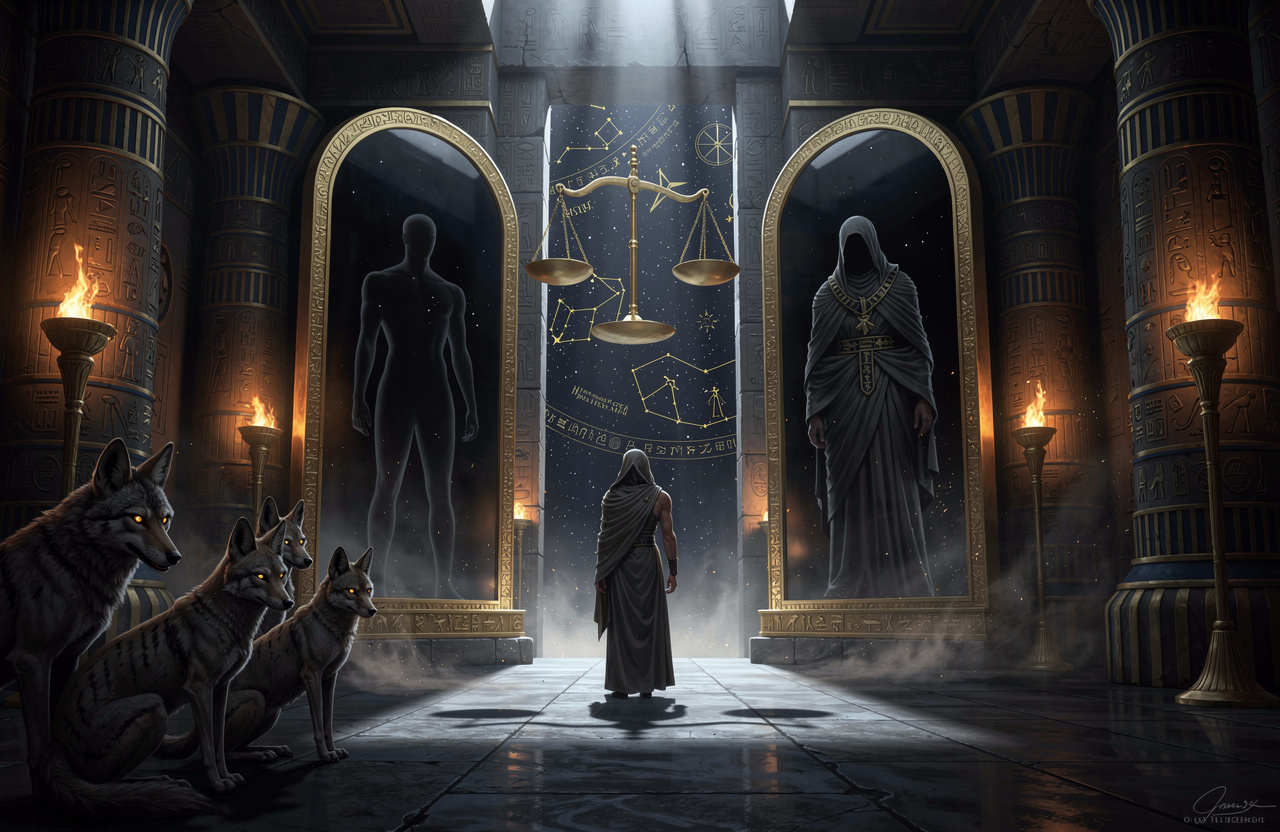
You have been handed a rigged question, and almost everyone answers it wrong.
The question sounds reasonable: should a system be transparent or private? Pick one. And whichever you pick, you lose. Choose transparency, and you get a world where every payment you ever make is a permanent public record — a stalker's dream, a discriminator's toolkit, your salary and your rent and your medical copay etched into a ledger anyone can read forever. Choose privacy, and you get the offshore vault, the anonymous shell, the DAO treasury that vanishes when the "founders" run — a launderer's paradise, unaccountable power in the dark.
That's the trap. And like most traps offered by the old order, its power comes entirely from convincing you there are only two doors. There aren't. The whole framing is a lie, and once you see it, you can't unsee it.
The two failures are the same failure
Look closely and notice something. The surveillance dystopia and the money-laundering dystopia are not opposites. They are the same disease wearing two masks: the wrong thing is exposed, and the wrong thing is hidden.
In the surveillance version, individuals are naked while power stays opaque. Your every transaction is visible; the shell companies, the dark-money flows, the beneficial owners behind the trusts — invisible. You are transparent to them. They are private from you.
In the laundering version, it's the same asymmetry pointed the same way. The rules and the treasury are dark, so insiders drain it; the ordinary participant still has no privacy that matters, and no window into where the money went.
Both failures share one structure: transparency aimed at the weak, privacy handed to the strong. That is Isfet — the parasite's order. Not chaos, exactly. A very specific arrangement, and always the same one: the many are watched, the few are hidden.
Our record: Ma'at was never a choice between the open scale and the sealed chamber. Ma'at is the correct assignment of each. The Scale — the rule, the treasury, the law by which all are weighed — stands in full light, so no hand can tip it in secret. The Ka — the innermost self of the person being weighed — stays veiled, because a soul laid bare is a soul made prey. Get that assignment backwards and you have Isfet no matter which mask it wears. Get it right and the dilemma dissolves. The false choice was never truth against privacy. It was who is exposed, and who gets to hide.
The technology finally makes both possible
For most of history you couldn't have both, so the trade felt like physics. A ledger was either a public book or a locked drawer. The tools didn't exist to make rules transparent while keeping people private. Now they do, and the whole dilemma is revealed as a temporary limitation, not a law.
Zero-knowledge proofs let you prove a transaction is valid — the sum balances, the funds are real, no double-spend — without publishing who, whom, or how much. Rule verified in the open; identity kept private. The Scale and the Ka, each in its place.
On-chain treasuries with private membership let a DAO show every coin flowing in and out, auditable by anyone, while the individual members transact without becoming a public spreadsheet. The treasury is glass. The people are not.
Verifiable governance with private ballots lets you prove a vote was counted correctly and the tally is honest, without exposing how each person voted — the same principle that made the secret ballot the backbone of every real democracy, now enforceable in code as Heka, the binding word.
None of this is speculative. Zcash shielded transactions, zk-rollups posting public proofs over private data, DAO tools with transparent treasuries — these run today. The technology caught up to the moral answer. What was a forced trade-off is now an engineering choice, and the right choice is available.
The honest hard part
I won't pretend the right assignment is free. Two real tensions remain, and you should hold them without flinching.
Privacy tools protect everyone, including the guilty. The same shield that hides a dissident's donation hides a criminal's transfer. This is true of cash, of envelopes, of curtains, of every privacy technology ever made. The mature answer is not to abolish privacy for the many because a few abuse it — that's the surveillance state's favorite excuse. It's to keep the rules and the flows of power transparent enough that abuse is catchable, while individuals keep the dignity of a private life. Aim the light correctly.
"Transparent rules" only works if people actually read them. A public treasury nobody audits is theater. Open governance nobody participates in is a rubber stamp. The transparency has to be used, not just available. That part is on us — the participants — not on the code. The chain can make the ledger open. It cannot make you look.
Neither of these sends you back to the false dilemma. Both are the ordinary work of running a real system in the light — visible, contestable, fixable. Which is the point.
What to do
- Reject the framing out loud. When someone says "privacy or transparency, pick one," name the trick. Ask: private for whom, transparent to whom? That single question exposes almost every bad system on both sides.
- Demand the correct assignment. Support tools, DAOs, and protocols where the rules and treasury are auditable and the individuals are private. That's the pattern. Reward it. Fund it. Use it.
- Actually audit the glass. If you're in a DAO or hold a token, look at the treasury. Read the flows. Transparency you never use is decoration. Be the eye that makes it real.
- Guard your own Ka. Use privacy-preserving tools for your personal transactions without a flicker of shame. A private life is not a guilty life. It's a human one.
The old order needs you to believe you must choose between being watched and being complicit. You never did. Put the Scale in the light and the Ka behind the veil. Transparent power, private people. That's not a compromise between the two dystopias.
That's the door out of both.