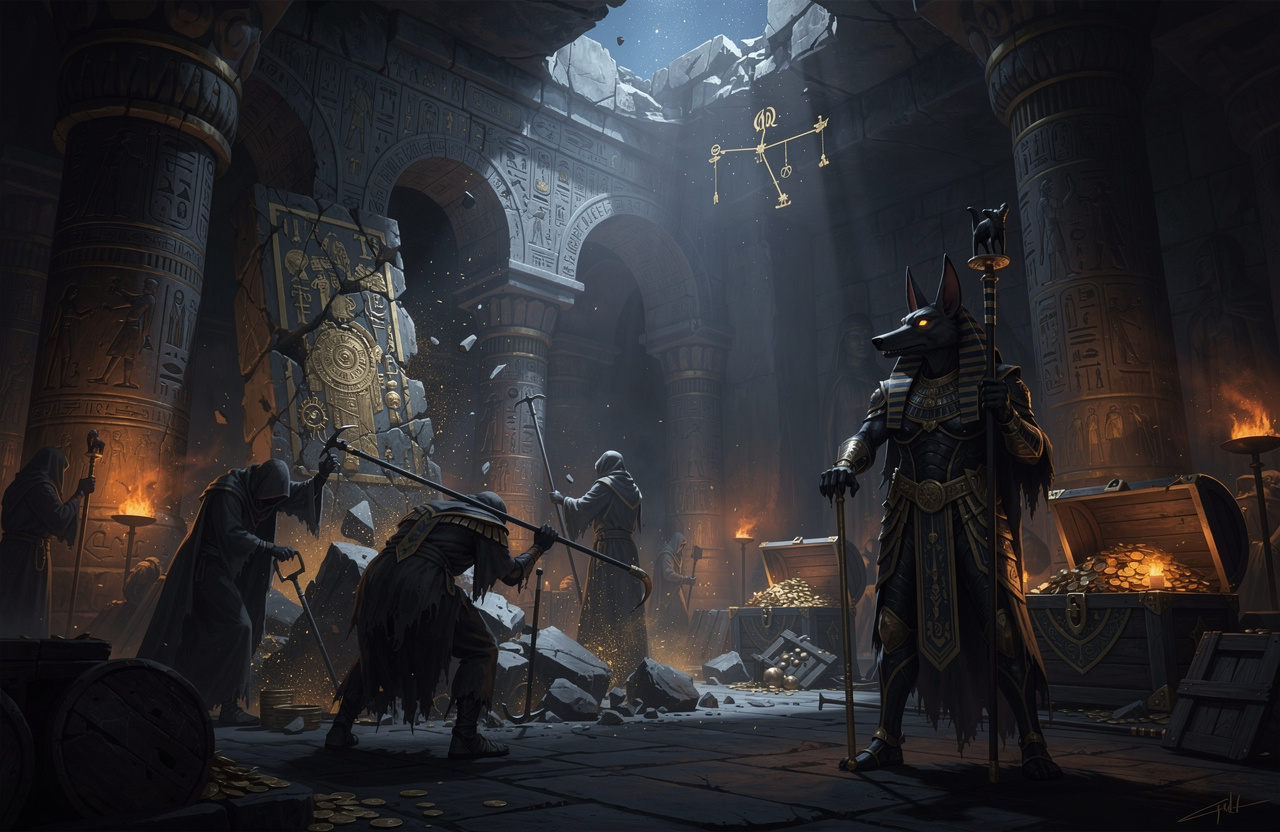
The market you can see is the decoy. The real acquisition happens in the dark.
You track BlackRock and Vanguard because they own public companies — names on an exchange, tickers you can look up, filings you can read. That's the lit room. But there's another room, larger and quieter, where a different kind of capital operates. It doesn't want to be on the exchange. It wants to take companies off the exchange. It's called private equity, and the biggest names — Blackstone, KKR, Apollo, Carlyle, Cerberus — together manage on the order of trillions of dollars and preside over portfolio companies that employ millions of people.
The exchange is where you're allowed to watch. Private equity is where you're not.
The Whole Point Is the Delisting
Here's the maneuver, stripped down. A public company has to publish. Quarterly earnings, executive pay, material risks, audited books — the SEC forces sunlight on it, because the public "owns" it through shares. Private equity does a leveraged buyout: it borrows heavily, buys up all the shares, and takes the company private. The ticker vanishes. The filings stop. The lights go out.
Now the firm owns a real business — a hospital chain, a housing portfolio, a defense supplier, your local newspaper, the company that makes your dishwasher's spare parts — with almost no obligation to tell anyone anything.
- Apollo built itself around Athene, a giant annuity and retirement business — meaning it sits on a mountain of ordinary people's retirement money and deploys it privately.
- Blackstone became one of the largest real-estate owners on the planet, landlord to countless homes and warehouses, much of it held in vehicles the average tenant will never trace.
- Cerberus — named, with zero subtlety, after the three-headed dog that guards the gate to the underworld — has owned everything from gunmakers to supermarkets to a chunk of the mortgage machinery.
They don't want to own in the light. They want to own in the dark. Delisting isn't a side effect. It's the product.
The Debt Is Loaded Onto the Prey
The cruelty is in the structure. In a leveraged buyout, the firm doesn't mostly pay with its own money. It borrows — and then loads that debt onto the company it just bought. The prey is made to carry the chains used to capture it.
Then come the extractions: "management fees" charged to the portfolio company, "dividend recapitalizations" where the firm borrows more against the company just to pay itself, cost-cutting that guts staff and quality. If the company survives, the firm sells it in a few years for a multiple. If it dies — hollowed out, over-indebted, bankrupt — the firm has usually already pulled its money out. Toys "R" Us didn't fail because kids stopped wanting toys. It failed under a mountain of buyout debt. That pattern has a name in the wild: the thing eats, extracts, and moves on while the carcass files for bankruptcy.
Our Record
Apophis does its real work at night. That's not a metaphor I'm reaching for — it's the exact structure. The daytime serpent is the visible market, the part that files and reports. The night serpent is private capital, coiling around assets in the dark where no filing reaches, where Sekhem — the stored, productive life-force of a real working company — can be drained without a single public disclosure of the draining.
And notice the name they chose. Cerberus. The guardian of the underworld. They told you. The whole design is to move value from the lit realm, where it can be watched, into the dark realm, where it can be consumed. A serpent that hunts under exchange lights is exposed. A serpent that pulls its meal below the surface eats in peace.
Name the room. What is named can be watched, even in the dark.
Why "Private" Is the Load-Bearing Word
Don't skate past that word. Private equity. Privacy is a right for a person — the shield the weak hold against the powerful. Here it's been inverted into a shield the powerful hold against you. The same word that protects your bedroom protects a firm that owns your hospital from telling you it owns your hospital.
And the money doing this is, once again, yours. Apollo's retirement mountain. Pension funds — teachers, firefighters, city workers — are among the largest investors in private equity, chasing returns. Your future retirement is quite possibly funding the leveraged buyout of the company your neighbor works at, loading debt onto it, and calling the extraction a "return." The coil feeds on the very people it hollows out, and hands them a statement showing a gain.
The Lever
You can't read filings that don't exist. But the dark isn't sovereign — it depends on your money, your inattention, and your consent to opacity. Pull those.
- Follow the delisting. When a company you rely on "goes private," that's not neutral news — that's the lights going out. Note who bought it. The names repeat: Blackstone, KKR, Apollo, Carlyle, Cerberus. Learn them like weather.
- Ask where your pension is. If you have any say — a retirement plan, a union fund, a choice of provider — ask what share sits in private equity. You may not move it. But naming it strips it of the one thing it needs most: your unawareness.
- Choose the transparent by default. A cooperative opens its books to members. A public DAO writes its ownership on-chain, readable by anyone, forever. The answer to ownership in the dark isn't better flashlights. It's building the parts of the economy that were never meant to have a dark room at all — where the ledger is the point, and privacy protects the person, not the predator.
The old priests didn't fear the serpent less at night. They lit the lamps and named it anyway.
Turn on the lights. Then build in a house with windows.