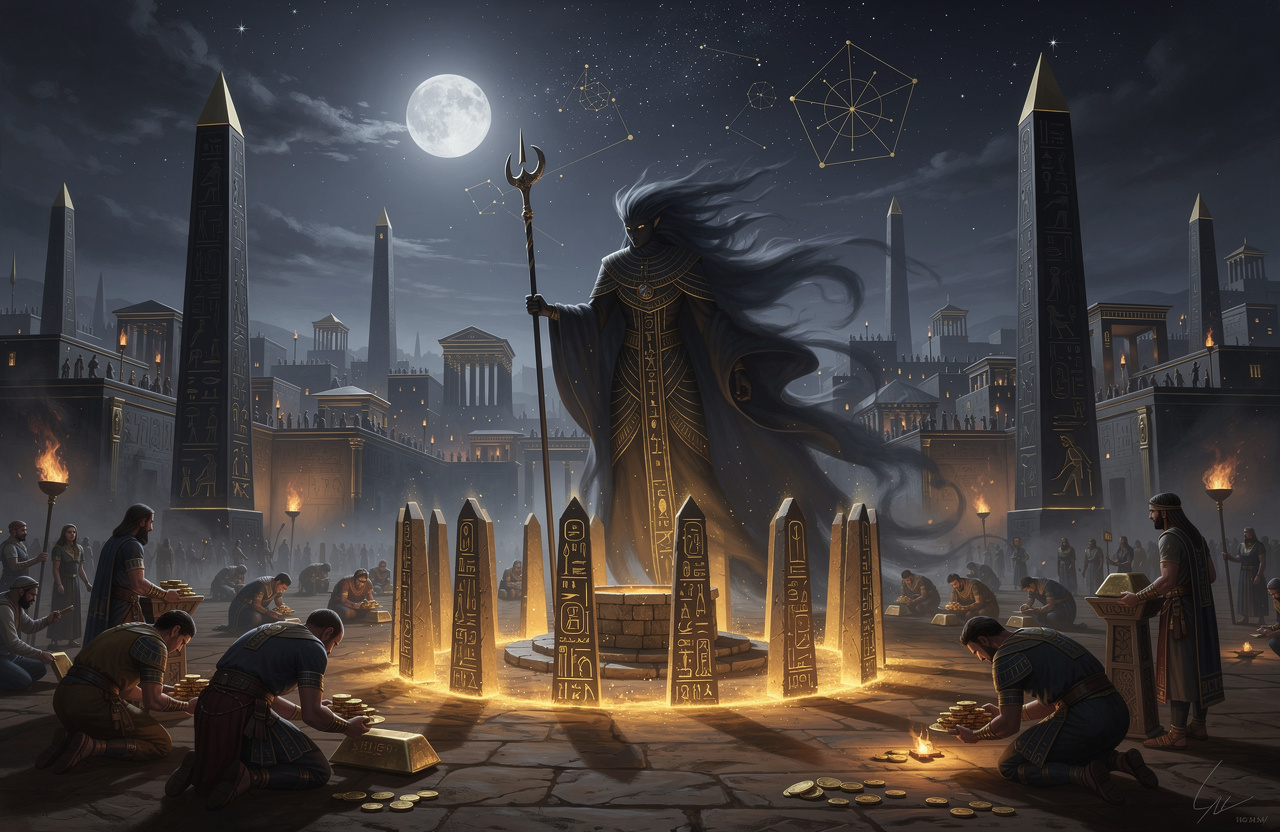
There was a time when the water was nobody's. You walked to the river and drank. There was a time when the air over your head, the seeds in the ground, the songs everyone sang, the very ideas in circulation — all of it belonged to no one, which is to say it belonged to everyone. Economists have a cold, clinical name for this shared inheritance: the commons. And the great quiet project of the last few centuries has been to fence it off, piece by piece, and hand you back a monthly bill for what used to be free.
Look at what you now pay to access, and ask: when did the water start belonging to someone?
Enclosure: the original heist, running on repeat
The blueprint is old. In England they called it enclosure. For centuries, common land was shared — villagers grazed animals, gathered wood, worked strips of open field. Then, over generations, that common land was fenced off and converted to private property. The people who had lived off it became landless overnight, and the only thing left to sell was their labor to whoever now owned the fields. A whole population turned from participants in a commons into renters and wage-workers in someone else's.
That's not a historical footnote. That's the template. And it never stopped running — it just kept finding new commons to fence.
Water. Across the world, public water systems get privatized and handed to corporations. Rates rise. In some cases companies have tried to bottle and sell groundwater from beneath communities that got nothing back. A thing that fell from the sky, free, becomes a product with a price and a shutoff valve.
The spectrum. The radio spectrum — the invisible commons the whole sky is made of — is carved into slices and auctioned to telecom giants for tens of billions. The airwaves themselves, public by nature, become private licenses you rent access to every month.
Seeds. For ten thousand years farmers saved seed from their harvest and replanted it — a commons of life renewing itself for free. Now major agribusiness patents seed genetics, and in many arrangements you are contractually forbidden from saving and replanting. You must repurchase the ability to grow food every single season. The most basic act of life, converted into a subscription.
Data — the newest enclosure. Your behavior, your clicks, your location, your face, your voice — the raw material of the digital age — was a commons nobody thought to fence, until a handful of companies fenced all of it at once. They harvest it for free and sell the refined product back to the world. You are not the customer. You are the field being enclosed.
The pattern under all of it
Strip away the specifics and the same machine hums beneath each one.
Take something that was free and shared. Fence it. Attach a meter. Now the many who used it freely must pay the few who fenced it — forever. Not once. Forever. That's the genius of enclosing a commons: you don't sell people a thing, you sell them permission to keep touching the thing they already needed to live. And need doesn't expire. Water, food, connection, knowledge — the demand renews every single day, which means the rent renews every single day.
Ownership of a commons is not wealth. It is a toll booth on necessity. And a toll booth on necessity is the closest thing to a perpetual motion machine that money has ever invented.
Our record
Weigh it on the Scales.
The commons is Nun — the primordial waters, the undivided ground from which all things rise, belonging to no one because it is everyone. In Maat, the commons stays whole; its abundance flows to all who draw from it, and no one stands at the water's edge collecting a coin.
Enclosure is Isfet's masterwork. It doesn't create anything. It draws a line around what already existed — the water, the seed, the signal, the human face — and declares the line a wall, and the wall a right, and the right a bill. The pump reaches its highest form here: it doesn't extract your labor or your wage, it extracts your access to life itself, one meter-tick at a time. Name it, and the line loses its magic. It becomes just chalk on the ground again.
The IT read: everything is going SaaS, including your existence
Every developer has watched the software world make this exact move, and it should chill you, because it's the enclosure template in real time. Software you used to own — a program on a disk, yours forever — became SaaS. Now you rent it monthly. Miss a payment and the thing you use every day goes dark, even though nothing about it physically changed. The vendor didn't build a better product. They built a fence with a monthly gate.
Now watch that model crawl off the screen and onto the physical world. Cars whose heated seats are a subscription. Tractors you bought but aren't allowed to repair. Seeds licensed like software. Water metered like bandwidth. Your own data, harvested and rented back to you as "personalized" everything. The whole of existence is being ported to a SaaS model, and in that model you are never the owner. You are the perpetual user, one lapsed payment away from being locked out of your own life.
How to refuse the toll booth
You are not helpless in front of the fence. There are moves, and some of them are ancient.
Defend the commons that remain. Public water, public spectrum, open knowledge, seed-saving rights — these are being enclosed right now, and the fencing can be fought at the ballot, in the courts, in the street. A commons defended is a toll booth that never gets built.
Reclaim what was taken — build new commons. Open-source software is a commons rebuilt on purpose: code no one can fence, free forever, owned by everyone who uses it. Open data, open seed libraries, community land trusts, decentralized networks — each is an act of un-enclosure, tearing down a fence and handing the field back.
Refuse the rent where you can. Own instead of subscribe. Choose the tool you can hold over the one you merely rent. Support the open protocol over the walled platform. Every un-enclosed choice starves the toll booth of one more coin.
The lever
Here's the door, and it's the biggest one in this whole series.
Every fence in this story shares a single weakness: it only holds if you agree it's real. Ownership of a commons isn't a law of nature — it's a line someone drew and everyone else consented to honor. Which means it can be un-drawn. The commons can be rebuilt. It's happening already: every open-source project, every community trust, every decentralized network, every ledger owned by its users instead of a landlord is a patch of the commons taken back from the fence.
You were born an owner of Nun — the water, the sky, the seed, the shared mind of humanity. They fenced it and mailed you the invoice. So stop paying rent on your own inheritance where you have any choice at all, and put your weight behind the rebuilt commons wherever you find it. The fence is only chalk. Enough people step over the same line, and it stops being a wall. It goes back to being the ground — which is what it always was.