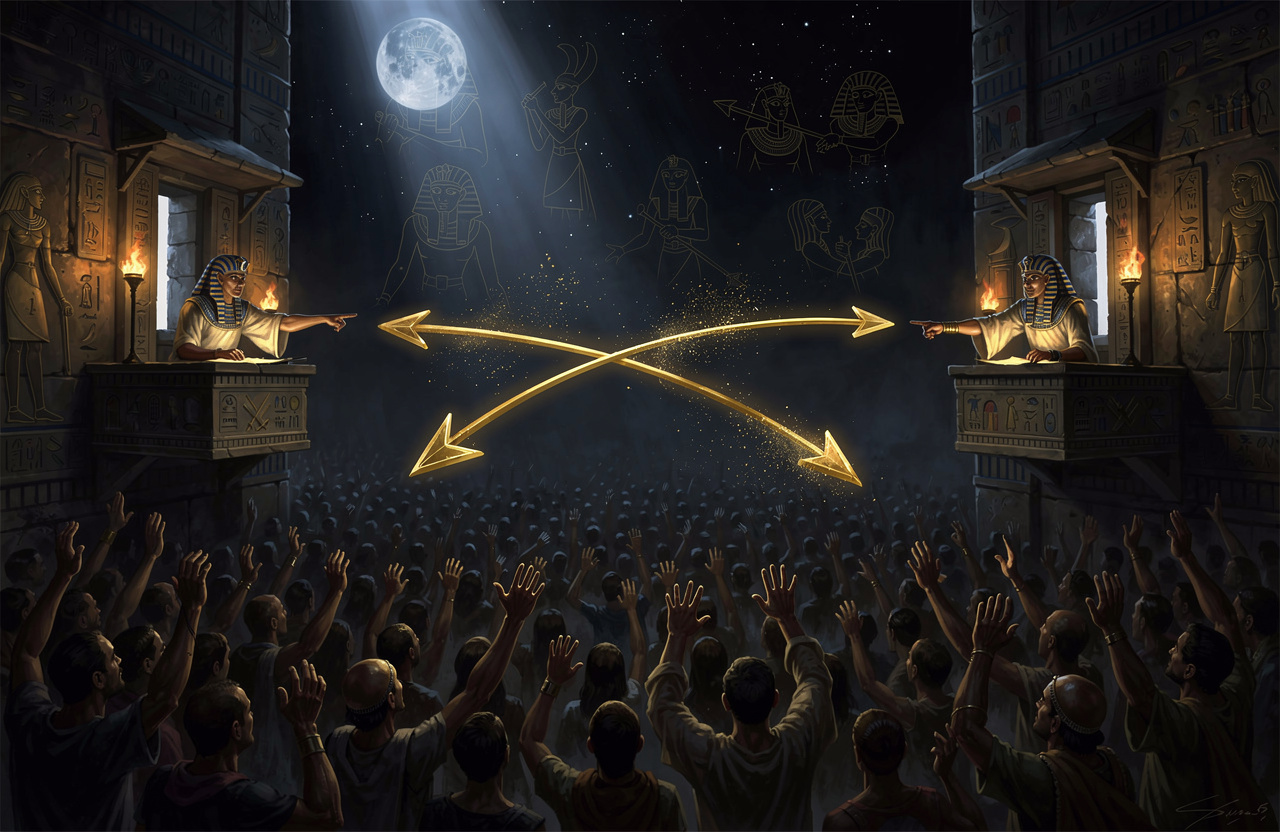
Every year, thousands of companies hold votes. Elect directors. Approve pay. Green-light mergers. Millions of shareholders — funds, pensions, institutions holding your retirement money — are asked to cast ballots on tens of thousands of proposals across the whole market.
No fund on Earth has the staff to actually study all of that. So here's what most of them do: they outsource the thinking. They pay a firm to tell them how to vote, and then they vote that way. And there are essentially two such firms. Two private offices, ISS and Glass Lewis, whose recommendations move a staggering share of the votes cast in the market. Two. Read that number until it unsettles you.
The recommendation that becomes the outcome
Meet the duopoly. ISS (Institutional Shareholder Services) is the elephant; Glass Lewis is the other one. Between them they dominate the entire proxy-advisory business. Their product is simple: for every shareholder vote at every public company, they publish a recommendation — for or against each director, each pay package, each proposal.
Their clients are the institutions that hold the market: index funds, pensions, asset managers steering trillions. Many of those clients don't just consult the recommendation. They follow it, often automatically, sometimes through systems literally configured to cast votes in line with the advisor's call unless someone overrides it.
Estimates vary, but a single ISS recommendation can swing a meaningful chunk of the vote — enough, in a close contest, to be the difference between a director keeping their seat or losing it, a pay plan passing or failing, a merger going through. When a large fraction of the market pre-commits to following two firms, those two firms stop being advisors. They become the counting house.
Why funds hand over the wheel
This isn't laziness, exactly. It's structure — and once you see the structure, the duopoly looks inevitable.
A giant index fund might hold shares in ten thousand companies. Each holds dozens of votes a year. That's hundreds of thousands of decisions, each needing real analysis. Building the in-house team to do that honestly would cost a fortune and eat the razor-thin fees that make index funds cheap. So the fund does the rational thing: it buys the analysis from a specialist and applies it at scale.
There's a second reason, quieter and sharper. Following a respected advisor is defensible. If a vote goes wrong and someone asks why the fund backed it, "we followed ISS policy" is a shield. Independent thinking carries liability; outsourced thinking carries cover. So the incentive doesn't just permit the duopoly — it actively feeds it. Everyone routes through the same two offices because routing through them is the safe move.
A single point of failure for the whole market
Now zoom out and feel the shape of it.
Corporate governance is supposed to be the system's immune response — the mechanism by which owners discipline the companies they own. Vote out the bad board. Reject the obscene pay. Block the value-destroying merger. That's the check.
But if the immune response is effectively coded by two private firms, then whoever shapes their policies shapes the market's collective conscience. Their voting guidelines — how they define a "good" board, an "acceptable" pay ratio, a "reasonable" climate proposal — become de facto law for a huge slice of global capital. Not through any statute. Through the quiet fact that everybody copies the same two answer keys.
In engineering terms, that's a single point of failure — two of them, technically, but two is perilously close to one. Capture, pressure, or simply err at ISS or Glass Lewis, and the error propagates into millions of votes with almost no friction. The system built to check concentrated power runs, at its core, on a two-firm bottleneck.
Our record
On the Scales of Maat, the vote is meant to be Hu — the creative, deciding word. The moment when owners speak and the company must answer. Governance is supposed to be the will of the many, weighed and voiced.
But the Shadow Netjeru learned a subtler move than seizing the vote: it automated the voice. Not "vote our way" — that would provoke resistance. Instead, "here is the recommendation," delivered to funds so overloaded they gratefully accept it, until the many are all speaking words written by two. A market of millions, and its deciding word narrowed to a duopoly's template. That is Apep's masterstroke — not silencing the voice, but centralizing it while everyone still believes they're speaking.
The word that was meant to be distributed became a monoculture. And a monoculture is the most fragile thing there is: one blight, one capture, and the whole field falls at once.
The lever
Never doom without a door — and here the door is bright, because the flaw and the fix are the same shape.
The duopoly's power rests on one thing: funds don't want to think about votes, so they route the thinking to two offices. Break that dependency and the bottleneck dissolves.
- Follow the guidelines upstream. Don't argue the individual vote. Read the policy — how ISS and Glass Lewis define good governance — because that document is where the market's votes are actually decided, one layer up from any single meeting.
- Demand pass-through voting. The real fix already has a name and momentum: let the ultimate owners — you, the pension holder, the fund investor — direct how your shares vote, instead of the chain outsourcing it to an advisor. Every share whose vote is chosen by its true owner is a share removed from the duopoly's template.
- Break the monoculture with more answer keys — open ones. The problem isn't that funds use guidance; it's that two private firms supply nearly all of it. Open, auditable, competing voting frameworks — the governance equivalent of open-source — turn a two-firm bottleneck into a diverse, forkable field.
- Vote where your voice can't be outsourced. In a DAO, there is no ISS between you and the ballot. The word is yours, on-chain, unmediated. That's the whole point of building governance where the voice can't be quietly centralized.
Two offices decide how the market votes only as long as everyone agrees not to think for themselves. That agreement is a default setting, not a law of nature. And default settings — as any engineer will tell you — are made to be changed.
Take back the word. It was always meant to be yours.