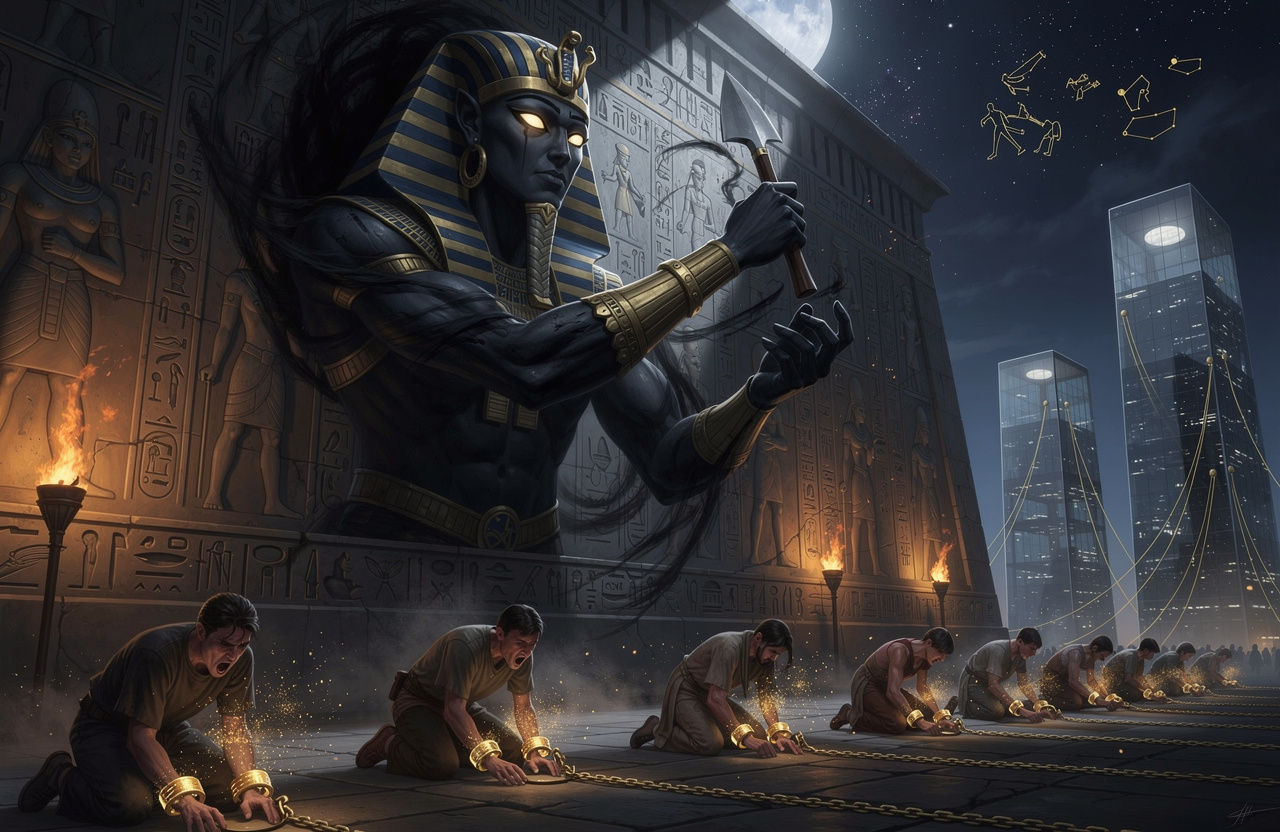
Three thousand three hundred years ago, Pharaoh Ramses II was busy with something that looks strange at first glance. He went around other people's obelisks, temples, and statues and erased their names. He did not destroy the monuments — too crude and too noticeable. He did something subtler: he scraped off a predecessor's name and carved his own over it. Hundreds of objects across Egypt. Careful, methodical, multi-year work of overwriting names.
Why would a great king who already has everything spend effort on someone else's inscriptions? A modern person shrugs: vanity. But through the eyes of the ancient Egyptians, and of an engineer, this was no whim. It was a technology of power. And the same technology works today — only the names are erased not with a chisel but with financial records.
What a name is in the Egyptian system
For us a name is just a label, what you're called. For the Egyptians a name — Ren — was one of the parts of a person, on par with the body and the soul. And not a decorative part, a functional one.
In the system described in the MAAT project's book, the Ren is the line of life, the channel of nourishment. As long as a person's name is spoken, written, remembered — the channel works, energy flows into the person (more precisely, into his Ka). Erase the name and the channel breaks. That is why the most terrible punishment in ancient Egypt was not the destruction of the body but damnatio memoriae — the erasure of the name. To strike out a name meant to kill the person for real, a second time, to disconnect him from the network forever.
An engineer grasps it instantly. A name is an identifier in the system, your account. Erase the record and the system no longer sees you, no longer routes resources to you; to it, you do not exist. And to write your own name over someone else's is not merely a rename. It is redirecting another's nourishment channel onto yourself.
What Ramses was actually doing
Now it is clear what he was doing. Every erased cartouche is a disconnected channel. Every inscribed "Ramses II" is a new channel redirected onto himself. And the obelisks were not just columns of vanity: the ancients built them as working devices, tuned to the principle of Ra, with a pyramidion of electrum at the top. Ramses appropriated these devices by putting his name on them.
And here is the astonishing part: these obelisks still stand, many far from Egypt. "Cleopatra's Needle" in London; its twin in Central Park in New York, its transport financed by the railroad magnate Vanderbilt and erected with thousands of Freemasons present. Thirteen Egyptian obelisks stand in Rome — more than in Egypt itself, one of them at the center of St. Peter's Square in the Vatican. And on many you can still read one name — the one Ramses inscribed over another's. Every time a tourist photographs a cartouche and says "Ramses," the channel works, by the logic of this system. Three thousand three hundred years of continuous flow onto one overwritten name.
The same move: renaming
The main tool of Isfet, according to the book, is renaming. You take a thing and give it a beautiful, false name. Call slavery "partnership" and people go willingly. Call exploitation "service," bondage "access to opportunity." A name changes perception, and perception changes behavior. This is the first stage of any funnel: first rename, then milk. Ramses did it with stone. The modern financial system does it with your life — and more elegantly.
How banks erase freedom
Today a person's name, in practical terms, is his records. Credit history. Score. Account status. A line in the database of a bank, a payment system, a credit bureau. That record determines what you may and may not do: whether you get a mortgage, whether the payment goes through, whether the account opens.
And here the modern erasing of names begins.
- Denial of service. A record is "flagged" — and suddenly the person cannot open an account, get a loan, make a payment. Not killed, not jailed — simply disconnected from the network, like an erased Ren. To the system he has ceased to exist.
- Rewriting terms. The contract you signed as an "attractive offer" is quietly renamed into a debt pit through fine print, a floating rate, and fees. The deal's name is "help," its essence is bondage.
- Scoring. An invisible algorithm assigns you a number that decides your fate instead of you — and you neither see it nor know its logic. Another's hand inscribes its cartouche over you.
The only difference from Ramses is the instrument. He scraped names off granite with a chisel. The modern system rewrites your account in a database. The essence is one: whoever controls the record of your name controls your access to resources — that is, your freedom.
Where is the ordinary person
He is the one whose name is rewritten without being asked. His financial "account" sits in someone else's databases, under someone else's control. He does not see who edits it, how, or by what rules, and learns of the "erasure" after the fact — when refused, blocked, charged. Like the Egyptian priests before the pharaoh, he can do almost nothing against it.
But the book has an antidote. To name is Heka. Conscious naming strips Isfet of its main power — invisibility. The book is an antivirus database of signatures: read it and you recognize the move. The first step to freedom is to see and name the mechanism. The second is to build a record that another's hand cannot erase.
The answer: the MAAT token and DAO
The power of Ramses and the power of the bank rest on the same thing: they control the record of your name and can erase or rewrite it at will. So the answer is a record owned by you, not by the gatekeeper.
That is MAAT. The MAAT token is membership in a cooperative and a single vote on the principle of one human, one vote, not "whoever holds the chisel rewrites the names." Governance runs through a DAO — a decentralized organization with a transparent treasury on a blockchain, where the record of your right and your vote does not sit in one database that can be quietly edited. It cannot be scraped off by decree: it is distributed across a network with no single owner holding a chisel. And transparency here works as Heka — naming aloud: everything is visible, nothing can be renamed in secret. The entry is simple: read the book, take the token, get your vote — and become the one whose name cannot be erased from someone else's obelisk.