Here is a fact that will reorganize how you see the economy. When Ticketmaster sells you a concert ticket, it did not write the song, book the venue, or play a single note. It stands at the gate, and it charges you to pass. Its "service fee" runs 20 to 30 percent of face value. On some events, more. That is not a payment for value created. It is a toll for a door it does not own but controls.
That is rent-seeking. And once you see it, you cannot unsee it.
Two ways to make a dollar
There are exactly two ways to earn money.
The first: you make something. Bread, code, a bridge, a song, a healed patient. You add value that did not exist before. The world is richer by the amount you built. This is production. Honest weight on the scale.
The second: you position yourself between other people and something they need — and you charge for passage. You did not grow the wheat. You own the only road to the mill. You did not build the app. You own the app store, and you take 30 percent of every transaction that flows through it. Apple's cut on the App Store is 30 percent for large developers, 15 for small ones — on software Apple did not write, sold to users Apple did not find, for value Apple did not create. That is a toll.
Economists have a polite name for the second thing. They call it rent-seeking. The word "rent" here does not mean your apartment payment specifically — it means income you receive by controlling access, not by producing. A patent troll who buys a vague patent and sues real builders is collecting rent. A cable monopoly in a town with one provider is collecting rent. A licensing board that makes hair-braiding require 1,000 hours of training is manufacturing rent for the people who already hold the license.
The tell: subtract the gatekeeper
Here is the test. Remove the actor and ask: is the world worse off?
Remove the baker — people go hungry. Production.
Remove Ticketmaster — the band still plays, the fans still come, and the tickets cost less. Rent.
Remove the patent troll — the engineers keep engineering, and nobody misses a thing except the troll's lawyers. Rent.
This is the cleanest lie-detector in economics. The producer, when subtracted, leaves a hole. The rent-seeker, when subtracted, leaves a discount.
Now look around. Payment processors skimming a few percent off every card swipe on rails built decades ago. Middlemen in drug distribution. Multiple-listing services in real estate that gatekeep the data on homes. Index-fund giants that vote your shares. Software that charges per-seat forever for a one-time build. Some of these do real work. Some are pure toll booths wearing a service badge. Your job is to tell them apart.
Our record
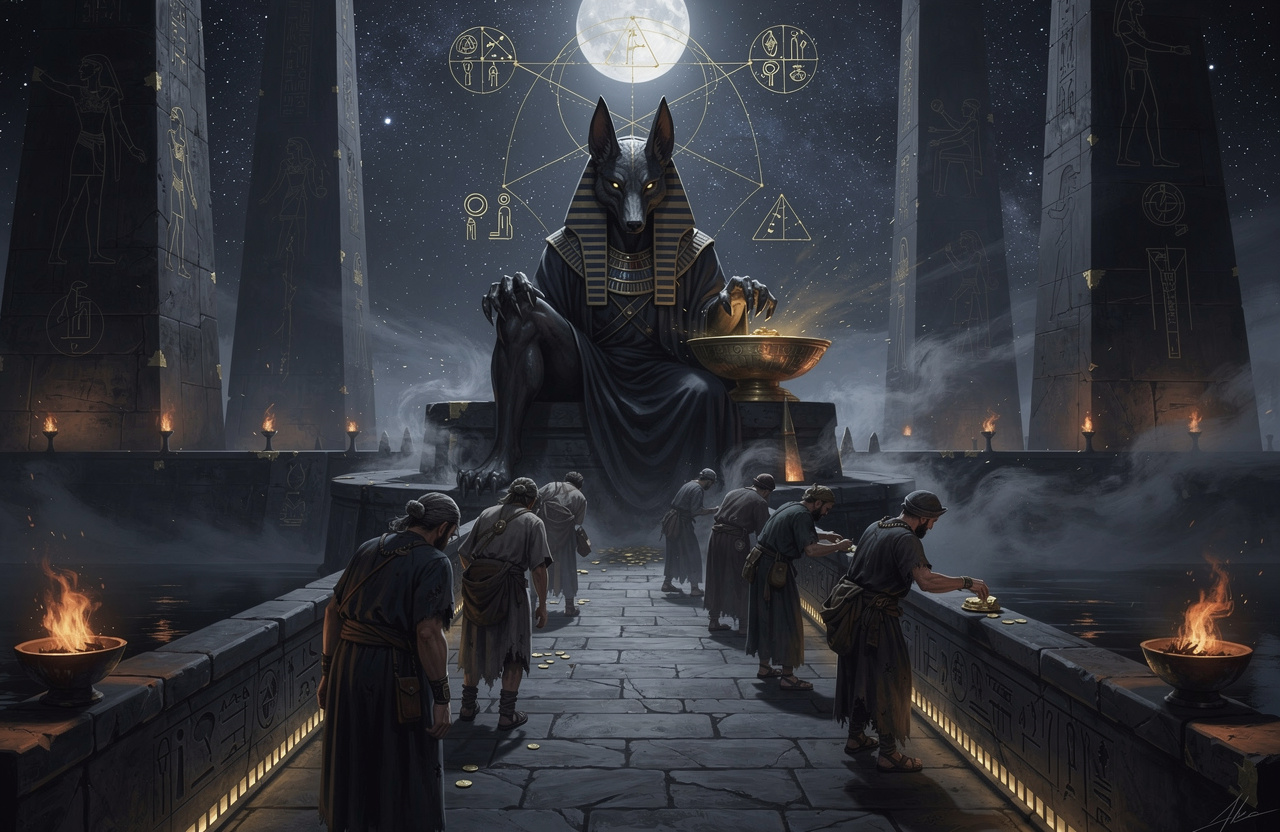
In the Egyptian frame, all of this has a name. Isfet is not merely chaos — it is the parasite. It produces nothing and consumes the Sekhem, the life-force, of those who do. The rent-seeker is Isfet in a suit. He does not swing the hammer; he owns the doorway and drains the vitality of everyone who must pass.
The Scales of Ma'at weigh one thing: did your weight on the pan match your worth? The producer's heart is light — he gave more than he took. The rent-seeker's heart is heavy with everything he skimmed and never earned. On the true scale, the toll-collector always weighs more than his contribution. That gap — between what he extracted and what he made — is the exact mass of Isfet in the system.
The pump runs upward. Sekhem flows from the many who build to the few who own the gates. Name the pump, and it starts to lose its cover.
Why it grows
Rent-seeking is a bug in the firmware of every economy, and it compounds for a brutal reason: rent is easier than production.
Building is hard. You can fail. The market can reject you. But if you can capture a chokepoint — a patent, a license, a network with lock-in, a regulation written by your own lobbyists — you get income without risk. So the smartest, best-capitalized players do the rational thing: they stop competing on value and start competing to own gates.
This is why lobbying pays better than R&D. A dollar spent influencing a regulation can return hundreds in protected rent. A dollar spent on research might return nothing. Capital is not stupid. It flows to the higher return. And so, decade over decade, more of the economy's brainpower goes into building toll booths instead of roads.
The tech world has a specific word for the endgame: enclosure. First the platform is open and generous — it courts you. Then, once you cannot leave, the extraction begins. Free becomes cheap. Cheap becomes expensive. Open becomes proprietary. The garden you helped grow becomes the garden you are locked inside, paying rent to the landlord who watched you plant it.
The lever
Here is the door, because we never leave you at the wall.
Rent-seeking survives on one thing: the gate must be closed and singular. A monopoly on the road, the data, the rails, the standard. Break the singularity and the toll collapses on its own — you cannot charge for passage when there are ten free doors.
This is not theory. It is the entire point of open protocols, open source, and decentralized rails. When the ledger is public and anyone can build on it, no one owns the doorway. When the standard is open, no gatekeeper can enclose it. The reason a permissionless network terrifies the toll-collectors is simple: it removes the gate they were planning to charge at.
So the practical move, at every scale: prefer the open door over the proprietary one, even when the proprietary one is slicker today. Own your keys. Own your data. Back the protocols no single actor controls. Every gate you route around is rent you stop paying — and rent you stop paying is Sekhem that stays with the ones who build.
Find the toll. Ask who built the road. If the answer is "not them" — route around it.