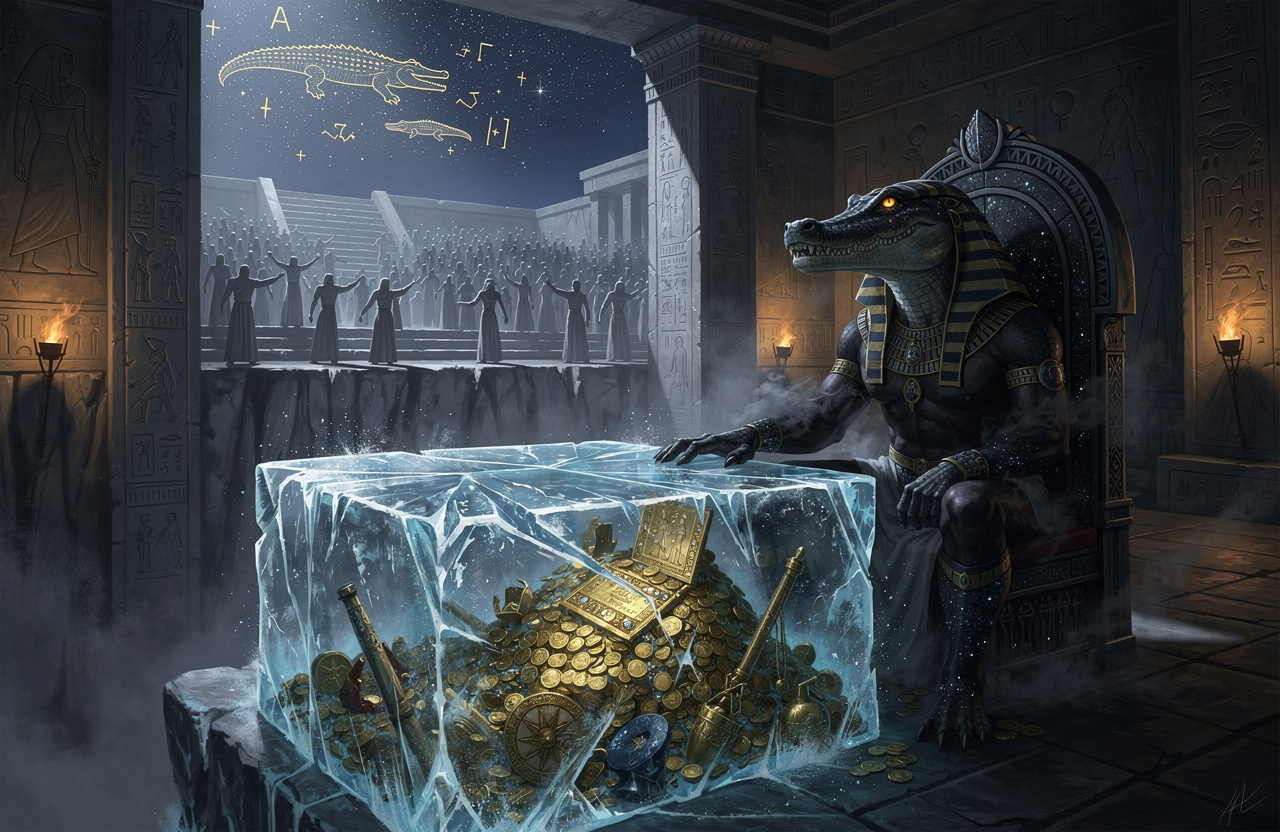
In 2022 something happened in world finance that history will call a turning point. The currency reserves of an entire country's central bank were frozen — around three hundred billion dollars of Russian state holdings sitting in Western banks became inaccessible in a single moment. This was not an oligarch's money, not a company's assets. This was the state's "golden rainy-day fund," the kind any country saves precisely for a black day.
You can feel however you like about the causes and the sides of the conflict. But the technical essence of the event matters more than the politics. On that day every central bank in the world was quietly shown a new rule: what you considered your untouchable reserves does not, in fact, fully belong to you. It belongs to you as long as the people holding it agree with you.
What reserves are and why they exist
Let me put it simply. A state, like a person, sets money aside for emergencies. Only the rainy-day fund is measured not in thousands but in hundreds of billions. These are currency reserves — a stock of foreign currency and securities a country uses as a buffer: to support its currency in a crisis, pay for critical imports, service debt, ride out a storm.
Where are these reserves kept? Here is the key point few people grasp. Mostly — not at home in a vault. They sit as entries in Western banks and in the government bonds of Western countries. That is, a country's "own" reserves are physically and legally located on someone else's territory, under someone else's jurisdiction. Entries in someone else's ledger.
An engineer would say: you thought you were storing your data yourself, but it's actually in someone else's cloud. And access to the cloud belongs to the provider, not to you. As long as you're on good terms — everything is fine. On the day of the quarrel, it turns out who the real admin of that cloud is.
Why 2022 is a precedent
Asset freezes happened before — of individuals, companies, small countries. But 2022 differs in scale and target.
For the first time, the reserves of a major power were frozen on this scale — a permanent member of the UN Security Council, one of the world's leading economies. And it was done fast, in a coordinated way, by the whole Western bloc at once. The sum — unprecedented. The signal — deafening.
A precedent works the same in law and in engineering: if something was done once and it worked, then it is now possible and permissible. A door opened once stays open. After 2022 no central bank in the world can consider its dollar and euro reserves absolutely safe anymore. Because now everyone has seen: under certain conditions they can be frozen. And the conditions are defined not by the owner of the reserves.
Fact and myth
Let's draw the line.
Myth: "The money was simply stolen, taken, and spent." As of this writing most of the frozen reserves are precisely frozen, not directly confiscated — that is, formally they exist, but there is no access to them. Long legal disputes continue over whether even the income from these assets can be channeled to other people's needs.
Fact: but for practical life, "frozen" and "taken" are nearly the same. If you cannot use your own money for an indefinitely long time and don't know whether it will ever be returned, economically that is a loss. And the main thing: the very fact that this is possible has already changed the behavior of the whole world. Central banks began buying gold more actively — physical metal that lies in your own vault and that no one can freeze with one click. This is a quiet but mass vote with the feet: trust in "cloud" reserves has been torn.
The conclusion is uncomfortable for everyone: a weapon used once on such a scale devalues the very system in which it was used. By showing that the dollar and the euro can be switched off by political decision, their custodians undermined the main quality of a reserve currency — unconditional reliability.
Where is the ordinary person
It seems that trillions in reserves and central-bank disputes are infinitely far from ordinary life. But the logic here is exactly the same as in your personal wallet — only the scale differs.
If even the reserves of an entire state turned out to be conditional — an entry whose access can be cut off — then what of an ordinary person's money in a bank account? It too is not "yours" in the full sense. It is an entry in someone else's ledger, access to which is held by an intermediary: the bank, the payment system, the regulator. As long as all is calm — you are the owner. On the day a decision is made at the top, it turns out the owner is whoever holds the keys to the database. The year 2022 simply showed this on the largest and most vivid example.
The answer: the MAAT token and DAO
The main lesson of the freeze is about the nature of property in a centralized system. What sits as an entry in someone else's infrastructure belongs to you exactly until the owner of that infrastructure changes his mind. This applies both to a power's reserves and to a person's savings.
MAAT offers a different model of ownership. The MAAT token is membership in a cooperative and a single vote on the principle of one human, one vote, not "whoever holds the keys to the vault decides." Governance runs through a DAO — a decentralized organization with a transparent treasury on a blockchain, where the record of your right does not sit in one bank that can be blocked on command. The token keeps existing even if tomorrow, for political reasons, some bank or broker shuts down — it is not in someone else's cloud but in a distributed network with no single admin. This is not "protection from every misfortune on earth" — it is one brick of independence the ordinary person simply did not have before. The entry is simple: read the book, take the token, get your vote — and stop keeping everything you've earned solely in someone else's ledger.