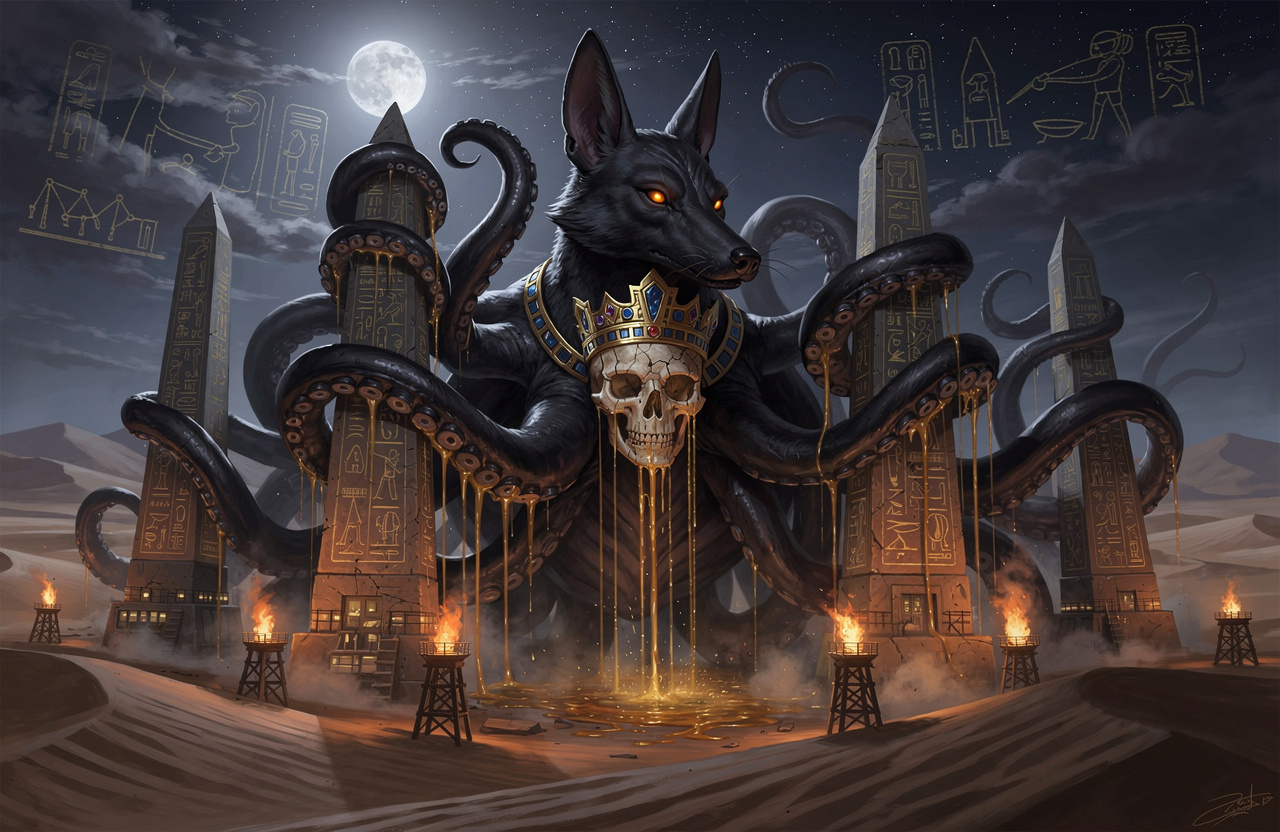
If the Rothschilds showed how to make money supranational, the Rockefellers showed something else: how to capture an entire industry so completely that, on paper, you've broken no rules, while in fact you hold a whole country by the throat. This is not a story about oil. It is a story about the architecture of control — and how people learned to hide it behind legal structures that still work today.
Not the cheapest, but the smartest
John Davison Rockefeller started as a bookkeeper. That detail matters: he looked at business not as an adventurer but as a man who likes the numbers to add up to the penny. In 1870 he founded Standard Oil. The oil boom back then was chaos: hundreds of small drillers and refiners, dirty competition, prices jumping around.
Rockefeller didn't try to become the biggest driller. He did something smarter — he took control of the bottleneck. In the oil business, the bottleneck isn't the well (there are many) but refining and, above all, transport. Whoever controls the pipes and the railroad controls everyone who owns a well.
Standard Oil negotiated secret shipping rebates with the railroads — and not only discounts on its own oil, but surcharges on competitors' oil too. So a rival paid more for transport, and part of that overpayment flowed to... Rockefeller. An engineer would call this control of the protocol: it doesn't matter how many apps you have, if I own the network they all travel through.
How to eat an industry and call it order
From there, a simple mechanism kicked in. A competitor would get an offer: sell us your business at our price — or we'll crush you with transport tariffs and you'll go bust on your own. Many sold. Those who held out were methodically squeezed.
By the early 1880s, Standard Oil controlled around 90% of U.S. oil refining. Ninety percent. That is no longer a company — it is infrastructure dressed up as a company.
And here is the key move worth remembering. To run dozens of formally separate firms as a single whole, in 1882 Rockefeller's lawyers invented the trust — a structure in which the shares of many companies are handed to a group of trustees. On the outside, a crowd of independent firms. On the inside, one center pulling all the strings. That is how the word "trust" entered the language as a synonym for monopoly, and how a template appeared for hiding power behind division.
The state strikes back — and loses big
Outrage grew. Journalist Ida Tarbell wrote an exposé series on Standard Oil's methods — one of the first great examples of investigative journalism. In 1911 the U.S. Supreme Court ruled that Standard Oil was an illegal monopoly and ordered it broken up.
It sounds like a victory for the public. Now the instructive part. The company was split into 34 pieces. Among them were the future Exxon, Mobil, Chevron, Amoco, and other names you still know. But the shares of all these fragments stayed with the same owners, above all Rockefeller himself. And when the broken-up companies listed separately on the exchange, their combined value... rose. The "punishment" left Rockefeller even richer.
Let's draw the line honestly. Fact: the monopoly was formally dismantled. Myth: that this dismantled Rockefeller power. Power was not in the "Standard Oil" sign — power was in the ownership stake. They changed the sign and kept the ownership, so the octopus simply grew several separate tentacles, each of which became a giant in its own right. That is the lesson: strike the form without touching the structure, and the structure survives the blow.
Immortality through trusts
The Rockefellers perfected one more device — the dynastic trust. Money and assets are packaged into a legal construct that belongs to no single heir personally, which makes it harder to tax, to divide in a divorce, or to squander. In 1934 irrevocable family trusts were created, designed to run for generations ahead. Capital stops being personal property and becomes a self-reproducing structure that outlives any particular human.
That is the corporate octopus in its purest form: a human doesn't own the money — a construct owns everything, and the people around it are merely temporary managers and beneficiaries. Perfect fault tolerance: an heir can drink himself to ruin, go broke, or die — the structure keeps running.
Where is the ordinary person in this
He's at the gas pump, the pharmacy counter, the store. He pays for everything that carries the markup of a monopoly or near-monopoly. His choice is an illusion: a dozen brands on the shelf, often backed by two or three owners. Control of the bottleneck means you pay not a market price but the price set by whoever holds the pipe.
The answer: the MAAT token and DAO
Rockefeller won by seizing the bottleneck and hiding control behind division into formally independent parts. The symmetric answer is not to build yet another monopoly "for good people," but to make the bottleneck shared and transparent.
That is MAAT. The MAAT token is membership in a cooperative and a vote under the principle of one human, one vote, not "one dollar, one vote." Decisions are made in a DAO — a decentralized organization with a transparent treasury, where there is no secret center pulling the strings of hidden trusts: every movement of funds is written to an open ledger and visible to all. Where Rockefeller hid unified control behind a multitude of signs, we do the opposite — a multitude of people under one open, verifiable rule. The entry is simple: read the book, take the token, get your vote — and stop paying tribute to whoever owns the pipe.