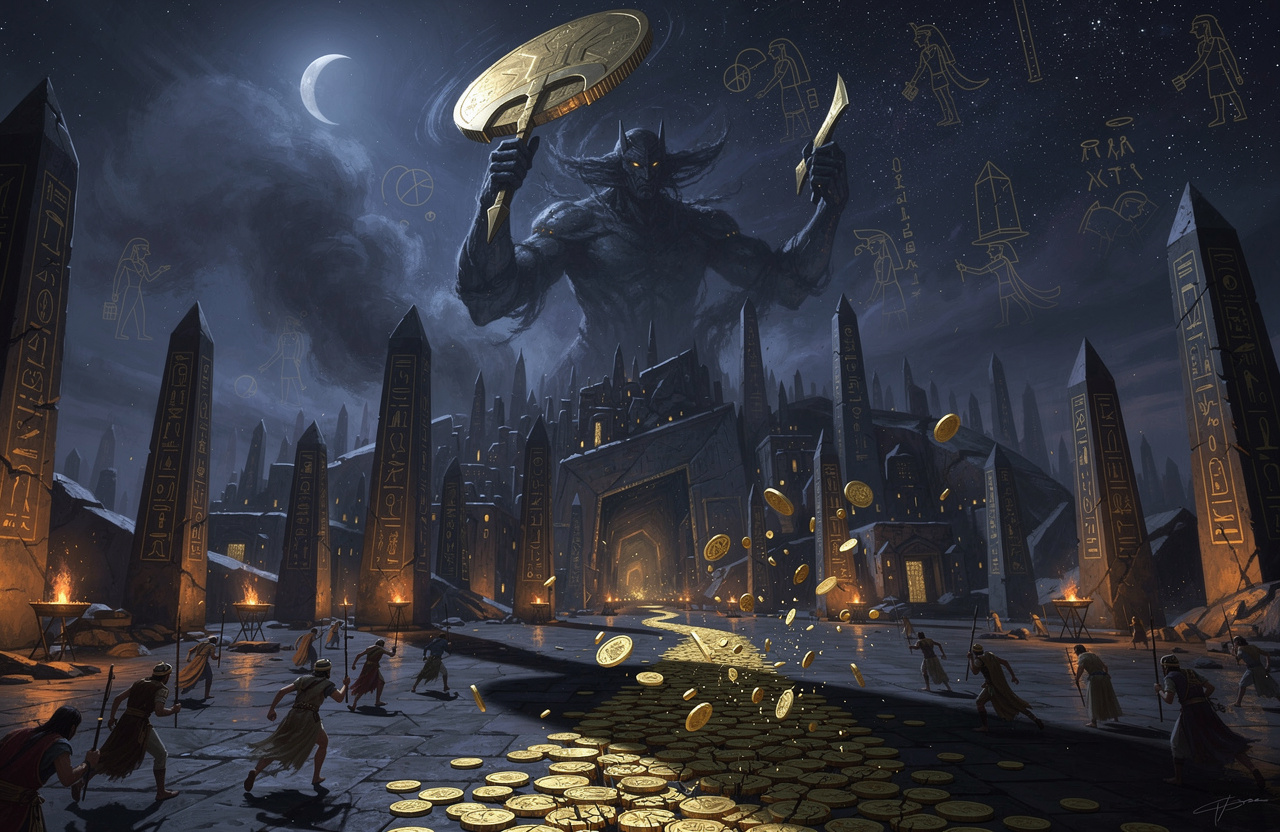
There is a weapon that makes no noise. It leaves no craters, appears in no military bulletins, and does not look like war. Yet it can bring a whole country to its knees faster than an army. That weapon is access to the dollar and to the world's financial infrastructure. And whoever controls that access can disconnect you from the system with a single command, the way an admin blocks an account.
Sanctions were long treated as something secondary, "diplomacy for the poor." In reality they may be the main weapon of the modern era. A bomb destroys one city. A financial blockade collapses the economy of an entire nation and never dirties the hands of whoever pressed the button.
Why the dollar is a lever
To understand the power of sanctions, you have to understand one thing about the dollar. It is not just the currency of the US. It is the operating system of world trade.
Most international settlements run through the dollar. Oil, metals, grain, ships, contracts — a huge share of it is priced and paid in dollars. And any dollar payment at some point passes through the American banking system — even if neither sender nor receiver is in the US. The dollar is everywhere, and so the American state has a say in nearly any deal on the planet.
An engineer would say: it is as if the whole internet ran through one root server, and the server's owner could shut off access to a specific user at any moment. Not hacking, not war — just striking you off the allowed list. You still exist, but the system no longer sees you.
How it works in practice
The mechanics of sanctions are simple, and that is what makes them frightening.
- Asset freezes. A country's or a person's money sitting in Western banks becomes inaccessible in a single day. It is supposedly yours — but you cannot reach it.
- Cutting off from payment systems. A country's banks are severed from international transfers. Foreign trade suffocates: nothing to pay with, nothing to receive with.
- Secondary sanctions. The most powerful. They punish not only the target but anyone, anywhere, who dares to trade with the target. This means a neutral company in a neutral country fears dealing with the sanctioned party — because otherwise it too would be thrown out of the dollar system. So one country forces the whole world to enforce its bans.
In the end, imposing sanctions requires no soldiers, no UN consent, no declaration of war. It requires one decree and control of the financial infrastructure. Cheap for the one who imposes. Devastating for the one it is imposed on.
Fact and myth
Let's draw the line.
Myth: "Sanctions are always a precision strike on villains; they don't touch ordinary people." That is how they are sold: "targeted sanctions against the regime." The reality is different.
Fact: broad economic sanctions hit ordinary people first. Medicine and food get more expensive, the currency collapses, jobs disappear, imports of needed things — from spare parts to medical equipment — stop. The sanctioned elite suffers last: it has workarounds, grey schemes, and reserves. The population pays. Historians and humanitarian organizations have repeatedly shown that broad sanctions cost lives — through shortages of medicine and food — on a scale comparable to military losses.
The uncomfortable conclusion: "the dollar instead of bombs" sounds humane, but by the number of victims the difference often does not favor sanctions. These victims simply aren't shown on the news — there are no explosions, no footage. The quiet war looks clean precisely because its consequences are smeared out and invisible.
Who collects the profit
Here it is worth naming things plainly. Beyond the political goal, the sanctions machine has a money side too.
Control of the financial infrastructure is a rent. Whoever holds the world's settlement system does not merely punish enemies — he locks in his privileged position: everyone is obliged to use his money, his banks, his rules. Any attempt to build an alternative is treated as a threat and crushed. That is the "exploit": a position seized once is used to stop anyone from challenging it. A structure that profits from its monopoly position and strangles competitors is, in the book's language, Isfet — the inversion of fair exchange. Not trade among equals, but power as a gatekeeper.
Where is the ordinary person
On both sides — at the bottom. In the country the sanctions target, the ordinary person loses his job, his savings, and access to medicine, though he made no decisions. In the country imposing the sanctions, the ordinary person pays for a costlier life and inflation, because severing trade hits everyone. The benefit — political and financial — is collected by a narrow circle at the top on both sides of the border. Peoples punish each other, and the bill passes by those who pressed the button.
The answer: the MAAT token and DAO
The strength of the sanctions weapon is that the world's money and settlements are a single centralized infrastructure with a kill switch in the hands of a narrow group. Where there is a single kill switch, there is always the one who owns it and the one who gets switched off. The ordinary person is by definition on the side of the switched-off.
MAAT builds a different logic. The MAAT token is membership in a cooperative and a single vote on the principle of one human, one vote, not "whoever has more reserves and banks rules." Governance runs through a DAO — a decentralized organization with a transparent treasury on a blockchain, where there is no single admin with the right to press a button and erase you from the system. A holder's assets and vote do not depend on whether two states quarreled somewhere at the top. This is not "a way to evade all sanctions" — it is a way to build a piece of infrastructure that has no single owner with a kill switch. The entry is simple: read the book, take the token, get your vote — and stop being an account that can be switched off by someone else's decree.