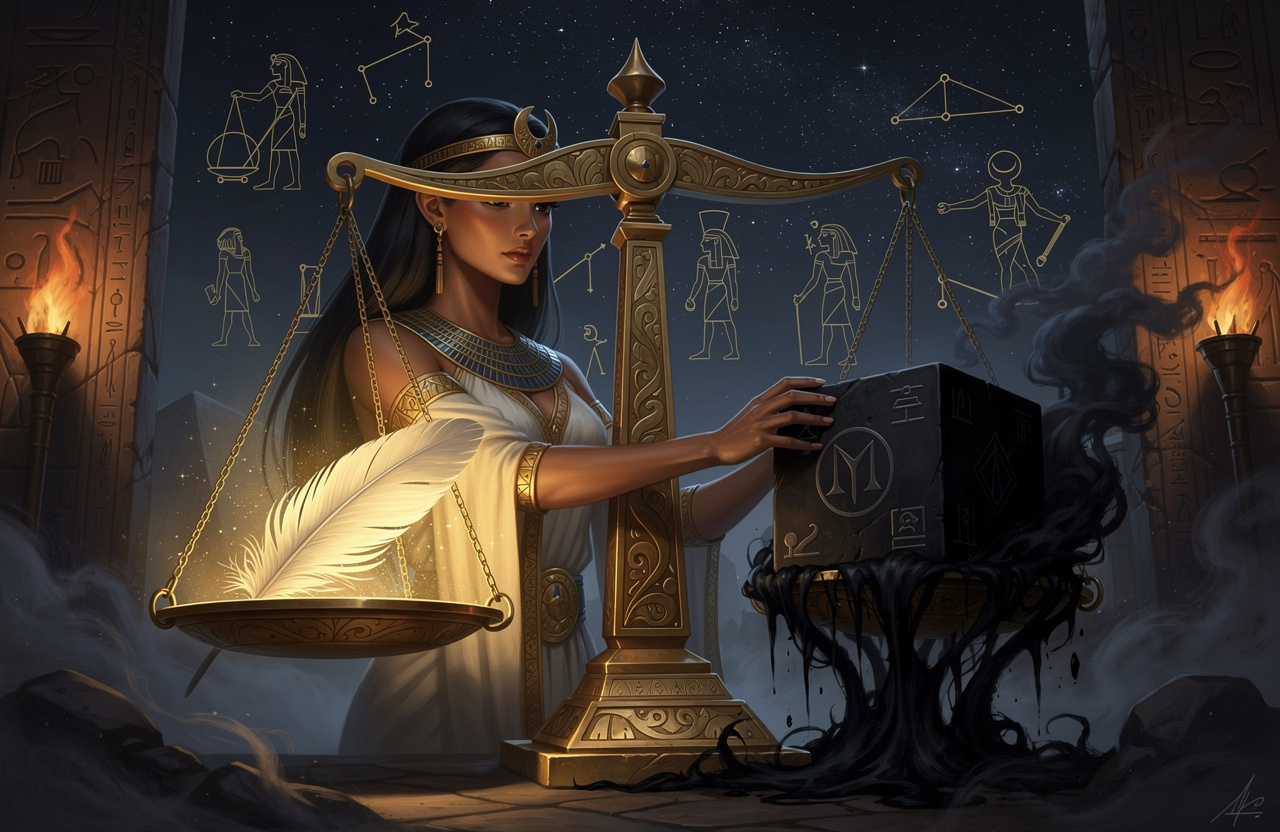
An AI that decides your life and refuses to say why is not a tool. It's a verdict. And a verdict without appeal is the oldest technology of tyranny, just wrapped in new silicon.
You've met it already. The loan you didn't get. The résumé the filter dropped. The account frozen by an algorithm no human at the company can explain. Each time, the same shape: a decision arrives, weighted with consequence, and when you ask why — silence, or a shrug, or "the system flagged it." That's the black box. And the black box is the Shadow Neteru's favorite architecture, because it is judgment with the accountability surgically removed.
The ancient Egyptians built the exact antidote four thousand years ago. It was a set of scales.
What the Scales actually demand
In the hall of judgment, the heart is weighed against the feather of Maat. Notice the design — because it's a governance spec, not a fairy tale.
The weighing is visible. Everyone in the hall sees the beam. There is no hidden calculation, no "the scale flagged it." The mechanism is public.
The standard is fixed and known. The feather. One clear criterion, declared in advance, the same for every heart. Not a shifting proprietary weight that changes with who's watching.
The verdict is explainable. Forty-two declarations, each a specific accountable claim. The judged one can hear precisely what is measured. No "it's complicated."
That's it. That's the whole anti-black-box protocol: visible mechanism, fixed public standard, explainable verdict. The Egyptians encoded due process into a myth. We forgot it and let a corporation ship us a scale you're not allowed to look at.
Our Record
Here is the deep reading. Maat is not "niceness." Maat is the principle that judgment must be balanceable — that every weight placed has a counterweight that can be seen, checked, and, if wrong, reversed.
The black box violates Maat at the root. It places a weight and hides the beam. It renders a verdict and burns the transcript. It makes the heart un-weighable — you cannot balance what you cannot see. That is Isfet in pure algorithmic form: consequence without accountability, force without the feather.
And note the deepest law of the Scales: the beam moves both ways. Nothing on the true scale is final in the sense of irreversible. A weighing can be re-weighed. That reversibility — the capacity to return, to undo, to appeal to the waters of Nun and begin again — is not weakness in the system. It is the safety mechanism of reality itself. The black box wants finality. Maat insists on reversibility.
Three feathers against the box
So what does Maat demand of any AI that touches human lives? Three concrete counterweights.
Transparency — the visible beam. If a model decides something that matters — credit, employment, freedom, benefits — its logic must be inspectable. Not the marketing gloss. The actual basis for the decision, in a form a human can audit. Open weights where possible; explainability requirements where not. A judgment you can't inspect is a judgment you can't trust, and the burden of proof is on the box, not on you.
Reversibility — the appeal to Nun. No automated verdict may be the last word. There must be a path back: a human review, an appeal, an undo. Regulators grope toward this — the EU's AI rules push for human oversight of high-risk systems — but the principle is older than any statute. If a decision can't be reversed, it should never have been fully automated. Irreversibility is where the parasite hides, because a mistake you can't undo is a mistake nobody has to answer for.
Right of voice — the heard declaration. The person judged must be able to speak into the process — to contest, to correct the record, to be more than a row in a database. Ma'at without voice is just a prettier boot. The feather only means something if the heart gets to answer for itself.
The counterargument — and why it fails
They'll say: "Modern AI is too complex to explain. The model has billions of parameters. Nobody fully understands it."
Two answers.
First — then it's not fit to judge you. If a system is too complex to account for its verdicts, that is a reason to bound its authority, not to excuse it. We don't let an unexplainable process sentence a person just because the process is impressive. Complexity is not a license.
Second — it's often a dodge. Plenty of consequential decisions run on models simple enough to explain, and the black box is a choice — opacity as a moat, not a necessity. And where models are genuinely complex, the demand isn't "explain every neuron." It's "show the mechanism, fix the standard, allow the appeal." Those are achievable. The engineering exists. What's missing is the requirement.
The lever
Here's what you carry out of this.
The black box is not inevitable — it's a design decision that Maat forbids, and design decisions can be reversed. Every one of the three feathers is a concrete demand you can make, back, and build.
Demand transparency: refuse verdicts you can't inspect, and support the tools and laws that force the beam into view. Demand reversibility: no consequential AI decision without a human appeal — treat irreversibility as the red flag it is. Demand voice: the right to answer for your own heart.
And build the alternative. Open models over proprietary ones. On-chain, auditable governance over corporate opacity — a DAO's rules are visible by construction; that's a scale you're allowed to look at. Local systems that answer to you over cloud oracles that answer to no one.
The Shadow Neteru rules through the sealed box. Maat rules through the open beam. You already know which one you'd choose to be judged by.
Now build the hall where the beam is visible. Weigh, and be weighed, in the open.