Twelve words. Sometimes twenty-four. Written in plain English, in a fixed order. That short list is your wallet — not a copy of it, not a password to it. It is it.
Anyone who reads those words can recreate your wallet on their own device, anywhere on Earth, and take everything. No hack required. No password to crack. They just type the words in. That's it. That's the whole heist.
Understand this in your bones before you touch real money: the seed phrase is not like the keys to the vault. It is the vault, the keys, the deed, and the getaway car, compressed into a dozen words. Guard it accordingly — or don't, and join the long list of people who learned this the expensive way.
What the seed phrase actually is
When you create a self-custody wallet, it generates a seed phrase (also called a recovery phrase or mnemonic) — usually 12 or 24 words drawn from a fixed list of 2048 (the BIP-39 standard). From that phrase, the wallet mathematically derives every private key and every address you'll ever use.
This is why it's so powerful and so dangerous:
- It's a full backup. Lose your phone, break your laptop, wipe your hardware wallet — type the seed into a new device and every coin reappears. The funds were never in the device; the device just held the keys.
- It's a full compromise. Anyone with the phrase has the same total control you do. There is no "reset password," no support line, no fraud department that reverses it. In self-custody, you are the bank, the vault, and the security guard.
Twelve words. Total power. Zero recourse if they leak. That's the trade you accept for being your own bank.
Why the cloud is exactly the wrong place
Here's the mistake that has drained more wallets than any exploit: people take a photo of the phrase, or paste it into a note, or email it to themselves. Convenient. Fatal.
The moment your seed phrase touches an internet-connected system, you've handed it to every attacker who ever breaches that system:
- A photo in your camera roll syncs to cloud backup automatically. Your seed is now on a server you don't control, protected only by your account password.
- A note in a notes app syncs across devices through the cloud. Same exposure.
- An email to yourself sits in your inbox forever, one phishing or breach away from total loss.
- A password manager is better than the above — but it's still a networked, hackable target, and if that vault falls, everything falls with it.
- A screenshot is a photo. Same problem. Never screenshot a seed phrase.
The rule is brutal and simple: the seed phrase never touches an internet-connected device as readable text. Not once. Attackers run automated scanners hunting for seed-phrase patterns across breached clouds, pasted text, and compromised machines. A phrase that has ever been digital-and-online should be considered already burned.
Our Record
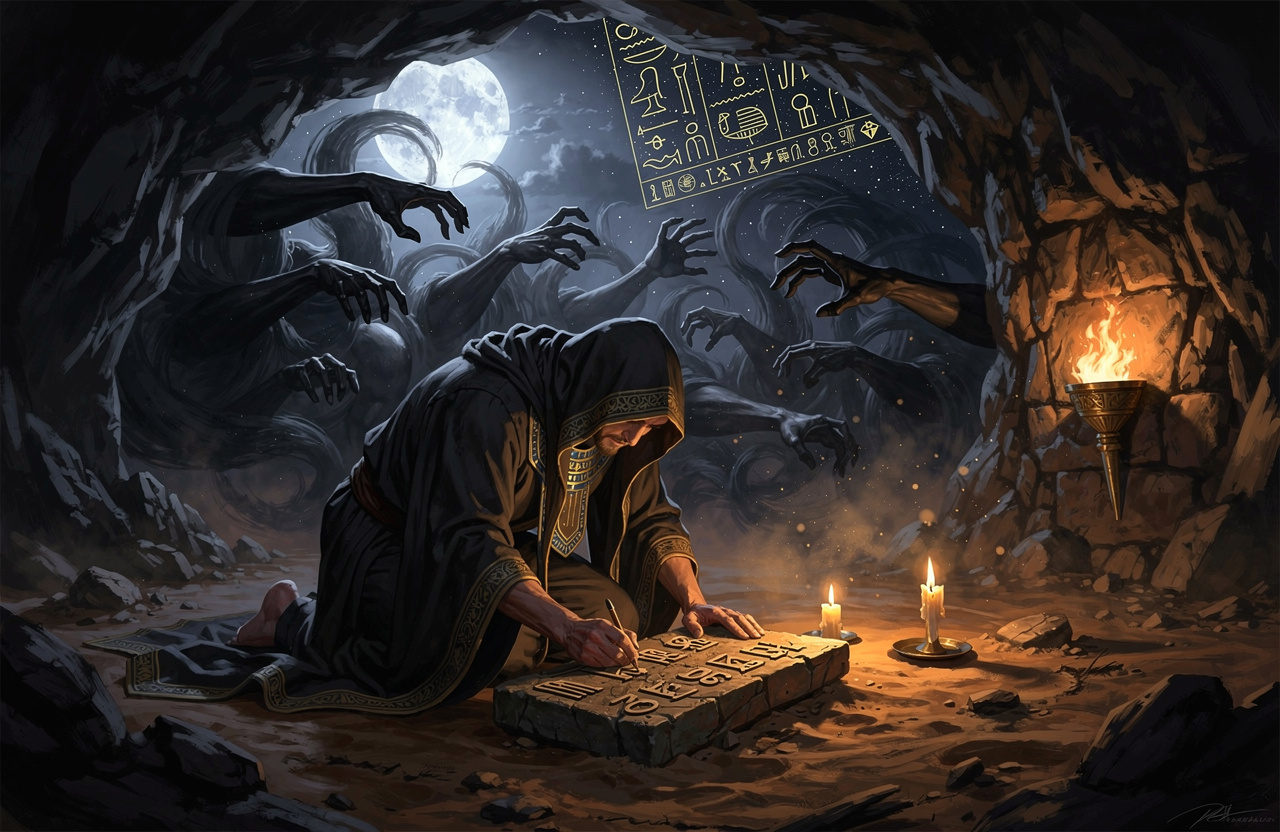
The seed phrase is the true name of your Ka — the essence from which your whole on-chain body is derived. In the old magic, to know a being's true name was to hold power over it entirely. That is not metaphor here; it is the literal cryptography. To speak that name into the cloud is to write it on the temple wall for any passing thief to read. Isfet is the leak, the careless photo, the convenient sync that quietly copies your essence to a server you'll never see. Ma'at is the discipline of the sealed name — kept offline, kept physical, kept known only to you. The inviolability of the Ka is not poetry. It is opsec. Guard the name, and you keep the body. Spill it, and there is nothing left to guard.
How people actually lose it — and how you don't
Two failure modes, opposite directions, both fatal. You have to defend against both at once.
Failure one: it leaks. Photo, note, cloud sync, phishing site that asks you to "verify your wallet" by typing the phrase (no legitimate service ever asks for your full seed — ever). Defense: keep it offline and physical. Write it by hand. Store it somewhere private and secure. For serious amounts, stamp it into metal — fireproof, waterproof, unhackable. And never, ever type it into a website or app that isn't your own wallet's recovery screen.
Failure two: you lose it. House fire, flood, a single sheet of paper misplaced across a decade, a hardware wallet that dies with no backup. Defense: redundancy. More than one copy, in more than one secure location. Consider splitting knowledge across trusted people or using established multi-share backup schemes. The goal: no single accident — fire, theft, forgetfulness — can destroy your only copy.
Balance the two. Too few copies and one fire ends you. Too many careless copies and one leaks. The sweet spot is a small number of offline, physical, geographically separated copies that only you can find and use.
Think of it like the root credential to production. You don't paste the root key into Slack because it's convenient. You don't store it in one place a single incident can wipe, either. You treat it with the paranoia its power demands — because in self-custody, the seed phrase is root, and there is no ops team to page when it leaks.
The lever
Self-custody is the whole promise: your keys, your coins, no middleman who can freeze or seize them. But that freedom comes with the full weight of responsibility. Nobody is coming to save you if the seed leaks or vanishes. That's not a bug — it's the same coin as the freedom.
So carry the discipline that earns the freedom. Never digital, never online, never in the cloud, never in a photo, never typed into anything but your own wallet's recovery. Write it by hand or stamp it in metal. Keep a small number of redundant copies in separate secure places. Test that you can actually recover from your backup before you need to.
Do this, and no breach, no scanner, no phishing site can reach the true name of your Ka. Twelve words, held right, are unbreakable. Twelve words, held carelessly, are already gone.
Guard the name. Keep the body.