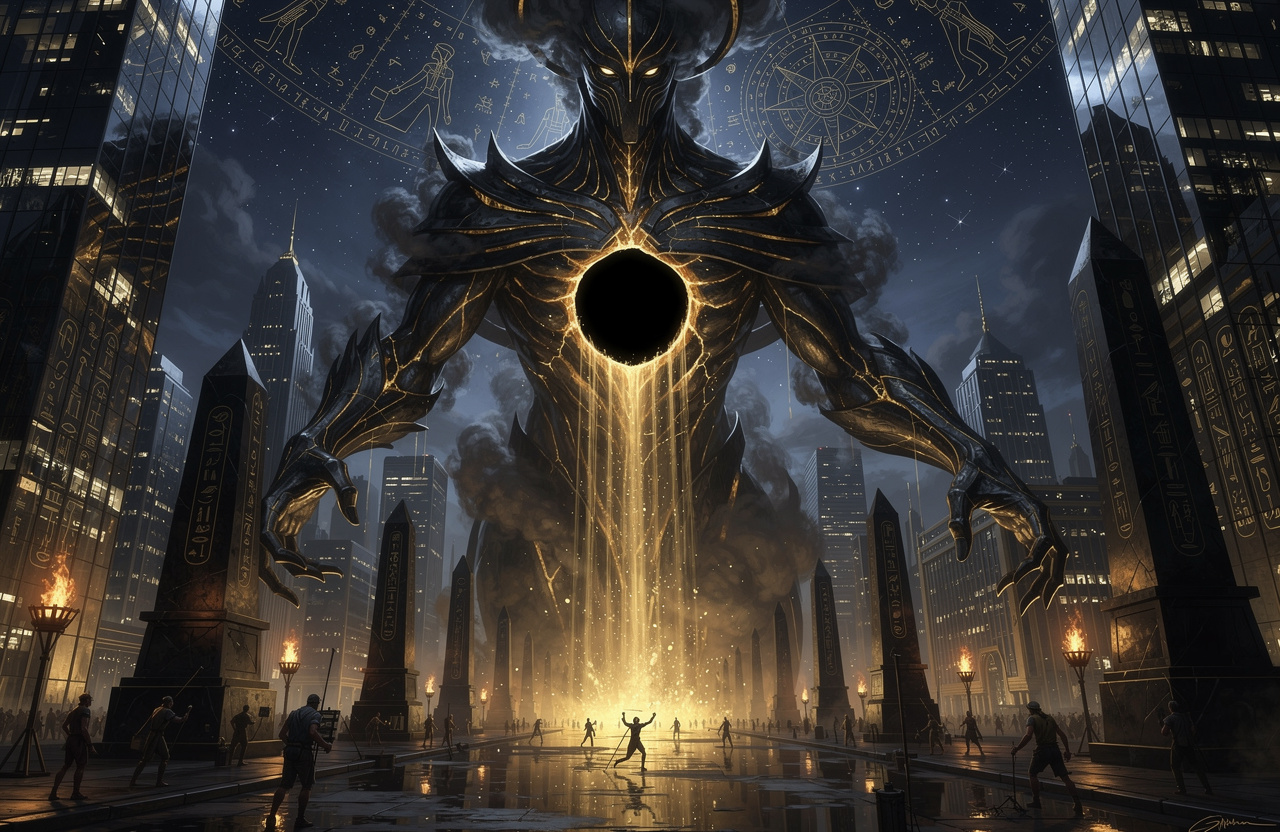
The book this project stands on opens with a brazen line: the fifth volume of the Egyptian Mysteries is what happens when a Shadow Neteru suddenly deploys onto Wall Street. It sounds like an inside joke, but behind it lies a rigorous idea. The same pattern of parasitism that, in the ancient Egyptian picture of the world, governs the dark entities of the afterlife Duat also governs the financial clans on Earth. The same mechanisms, the same attachments, the same conveyor belt. Let's take apart what that means, without the esoteric fog — the way an engineer takes apart an architecture.
What Isfet actually is
First let's drop the childish idea of evil. In the Egyptian tradition, Isfet is not a "fairy-tale villain," not horns and hooves. Isfet is the inversion of fair exchange. A structure that takes more out of the system than it puts back. In plain speech there's a short word for it: parasite.
And here's the key clarification that strips away the melodrama: a parasite doesn't "choose to be evil." It simply latches onto a working organism and draws the resource. It doesn't need hatred, it needs a flow. So when we call a financial structure a "parasite," it isn't an insult but a technical term — a description of a position, not of the character of the man in the suit. Modern financial etiquette prefers to speak softly, not to "demonize," and that politeness works as anesthesia: while you speak softly, they keep milking you.
Why "Shadow Neteru," not just "greedy people"
In the Egyptian system, the Neteru are not "very powerful end-game bosses." They are principles of reality: Maat is the very structure of balance, Osiris is transformation as a function of the cosmos. They don't sit on thrones — they are thrones. A parasite can never become a god: it has a different architecture, it doesn't generate energy, it only pulls it.
But the book still deliberately uses the term "Shadow Neteru" — and here's why. Having accumulated enough power, a parasite begins to act as an anti-principle. Not a "god of evil," but a working mechanism: the principle of stagnation against renewal, the principle of destruction without restoration. The book's comparison is precise: like a botnet of a million infected machines — not a supercomputer, but able to generate traffic comparable to one. "Shadow Neteru" describes not the nature of these entities but the scale of their impact. And in exactly that sense, Wall Street is the perfect body for such a pattern.
One protocol: the Duat and Wall Street
The book's strongest observation is that this is literally the same architecture described in two languages. Take the financial system. Fractional reserve banking, a hierarchy of banks where a small one can't move a payment past a large one, where the person with a loan produces real energy through his labor and passes part of it upward — the author admits that, drawing this diagram, he realized he was drawing a botnet. The mother "virus" creates the code, the large banks replicate it at industrial scale, the small ones stamp out local copies, and the end cell — the human — generates the resource. Every level is sure it's its own master. In reality it's a battery for the level above, like a process that thinks it runs in user space while it's controlled from the kernel.
Now the same picture in traditional terms. The third book describes the Mut-Heser — a parasitic "stuck dead" that latches onto the living: the victim weakens but doesn't understand from where, because the attachment is invisible. Scale that up to a state and you get the debt trap. Three hundred trillion in world debt is, in the book's phrase, a planet-scale Mut-Heser: every debt contract is a channel of one-way transfer of life force. The priest of Amun rewriting someone else's sarcophagus and the bank printing dollars out of thin air are, as the author says, not "similar." They're the same riverbed at different sections.
Invisibility as the chief weapon
In the Duat and on Wall Street alike, the parasite survives on one thing — invisibility. The Mut-Heser draws life as long as the victim doesn't know it's being drained. The financial parasite latches on through managing other people's money — yours, grandma's pension — and aims it against you, as long as you don't see the mechanism. "A private structure with a state-sounding name" is a masking of the name, the very camouflage under which a capture is passed off as service or as the "free will" of the captured.
Hence the method of resistance embedded in the book itself. Compute it — break the mechanism into parts: botnet, batteries, channels, contracts, pyramid. And name it — because in this tradition, to name is to strip of power. The nameless is all-powerful; the named is manageable. The book is precisely such an antivirus database: a set of signatures — "here's a contract," "here's the exploitation," "here's the parasite." Whoever has read it recognizes them. Isfet without invisibility loses almost all its strength.
Where the ordinary person stands
He is that very end cell, that very battery. He produces real value through labor and passes part of it upward through interest, fees, inflation — through six or seven channels at once, most often without even knowing. He's kept scattered and unseeing, because a battery that has woken up and joined others stops being a battery. The parasite's whole bet is that you won't compute the scheme and won't name it aloud.
The answer: the MAAT token and DAO
If parasitism survives on invisibility and fragmentation, then the antidote is visibility and union. We've already begun naming the mechanism. What remains is the second part: to gather. Because one awakened person doesn't frighten a parasite — a network of awakened people does.
That is MAAT. The MAAT token is membership in a cooperative that flips the parasitic pyramid: instead of a flow running bottom-up toward invisible nodes — a common pool, visible to all. Governance runs through a DAO — a decentralized organization with a transparent treasury, where every movement of funds is written in open code, and no node can quietly latch onto the common. Voting follows the principle of one human, one vote, not "one dollar, one vote": a parasite is strong where the size of the wallet rules, and weakens where weight comes from the person himself. The Shadow Neteru deployed onto Wall Street because it found a scattered, unseeing body. MAAT is an attempt to gather that body into a network that sees and that can be seen. The entry is simple: read the book, take the token, get your vote — and stop being an invisible battery in someone else's botnet.