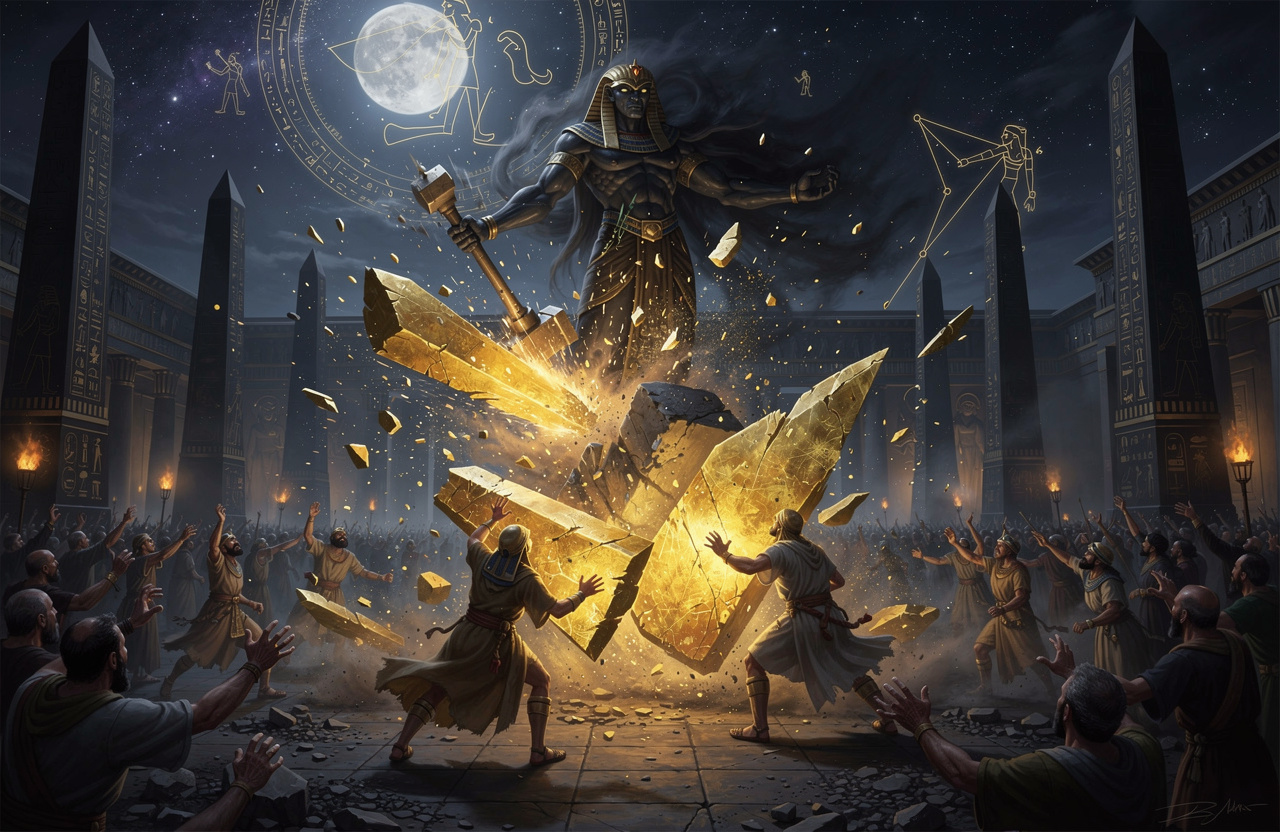
"Shock therapy" is a pretty medical phrase. As if a doctor inflicts pain, but for the sake of recovery. Free all prices at once, privatize everything fast, throw the markets wide open — yes, it'll hurt, but then a market will bloom and everyone will thrive. That's how it was sold in early-1990s Russia and beyond. Thirty years have passed. The patient mostly survived, but the "therapy" produced one curious side effect: a handful of billionaires. By accident? Let's take apart the mechanics.
I look at this as an engineer: if after the "treatment" one percent became fabulously rich while the rest were impoverished, then either it's the worst medicine in history, or it had another, undeclared function. And, as usual, the truth isn't that "everyone's a villain," but in how the scheme is built.
What shock therapy is, step by step
The recipe was presented as strict economic science, the one correct path. Three main blows:
- Price liberalization. The state stops holding prices all at once. Amid shortages and monopolies, this doesn't produce "market equilibrium" but hyperinflation. In Russia it reached 2,500%.
- Fast privatization. State property is handed out and sold off as fast as possible. In Russia — vouchers "worth 10,000 rubles" for everyone (worth a loaf of bread by the time you could use them), then the loans-for-shares auctions of 1995.
- Opening the markets. Borders are thrown wide open to capital. Money gets to enter freely and, crucially, to exit.
The key word in all three points is fast. It was the speed, not the fact of reform, that was the main weapon. Here's why.
Why speed in particular creates oligarchs
Imagine an announcement in an apartment building: over three days all shared property passes into private hands, grab it. Who takes the best? Not the most honest, but the one who:
- knew the rules in advance (was close to those who wrote them);
- had access to money or to a banking lever;
- understood that a paper voucher in the hands of a bewildered person is worth pennies, and bought them up by the sackful.
While the ordinary person is in shock — his savings gone, unsure he'll make it to payday — he has no time for "factory shares." He sells his voucher for a bottle or for cash, to survive here and now. And the one who understood the scheme and had capital bought up those vouchers by the ton and assembled control over factories from them.
The 1995 loans-for-shares auctions perfected the trick: the country's largest enterprises went to a narrow circle for sums laughable against their real value. So in a few years, fortunes that take generations to build on an honest market appeared out of nothing.
The shock wasn't a side effect. The shock was the scheme's operating condition. In a stunned state, a person is easier to separate from his property. An engineer would call it a race-condition exploit: while the system is in an unstable transitional state, you slip past the checks and seize the resource.
Where soft power comes in
What does outside influence have to do with it? This: the "only scientific" character of shock therapy wasn't born in Russia. It was imported and justified by outside advisors — the very Harvard consultants whose work was funded in part by the line of Western "development aid." The alternative, slower and more protected path was branded backwardness and populism.
The book describes this as part of "the familiar pattern": consultants, IMF loans with conditions, fast privatization — the same construction run across many countries. The outside player sets the speed and the "scientific" frame; local partners with access skim the assets; the population pays in shock. Each layer is "right" in its own way, and in sum it's the robbery of an entire nation to the applause of a textbook.
Fact and myth
Fact: the rapid liberalization and privatization of 1990s Russia coincided with hyperinflation, the impoverishment of the majority, and the swift emergence of a narrow class of the ultra-rich. That's not an opinion, it's a sequence of events.
Myth: that the oligarchs are simply "the most talented entrepreneurs" who rose honestly on a free market. There was no free market. There was a managed redistribution under artificially created shock, with rules known in advance to insiders. There may have been talent — but it wasn't talent that decided, it was access.
Where the ordinary person stands
He is the anesthetized patient from whom everything valuable was carried out while he was unconscious. His savings were zeroed by inflation. His share of the common property — the voucher — he sold for a pittance to eat. His factory went to a man with access to the auction. The life expectancy of a whole generation fell by 5–7 years. The ordinary person paid the full bill for a "therapy" whose fruits others enjoyed. He wasn't asked — he had neither a voice nor a lever.
The answer: the MAAT token and DAO
Shock therapy worked precisely because ordinary people were scattered, stunned, and had neither access to the levers nor transparency. When the rules are written for insiders, and you're in shock and alone, you'll be cleaned out by all the rules of science. The only defense is to have, in advance, your own network, your own rules, and an open treasury.
That is MAAT. The MAAT token is membership in a cooperative where the common property and treasury belong to the members themselves, and decisions are made on the principle of one human, one vote, not "whoever has access to the auction takes the factory." Governance runs through a DAO — a decentralized organization with a transparent treasury where every movement of funds is visible to all. Here a quiet redistribution is impossible: every deal is open, every vote recorded, no one "buys up the vouchers" in the dark while the rest are in shock.
The 1990s proved that a scattered person is easy to separate from his share in a moment of chaos. MAAT gathers people into a transparent network where the share is protected by a shared vote and the visibility of every transaction. The entry is simple: read the book, take the token, get your vote. And never again be the patient from whom the "therapy" takes everything.