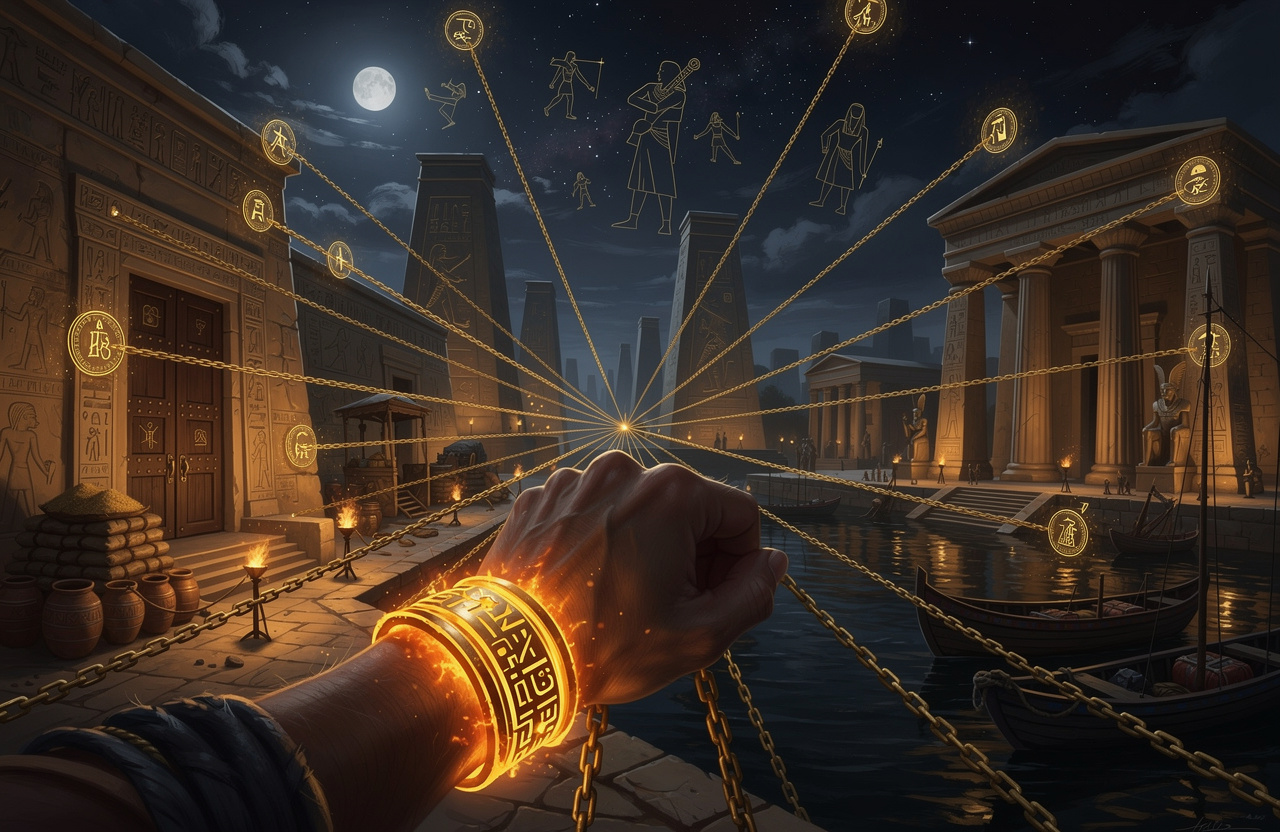
There is a quiet dream running in the back rooms of governments and consortiums. One key. One credential. One string of numbers that is you — and everything you touch answers to it. Your bank. Your doctor. The turnstile at the metro. The border. The comment box under a video.
They don't sell it as a leash. They sell it as convenience. "No more passwords. No more paperwork. No more standing in line." And that pitch works, because standing in line is genuinely awful. But watch the architecture, not the brochure. When one identifier unlocks every door, whoever holds the master key holds you.
What "single" actually means
Right now your life is fragmented across dozens of identity silos. Your passport doesn't know your bank balance. Your pharmacy doesn't know where your phone was last night. Your employer doesn't know how you voted. That fragmentation is annoying — and it is also freedom. The seams between systems are where you breathe.
A single ID welds the seams shut.
India built Aadhaar and enrolled over 1.3 billion people — biometrics, iris, fingerprints, tied to bank accounts and welfare. The EU is rolling out the European Digital Identity Wallet, one app meant to hold your ID, your driving licence, your diplomas, your payment credentials. The WHO signed a deal in 2023 to build a global digital health certificate network, seeded by the EU's COVID pass. China's social credit experiments already fuse identity, payment, and movement into a single score that can bar you from a train.
Each project is defended on its own merits. Each is convenient. And each is a rail. Lay enough rails in the same direction and you have built a track. The train that runs on it does not care about your merits.
The bind is the point
Here is the mechanism, stripped of PR. When your identity, your wallet, your health record, and your location all resolve to the same key, three things become trivially easy for whoever runs the registry:
- Correlation. Cross-reference anything against anything. Who was at the protest, and which of them has an outstanding loan, and which of those just got flagged by a health algorithm. One query.
- Revocation. Turn one person off. Not arrest — that's loud and legal and leaves a paper trail. Just flip a bit. Card declined. Login failed. "Your account has been restricted." No court, no cell, no explanation.
- Conditioning. Once off is possible, on becomes a reward. Behave, and the key works. Step out of line, and it flickers. You will never be told the rule. You will simply learn to stay inside it.
That third one is the trap that closes without a sound. You don't need to punish a population that pre-punishes itself.
Our record
In the older accounting, a person's name was not decoration. To know a true name was to hold a lever on the being. The Egyptians understood this so precisely that they wrote spells to protect the name — because a name spoken by the wrong mouth could command the one who bore it.
The single ID is a true name industrialized. It gathers your scattered aspects — your wealth, your body, your movements, your speech — and binds them under one utterable token, held by a hand that is not yours. That is the signature of the Shadow Neteru: not chaos, but order weaponized. Isfet does not always arrive as a storm. Sometimes it arrives as a perfectly clean database where every row is a life and every life has an off-switch.
Maat is not the enemy of order. Maat is order. But Maat's order is balanced — the feather weighs against the heart, and the judgment belongs to the one being weighed as much as to the scale. A system where one party holds the key, sets the rule, and hides the rule has thrown away the feather and kept only the blade.
The counterfeit of trust
They'll tell you the system is safe because it's encrypted, audited, regulated. Sometimes it even is — technically. But encryption protects data from outsiders. It does nothing to protect you from the insider who legitimately holds the key. The threat model of a single ID is not the hacker. It's the operator.
And operators change. The database built by a benign government is inherited by the next one. The registry designed for pandemic response is repurposed for tax enforcement, then for dissent management, then for whatever the next crisis demands. Infrastructure outlives intentions. You are not consenting to today's use. You are consenting to every future use by every future hand, forever.
That's the part the convenience pitch never mentions. A single point of control is also a single point of failure — and in security, we've known for decades that single points of failure are the first thing you engineer out of a serious system. They're building it back in on purpose, at the scale of a civilization.
The lever
So what do you actually do? Not despair — despair is what makes the leash feel inevitable. You refuse the architecture, not just the app.
The counter-design already exists and it has a name: self-sovereign identity. The principle is simple and old — the key belongs to the person, not the registry. Cryptographic credentials you hold in your own wallet. You prove you're over 18 without revealing your birthday. You prove you're a citizen without exposing your name. You prove you paid without broadcasting your balance. Zero-knowledge, they call it — reveal the fact, not the file.
This is not utopian. Verifiable credentials are a published W3C standard. Decentralized identifiers work today. The tools exist. What's missing is demand — and demand is you.
Concretely:
- Fragment on purpose. Refuse to link accounts that don't need linking. Every seam you keep is oxygen.
- Ask who holds the key. When any service offers "one login for everything," that is the tell. Convenience for you is leverage for them.
- Back projects that separate proof from identity. DAOs, self-sovereign wallets, zero-knowledge systems. Put weight where the key stays in your hand.
- Say the name out loud. A single ID sold as convenience is a control system wearing a lanyard. Name it, and it loses the disguise.
They want one key to bind you. The answer is not to smash all keys. It's to make sure the key that opens your life stays in your hand — and only yours.
Hold your own name. Everything else is a login screen.