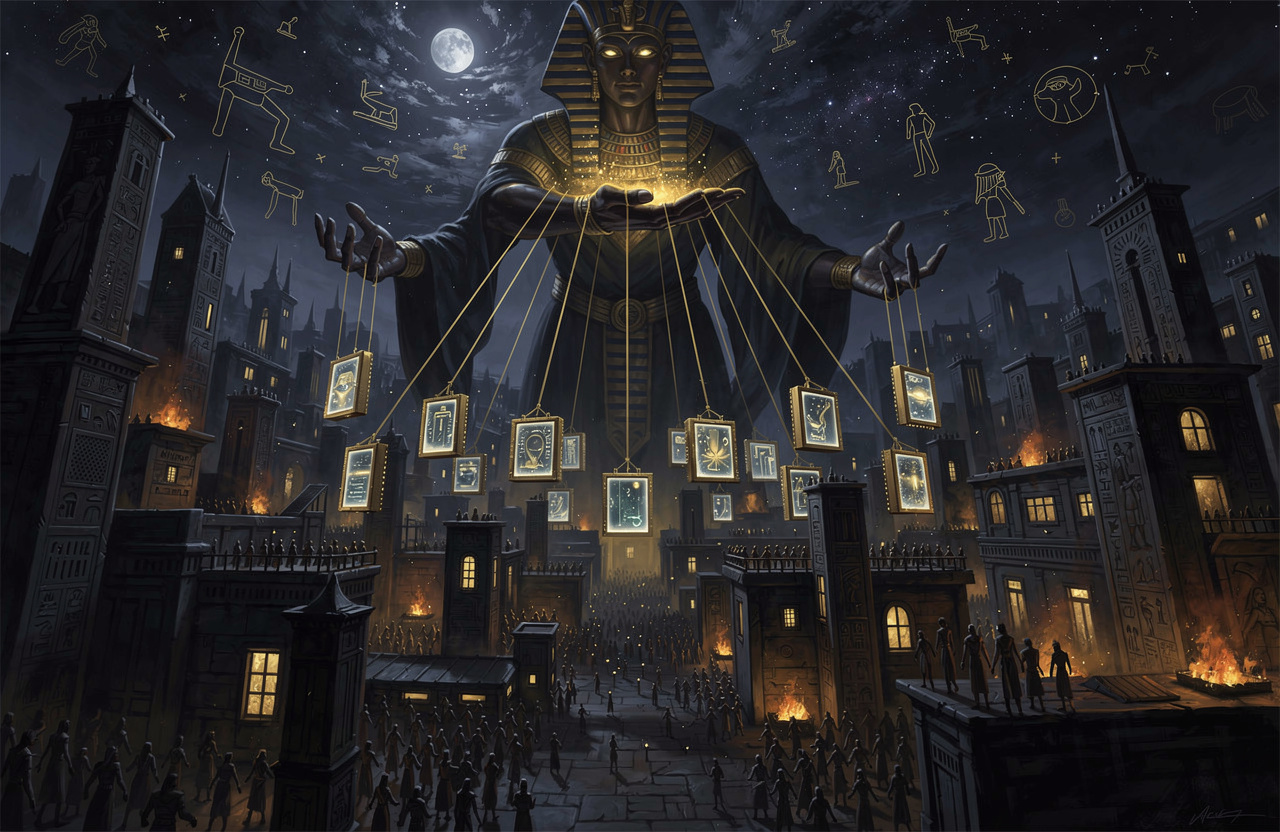
Old soft power worked like a tank in reverse: don't frighten, be liked. Hollywood, jeans, music, the promise of a free life. They showed you a beautiful picture and you wanted to live there yourself. Clever, but slow and blunt — it hit everyone at once, no aim.
Today the aim has arrived. It's called the feed. And unlike television, which showed everyone the same thing, the feed shows each person something different. This is no longer broadcasting. It's a sniper with a billion barrels, one per user.
What a social network actually sells
Let's be honest: you are not the customer. If the service is free, you are what's being sold. More precisely — your attention. The advertiser pays to get a message in front of you in the right mood at the right second. And the platform takes on one job: keep you in the app as long as possible so there's something to sell.
This is where the engineering begins. The feed's algorithm is not "random interesting posts." It's an optimizer. It has one metric: retention time. It spins through thousands of options of what to show you and keeps whatever you react to most strongly. Not what's useful. Not what's true. What you react to.
And humans react hardest to three things: fear, outrage, and envy. Evolution wired them in — predator, stranger, rival. The algorithm isn't evil; it simply found that button and presses it around the clock, because that's how its metric grows.
The feed as a personal reality server
Imagine each person has their own private news channel, assembled by a machine around their weak spots. One sees a world collapsing because of migrants. Another sees a world dying from climate change. A third sees a world where everyone around is getting rich while he alone is the sucker. Each picture is distorted in its own way, and each is perfectly fitted to its viewer.
In IT this is called a filter bubble. You think you're looking through a window at the world. You're looking into a mirror that shows an amplified version of your own fears. The people in your feed "agree" with you not because the world is like that, but because the algorithm filtered out the ones who disagreed — they lowered your retention.
The result: a society where everyone has their own reality, and these realities fit together worse and worse. People can't reach agreement not because they're stupid, but because they were literally shown different worlds. This isn't a bug. For anyone who wants to manage a crowd, a fractured crowd is a dream.
Who holds the switch
Don't slide into magic here. There's no single "zombie-control headquarters." There are a few companies that own the platforms where half of humanity sits, and there's an ad auction that lets anyone with money reach those people.
Fact: algorithms demonstrably amplify emotional, conflict-driven content — you can see it in the platforms' own internal research, which leaks periodically. Fact: ad dashboards let you target a message by the finest slices — age, neighborhood, fears, recent purchases. Fact: political campaigns and governments use this aggressively.
Myth: that someone personally sits and decides what thought to plant in your head today. Reality is duller and scarier. The machine optimizes retention, and retention grows best on division and anxiety. Nobody ordered people to be turned against each other — it's simply the system's most profitable mode. And whoever pays for access steers the already-heated crowd where they need it.
Why it beats old propaganda
Old propaganda told you what to think. You could disagree — there was something to argue with, a rival voice. The new soft power doesn't argue. It simply decides what you'll even see. The most effective censorship isn't a ban; it's a downranking. What wasn't shown doesn't exist for you.
And here's the cunning part: it feels like your choice. You scrolled, you liked, you got angry — all by yourself. No one held a gun. But the menu you chose from was assembled by a machine for someone else's purposes. You're free to pick the dishes. You never saw the kitchen.
The book The Architecture of Chaos names it plainly: a person thinks he's participating, while in fact he's becoming a resource and fuel. The feed feeds on your attention the way a hungry dead man feeds on someone else's energy — it takes your Sekhem, the charge of life force, and hands you a cheap dopamine crash in return. Endless scrolling is, in effect, the sleep of consciousness with your eyes open.
Where is the ordinary person in all this
In the role of a battery. Your attention is ore being mined. Your outrage is a product being sold. Your vote, your purchase, your mood — all of it can be nudged if the feed is tuned right. And you won't even notice the nudge, because it happens inside your personal reality, which no one but you can see.
Noticing is already half the defense. The book, in this sense, works like an antivirus: it names the mechanism, and the mechanism loses its invisibility — and with it, most of its power.
The answer: the MAAT token and DAO
The algorithms' strength is that they split us into isolated bubbles and milk us one by one. Everyone sits in their personal reality thinking they're the only one. So the answer is to gather back — not inside someone else's feed, but in our own structure.
That is MAAT. The MAAT token is membership in a cooperative where scattered people see one another again and gather their votes into a single bundle. The principle is strict: one human, one vote — not "one dollar, one vote," and not "one like, one vote." Decisions run through a DAO — a decentralized organization with a transparent treasury where every movement of funds is visible to all, and no algorithm chooses for you what to see. The entry is simple: read the book, take the token, get your vote — and stop being ore mined inside someone else's app.