Few names have gathered as many myths as George Soros's. To some he's the embodiment of world evil; to others, a generous philanthropist and defender of freedoms. The truth, as usual, is both simpler and more interesting than either picture. Let's take apart, without hysteria, a two-stroke mechanism: how the man earned his money, and how he turned it into a network of influence that now lives separately from him.
Stroke one: how the money was earned
Soros is a speculator. Not in the insulting sense, but the technical one: he earns not by creating anything, but on bets against. His signature move is the short — betting that something will collapse, and if it does, you're hugely in the black.
The most famous episode is 1992, "the man who broke the Bank of England." Soros placed a giant bet against the British pound, wagering that Britain couldn't hold the exchange rate. Britain couldn't. The pound crashed, and Soros earned, by various estimates, around a billion dollars in a matter of days.
Remember the logic: he built no factory, grew no harvest. He found a fragile point in the system, pressed on it, and earned on the fall. The book describes exactly this pattern with Greece: Goldman Sachs first helped hide the debt (a fee), then earned on the country's collapse by betting against it. The same move: create or find a weakness, then skim profit from the collapse. The book calls it a triple profit exploit. Soros is a virtuoso of precisely this genre.
Stroke two: how the money became a network
Having made a fortune, Soros did what distinguishes a major player from a merely rich man: he built influence infrastructure out of the money. Thus appeared the Open Society Foundations.
The name nods to the philosopher Karl Popper and his idea of an "open society" against the "closed," totalitarian one. The idea itself is worthy. But what matters is what it became in practice: for decades Soros poured billions of dollars (in aggregate, sums comparable to small states' budgets) into a network of foundations, grants, NGOs, universities, media, and scholarships around the world — especially actively in Eastern Europe after the collapse of the USSR.
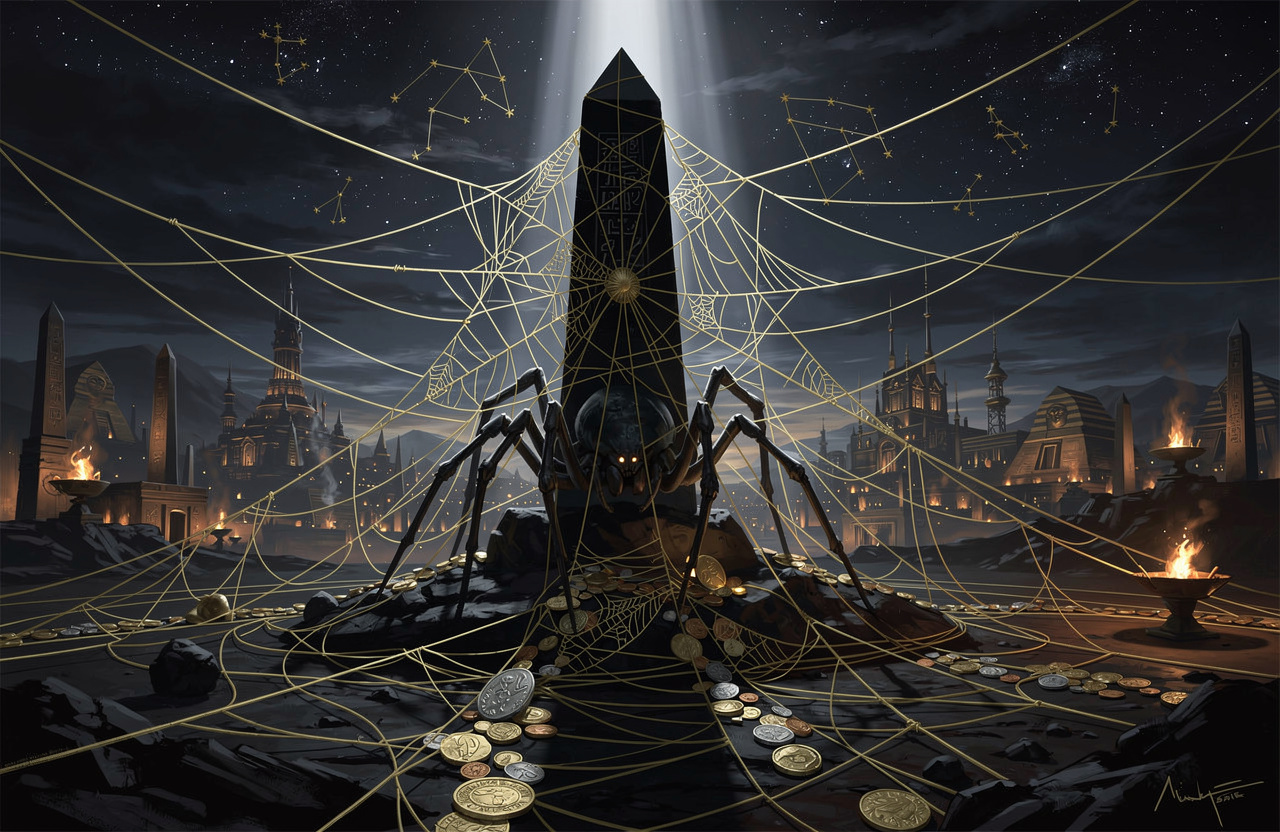
An engineer recognizes the architecture instantly: it's a distributed network with thousands of nodes. Not one center commanding everyone, but a multitude of funded points, each doing "its own" thing — education, rights, journalism — yet all fed from a common source and gravitating toward a common agenda. The same "five arrows" logic as the old banking houses, only now there are thousands of nodes and they go by the name "civil society."
Why this is power
There may be no direct order in such a network at all — and that's its strength, not its weakness. Money creates gravity. What gets funded is what the funder likes; those whose agenda matches the foundation's rise and get a platform; what the foundation doesn't favor simply gets no resource and quietly withers.
The result is influence without visible force and with almost no trace: no one forced anyone, everyone "freely" chose — only the choice was made on a field already mapped out with money. That is soft power in its purest form. And that is exactly why Soros so irritates governments: he acts on their territory, but not by their methods and not by their rules.
Honest line-drawing
There's no avoiding it, because around this figure there are more myths than facts. Fact: Soros really did earn billions on currency speculation, really did pour billions into a global network of foundations, and that network really does influence the agenda in many countries. This is documented and not hidden.
Myth: that Soros personally pulls the strings of every event on the planet from a secret HQ, that every protest and every NGO runs "on Soros's money." That's the same trap as with the Rothschilds: it's convenient to appoint one man conductor of all chaos. Reality is duller and more important: there is no all-powerful man but a principle — money organized into a network and placed above borders shapes the agenda more than scattered citizens do. Soros embodied that principle vividly, but he didn't invent it and it won't end with him. The name will change; the architecture will stay.
Where is the ordinary person in this
Again in the role of a field across which gravity is distributed. Your sincere striving for freedom and justice is a valuable resource, and there's a fight over it waged with money. The question isn't whether open-society ideas are good (many are), but who pays for the agenda and therefore who ultimately decides where it turns. When one rich man pays, the agenda is, in the end, his — however noble it sounds.
The answer: the MAAT token and DAO
Soros's network is strong in the same way all clans are strong: concentration of money in a few hands and opacity about where and why it flows. So the counterweight is built symmetrically — a network, but one belonging to the people themselves, where the agenda is paid for and decided by many, and everything is visible.
That is MAAT. The MAAT token is membership in a cooperative and a vote on the principle of one human, one vote, not "whoever has a billion sets the open society for everyone." Governance runs through a DAO — a decentralized organization with a transparent treasury where every movement of funds is visible to all. Here it's impossible to quietly fund a desired agenda from the shadows: the source and recipient of any money are in plain view by default, because Isfet lives in the dark and light disarms it.
In two strokes Soros demonstrated a theorem: money gathered into a network shapes reality more than loners do. MAAT turns it around in favor of those who were always the field, never the player. The entry is simple: read the book, take the token, get your vote — and become a node in your own network, not someone else's.