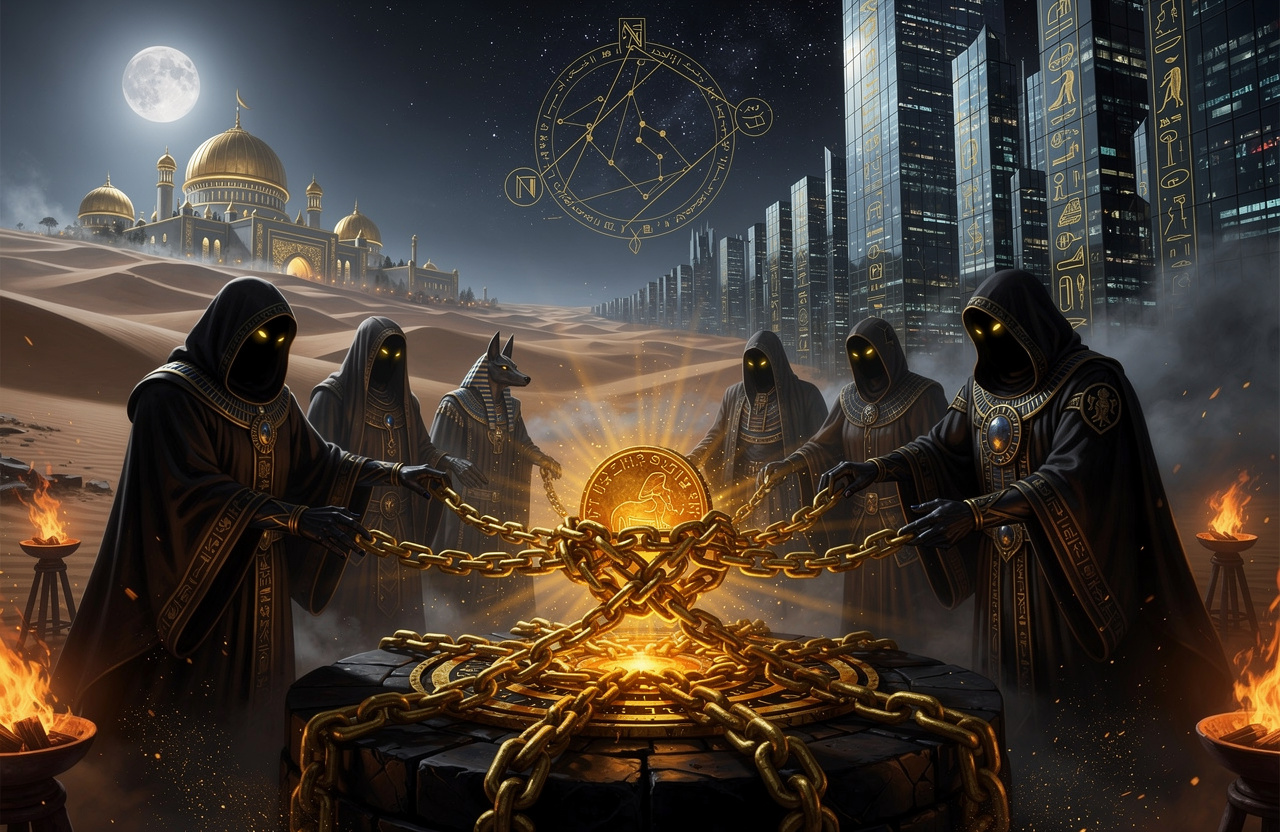
You picture a rivalry. Nations against nations. The Gulf against the West. Different flags, different faiths, different interests, all supposedly circling each other in a great geopolitical contest.
Then you look at the money, and the flags dissolve.
Saudi Arabia's Public Investment Fund holds on the order of 900 billion to a trillion dollars. Abu Dhabi's funds — Mubadala, ADIA, and their siblings — command well over a trillion combined. Qatar's QIA sits in the hundreds of billions. And where is that money? In the same places. In Wall Street's asset managers, in US and European megacaps, in the very same tech, energy, and financial names topped by BlackRock and Vanguard. The sovereign wealth of the Gulf and the private capital of Wall Street are not two opposing armies. They are threads tied into a single knot.
The knot, traced
Follow a few strands. PIF took a landmark multi-billion-dollar stake in SoftBank's Vision Fund — which then poured capital into the West's biggest tech names. PIF took a large position in Uber, in Lucid, in gaming giants, in Western sports. Qatar became one of the most significant shareholders in European banks and blue chips, a major holder in London and Frankfurt. Mubadala co-invests alongside Blackstone, Carlyle, Apollo, KKR — the private-equity titans — in deal after deal.
And it runs both directions. BlackRock opened up in Riyadh and Abu Dhabi, managing Gulf money and building infrastructure platforms with Gulf partners. The largest Western asset managers and the largest Gulf sovereign funds are increasingly co-owners — of the same infrastructure, the same private-equity deals, the same megacaps, the same AI and energy build-out.
So the "sovereign versus Wall Street" story you half-absorbed from the headlines is, at the ownership layer, closer to sovereign woven into Wall Street. The knot doesn't have a clean seam where "them" ends and "us" begins. It's tied through.
Why the knot matters more than any single ring
Every other ring in this series has an edge — a place where you might route around it. This one is different in kind, because it ties the previous rings together. The same capital pool that sits atop pharma and seeds and the grid also runs through sovereign funds that can move geopolitically, that hold physical territory, that command sovereign immunity and diplomatic weight and, when they choose, force.
That's the real significance of the sovereign-corporate knot. It's where financial concentration touches actual sovereignty — where "who owns the shares" meets "who commands the state." The rings become a network, and the network has both a balance sheet and a flag. Not a conspiracy of a few men. A knot of aligned interests so large it behaves like weather.
Our record
On the Scales, this is where we name the Shadow Neteru most plainly. The Neteru are the great powers, the principles that order the world — sovereignty, wealth, law, force. Each has a true face and a shadow: the same power inverted, turned from serving Maat to feeding on it. Real sovereignty serves its people; shadow-sovereignty extracts from them. Real wealth is stored life-force circulating; shadow-wealth is Sekhem coiled and hoarded, pulled out of circulation into the knot.
The sovereign-corporate knot is where the shadow-forms of several Neteru braid together — wealth, sovereignty, and force wound into one cord. Apep at civilizational scale isn't a monster at the gate. It's a knot in the flow — the point where the world's Sekhem, its money and energy and grain and light, gets tied off and held. The genius of the knot is that it looks like many separate powers in tension. It behaves like one held breath.
Name it. Not to despair at its size — to see it clearly enough to find where the cord can be cut. A knot, unlike a wall, has ends. Ends can be pulled.
Never doom without a door — and this is the door
Here's why this article closes the set instead of crushing it. A knot this large has a fatal property: it depends on everyone else staying outside it — atomized, abstracted out of ownership, holding no keys. Its power isn't just its size. It's the concentration ratio. It's how few hold how much while how many hold nothing they control.
Change the denominator and you change everything. Every person who moves even a fraction of their Sekhem out of the knot's structures and into structures they actually hold shifts the ratio. Not by defeating the knot head-on — you don't out-capital a trillion-dollar sovereign fund. By reducing the surface it can tie through.
The lever
See the knot as one thing. The single most disorienting move the knot makes is to appear as rivals — nation against nation, fund against fund, East against West. Once you read the co-investments, the shared cap tables, the joint platforms, you stop being fooled by the flags. Clarity is the first cut.
Move Sekhem out of the knot's structures. Self-custodied crypto — not your keys, not your coins, and here that's the whole doctrine. A DAO treasury the sovereign funds don't sit atop. A cooperative where ownership is yours, not abstracted up into the cord. Open-source AI that audits the knot instead of serving it. Each is a strand that runs outside the knot and can never be tied back in.
Build the parallel network. The knot is a network, so the answer is a network — a decentralized, member-owned, open one. Not a single hero fund fighting the giants. A mesh of held keys, cooperative treasuries, and open protocols that, together, is the one structure the knot cannot buy, cannot vote, and cannot tie off: because it was never issued as a share, and its owners are already holding their own keys.
The knot ties the world's Sekhem into one cord and calls it order. It isn't order — it's Isfet wearing Maat's mask at the largest scale there is. But every cord has ends, and every end can be pulled. You pull it not with a bigger knot but with an open weave — many hands, many keys, one honest scale.
See the knot. Hold your keys. Weave the network that can't be tied.