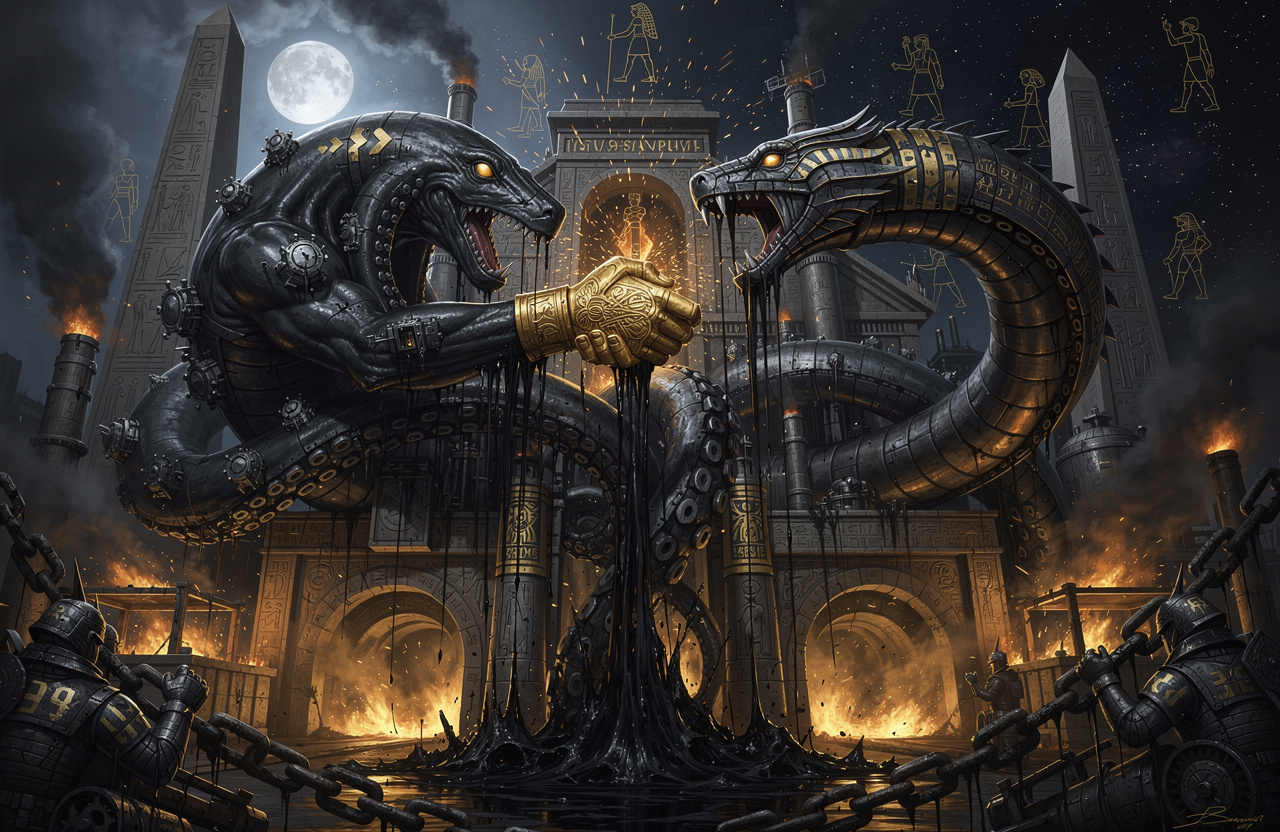
When people say "a corporation helped the enemy," they usually picture suitcases of cash and secret meetings in basements. The reality is duller and more frightening. The most powerful form of collaboration with the enemy is not a bribe. It is a patent agreement — a piece of paper that says "we share technology and we stay off each other's markets." And that piece of paper can slow down an entire war machine.
The story of Standard Oil and IG Farben is exactly this.
Two giants sign a pact
In 1929 the American Standard Oil of New Jersey (today's ExxonMobil) and the German chemical conglomerate IG Farben signed a cartel agreement. In essence it was a treaty for dividing up the world. Standard Oil — the kings of oil. IG Farben — the kings of chemistry: dyes, drugs, synthetics. They agreed to exchange patents and not to compete on each other's turf: the Americans stay out of chemistry, the Germans stay out of oil.
It sounds like an ordinary corporate deal. But this deal involved dual-use technologies. The crucial ones were synthetic rubber (the German Buna process) and tetraethyl lead, the additive without which you cannot make high-octane aviation fuel. In other words, the very things armies literally fly and drive on.
What IG Farben was
To grasp the scale, you have to grasp who the second partner was. IG Farben was not a "German paint factory." It was the largest chemical conglomerate in the world at the time — a merger of BASF, Bayer, Hoechst and others. When the Nazis came to power, IG Farben became the industrial backbone of the Reich.
The conglomerate produced almost everything a war needs: explosives, fuel, synthetic rubber. And, through a subsidiary called Degesch, a pesticide named Zyklon B — the very gas used to murder people in the gas chambers. IG Farben also built its own synthetic rubber and fuel plant right next to Auschwitz: IG Auschwitz, or Monowitz. The labor force was the camp's prisoners. Those who could no longer work were sent to the gas chambers. The factory and the camp were, if you like, parts of one production chain.
Where America comes in
Here is the uncomfortable part. The 1929 cartel agreement was not torn up when Hitler took power. It stayed in force. And it created a problem for the United States itself.
When America entered the war, an unpleasant detail surfaced: the patents on synthetic rubber that the U.S. military needed were bound by the agreement with Standard Oil, which shared them with IG Farben. By then Japan had seized the natural-rubber sources of Southeast Asia. America was left without rubber for tires — while its own oil company sat on synthetic-rubber technology it was in no hurry to deploy at full scale, so as not to breach the deal with its German partner.
A special Senate committee chaired by Senator Harry Truman — the future president — took up the matter. At the hearings, Truman named Standard Oil's conduct with a blunt word: treason. The company was eventually forced under pressure to hand the patents to the government and pay a fine.
Where fact ends and myth begins
Let's draw the line honestly. Myth: "Standard Oil deliberately worked for Hitler and wanted the Reich to win." No. The corporation's goal was not ideology but the agreement and the profit. It did not care who won — what mattered was not breaching the cartel and keeping its share of the postwar market.
Fact: the cartel agreement between Standard Oil and IG Farben genuinely existed, genuinely covered critical military technologies, and genuinely hampered America's own war effort enough that the Senate took it up and the word "treason" was spoken. These are public hearing records, not guesses.
And here is the key conclusion. The corporation behaved neither as a patriot nor as a traitor. It behaved as a corporation — a structure for which a cartel agreement matters more than a front line. An engineer would say: two systems had a shared API and a non-compete contract, and they kept exchanging data even when their users started killing each other.
The parasite above the flag
This is Isfet — the inversion of normal exchange. In a normal world chemistry heals and builds. In the world of the cartel, the same chemistry simultaneously makes medicine in one country and gas for the chambers in another, and the rubber patent matters more than the soldiers stuck without that rubber. The structure extracts from the system and does not think about whom it feeds in the process.
After the war IG Farben was split back into BASF, Bayer and Hoechst — companies doing very well to this day. Standard Oil had been broken up earlier, but its fragments are today's oil giants. A few individuals were punished, some imprisoned. The architecture was not. It simply changed its signage.
Where is the ordinary person
At the very bottom, as always. It was his son who did not get tires for the truck in time because the patent was hostage to a cartel. It was his taxes that paid for a war whose raw materials enriched both contracting sides. And he never sat at the table where two corporations carved up a living world.
The answer: the MAAT token and DAO
A cartel is a network that signs a deal over the heads of millions. Its strength is that it is closed and coordinated, while we are open and scattered. So the counterweight is built the same way: people must learn to coordinate their interests — but transparently, and without an intermediary trading our fates behind our backs.
That is MAAT. The MAAT token is membership in a cooperative and a single vote, on the principle one human, one vote — not "whoever has more patents and shares decides for everyone." Governance runs through a DAO, a decentralized organization with a transparent treasury where every deal is visible to all, and where no one can quietly sign a "carve up the world" cartel in a closed office. The entry is simple: read the book, take the token, get your vote — and finally sit at the table where they used to decide without you.